
Female Founders: Emma May of Sophie Grace On The Five Things You Need To Thrive and Succeed as a Woman Founder
An Interview With Candice Georgiadis
It’s really lonely. As the founder the entire business lives in your head and generally your head alone. No one else knows all the details like you do. And its impossible for anyone else to know the pressure. So you get a bit stuck in your head with things. I have a few people who are my go to mentors for this. People who have been there. It isn’t something you can talk to friends or family about without overwhelming them and never being invited to dinner again. (Friends, if you are reading this I promise I won’t bore you with the story of crotchgate again).
As a part of our series about “Why We Need More Women Founders”, I had the pleasure of interviewing Emma May.
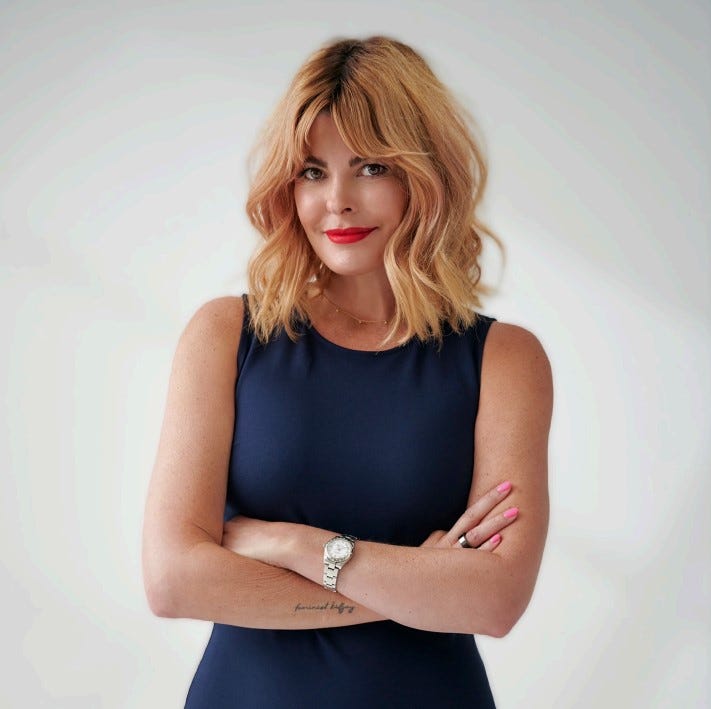
As a former corporate lawyer, senior staffer to a Premier in Canada, and founder of a boutique real estate agency, Emma May knows firsthand that getting dressed for work is way harder for women than it is for men; regrettably, women ask themselves daily questions such as, “Is this too sexy?” “Is this work appropriate?” and “Am I going to be taken seriously?”. To create clothing women their most comfortable and confident selves in, Emma May launched Sophie Grace, offering coordinated separates from comfortable, high-quality fabrics. With these pieces, women will always have cohesive, professional outfits too make them feel like their best self while tackling everything on their plate.
Thank you so much for doing this with us! Before we dig in, our readers would like to get to know you a bit more. Can you tell us a bit about your “backstory”? What led you to this particular career path?
This is now my fourth career. And it definitely was an evolution over the course of my life to get here. I started out as a lawyer, had kids in my late 20’s and spent much of my early career trying desperately to balance my need to be with my kids as much as possible with my raging ambition. And that was really effing hard. I didn’t do that well. And it was my career that took a back seat. So when I was around 38 I quit law and got licence to sell real estate. Much to the horror of my mother and husband- both of whom are lawyers. But that proved to be a really good career for me in that time of my life. I had flexibility, could use my legal skills and got to work with interesting people. Eventually a natural disaster in my town pulled me into community service. Which lead to be being promoted to a leadership position in government. When we lost the election I went back to real estate but had the drive to try something new / and a few years later I came up with the idea for SophieGrace.
Can you share the most interesting story that happened to you since you began leading your company?
I really think it was launching the it with no clue about the apparel industry and having 30 boxes of women’s workwear show up in my driveway Feb 2020 — One month before covid obliterated the need for my customer to go to the office.
Can you share a story about the funniest mistake you made when you were first starting? Can you tell us what lesson you learned from that?
We have paypal attached to our site and some customers pay us there. One day I went to log in to the account and saw that there was 60k sitting in it. I thought it was a mistake — until I realized I needed to transfer the money OUT of paypal and into my bank account. That was a stupid but lovely mistake.
None of us are able to achieve success without some help along the way. Is there a particular person who you are grateful towards who helped get you to where you are? Can you share a story about that?
There are a lot of them. I have a friend who taught me how to run a 16 week cash flow model. Product based businesses are cash flow beasts and this saved my ass. I also have an investor who looked at the deck, chatted to me for 20 min and cut a cheque. His faith in me — helped me gain faith in myself.
Ok, thank you for that. Let’s now jump to the primary focus of our interview. According to this EY report, only about 20 percent of funded companies have women founders. This reflects great historical progress, but it also shows that more work still has to be done to empower women to create companies. In your opinion and experience what is currently holding back women from founding companies?
I am not sure that women are held back from founding companies — women start small businesses at a faster rate than men. I think we have just struggled with getting money to scale them. Inherent bias mean people like to invest in things they know and understand, and people who remind them of themselves. Men are still the ones doing the funding. And until that changes — I think women and other underrepresented minorities will continue to struggle.
The funders also need to understand the problem we are trying to solve. I make clothes designed to make getting dressed as a professional woman a lot easier. Women immediately understand my concept. Men have no idea the problem even exists. Wool suit or a Patagonia vest and slacks and they are done.
Can you help articulate a few things that can be done as individuals, as a society, or by the government, to help overcome those obstacles?
Women who make money must fund other women.
This might be intuitive to you as a woman founder but I think it will be helpful to spell this out. Can you share a few reasons why more women should become founders?
Our world is not designed for us. It is still primarily constructed around men. Around their biological clocks, around their hormonal cycles, around their needs and desires. We have create a world that works just as well for us. No one else is going to build that world but us.
What are the “myths” that you would like to dispel about being a founder? Can you explain what you mean?
I think it is hard to be a founder unless you yourself are a half decent sales person. You are always selling — selling to employees, banks, customers, partners — all the time its sales.
Is everyone cut out to be a founder? In your opinion, which specific traits increase the likelihood that a person will be a successful founder and what type of person should perhaps seek a “regular job” as an employee? Can you explain what you mean?
The ability to be OK with uncertainty is probably the most important characteristic. There are things beyond my control that can go wrong at any minute. I have to trust that one way or another I will find my way through it. So the ability to stay sane and moving forward while accepting and managing risk isn’t for everyone. I have responsibility to my employees, to my investors, to my community and to my customers. This isn’t all about me anymore.
I can’t do a regular job. I never really have. So its hard for me to even imagine it anymore.
Ok super. Here is the main question of our interview. What are your “5 Things I Wish Someone Told Me Before I Started” and why? (Please share a story or example for each.)
- The fear doesn’t go away — but spreadsheets
- Make it manageable. Google Sheets is my friend. Ok, maybe more like frenemy…
- Why does everything seem to move so slowly when I want to move at light speed?
- It’s really lonely. As the founder the entire business lives in your head and generally your head alone. No one else knows all the details like you do. And its impossible for anyone else to know the pressure. So you get a bit stuck in your head with things. I have a few people who are my go to mentors for this. People who have been there. It isn’t something you can talk to friends or family about without overwhelming them and never being invited to dinner again. (Friends, if you are reading this I promise I won’t bore you with the story of crotchgate again).
How have you used your success to make the world a better place?
I am not sure I have yet. I try to make decisions that not only benefit the business but also my community, employees, the environment. We don’t make more than we need to. We have moved 80% of our production to local ethical manufacturing facilities. We have switched doing business with a supplier that fights against reproductive rights (look into where you get your shipping supplies — pro tip). Small decisions can add up over time. My hope is my small decision ends up having a larger impact.
You are a person of great influence. If you could inspire a movement that would bring the most amount of good for the greatest number of people, what would that be? You never know what your idea can trigger.
Free, well regulated childcare improves the lives of women and their children. Giving mothers the ability to get educated and work knowing their children are receiving educational care is the great gift that keeps on giving. Believing we should wait until kids are 6 years old to receive free education and care is antiquated. It sets women up to bear the economic burden of raising children (even when married) and children who receive quality early care do better in school.
We are very blessed that some very prominent names in Business, VC funding, Sports, and Entertainment read this column. Is there a person in the world, or in the US with whom you would love to have a private breakfast or lunch with, and why? He or she might just see this if we tag them.
Martha Stewart. She is balling it into her 80’s. She built incredible lifestyle brands. And she clearly has no intention of not living life to the fullest. I’m 50 now, and I want to be Martha when I grow up.
Thank you for these fantastic insights. We greatly appreciate the time you spent on this.
Female Founders: Emma May of Sophie Grace On The Five Things You Need To Thrive and Succeed as a… was originally published in Authority Magazine on Medium, where people are continuing the conversation by highlighting and responding to this story.