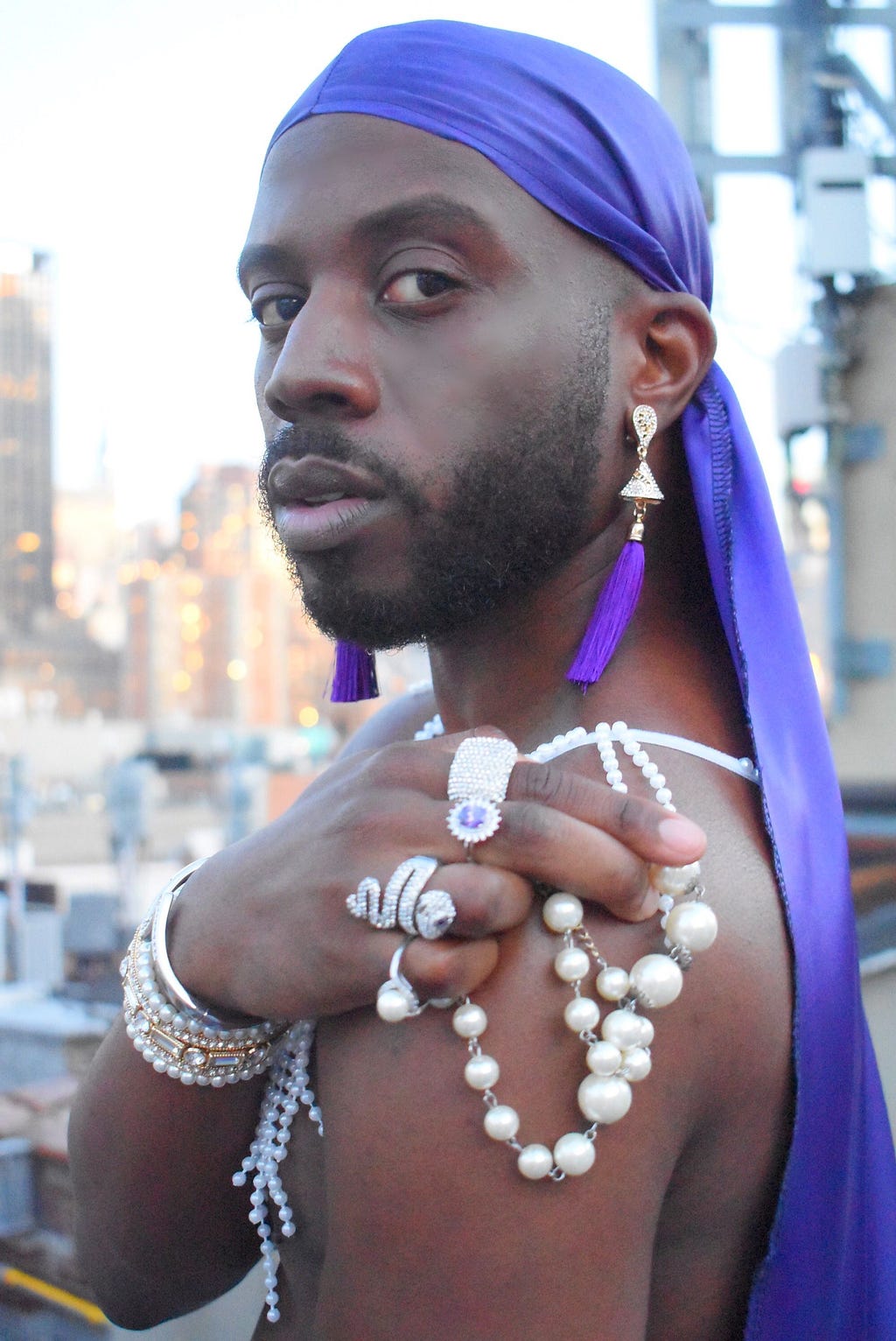
Activist Kadeem Alphanso Fyffe: They Told Me It Was Impossible And I Did It Anyway

…if my words, ideas or designs can inspire someone else to live their live authentically and pursue their dreams fiercely, I am satisfied.

As a part of our series about “dreamers who ignored the naysayers and did what others said was impossible”, I had the pleasure of interviewing Kadeem Alphanso Fyffe.

Kadeem Alphanso Fyffe, 29, is a Jamaican-American fashion designer, entrepreneur, activist, and public speaker. He is the Founder and Creative Director of MUXE NEW YORK (pronounced moo-shey) and currently serves as the Head of Design for multiple activewear start-ups. His design work has been featured in People, Cosmopolitan, and USA Today; he was recently named to Out Magazine’s 2020 Out 100 List.

Fyffe studied Studio Art as well as Women, Gender, Sexuality Studies at the University of Richmond and completed his graduate studies in Fashion Design at Parsons School of Design. In 2011, he studied abroad in Milan, Italy, and received a certification in womenswear design from Istituto di Moda Burgo. He has worked in the NYC Fashion Industry since 2013 as a Fashion Designer and Visual Merchandiser for brands including Michael Kors, Burberry, Lyssé, PVH, and Marc Jacobs. His last role was Head of Design at WOLACO and his activewear collections are currently sold nationwide at Barry’s and Equinox.

Social justice and LGBTQ+ activism have always been deeply important to Fyffe. He was heavily involved in LGBTQ+ student life in college, serving as the Founder and President of the Black Alliance for Sexual-minority Equality at the University of Richmond. He is currently an active member of the National Black Justice Coalition, and serves as a volunteer, speaker, and committee member of NYC-based LGBTQ+ youth organization, Live Out Loud.

Fyffe’s primary focus is fashion, but he has also worked as a commercial model and actor, having landed a contract with Wilhelmina at 19, and has since appeared in TV, film and theatrical productions in the US and Australia, with current representation by J&R Management Melbourne.

Born in Queens, NY, raised in Durham, North Carolina, Fyffe currently lives in New York.

Thank you so much for joining us! Our readers would love to ‘get to know you’ a bit better. Can you tell us your ‘backstory’?

I am an Artist first, Fashion Designer second, and a fierce advocate for my community always. My work fuses social commentary, fashion, and gender fluidity to help push our culture towards a world that is free of so many of the shackles that we all are subject to on a daily basis. Like so many LGBTQ+ people, growing up I faced many challenges, but I decided a long time ago that I would always work to defy odds, and make it better for the next generation. Part of my mission is to ensure that young people growing up today feel freer to be themselves and express who they are — which is why I have made it a part of my platform to serve as a volunteer speaker and committee member of Live Out Loud, an NYC based LGBTQ+ Youth Organization, additionally we donate a portion of our sales from MUXE to support queer minority youth.

Are you working on any new or exciting projects now? How do you think that will help people?

I am working on everything! The upcoming 2021 Spring/Summer collection for my fashion label, MUXE, will be the first evolution into gender-free ready-to-wear, and I will be expanding the line volume while focusing on bolstering online sales and getting into more stores. I am also working on some special collections for a few activewear start-ups. I love designing for other brands + helping other entrepreneurs see their ideas come to fruition.

In your opinion, what do you think makes your company or organization stand out from the crowd?

Fashion is a very crowded space but we’ve been able to carve out our niche. I believe we’ve been able to do this by combining thoughtful design, a social mission and philanthropy. I started MUXE to disrupt traditional streetwear — by centering social justice and LGBTQ+ issues and bodies within the context of fashion and streetwear. I want the people who wear my clothes to feel like one of the “cool kids’’ no matter their race, sexuality, body size, gender identity, or expression. I purposely show my designs on a widely diverse group of models including Black, non-binary, trans to represent my own intersectional identity as a Black, queer, gender-fluid individual, with the hope of inspiring others to live their lives authentically and to pursue their dreams fiercely. In many ways my journey as a business owner and entrepreneur with MUXE has mirrored my life journey — there have been so many times when I wanted to give up, but have chosen to keep going because of my larger mission. My life experience has been one of perseverance and determination, and I want this brand to serve as a constant reminder to little queer kids that you are “cool” and it will get better, but you have to keep fighting for equality.

Ok, thank you for that. I’d like to jump to the main focus of this interview. Has there ever been a time that someone told you something was impossible, but you did it anyway? Can you share the story with us? What was your idea? What was the reaction of the naysayers? And how did you overcome that?

I have been told “no” my entire life, and it has always been what motivated me. It sounds petty, but my favorite pastime is proving people wrong. One particular experience stands out in may memory: when I was in college I worked at a hair salon one summer, and my boss told me that I wouldn’t be able to get into Parsons or St. Martins for grad school. He told me that my goal was “too lofty”. That very day I went home and did tons of research and laid out a detailed plan as to how I was going to get into Parsons. Fast forward — I got in to Parsons, and did exactly what I said I was going to do. If I listened to every adult that told me my dreams were “too lofty”, I’d still be working at my first high school job at Chick-Fil-A on Roxboro Road in Durham, daydreaming about my shoulda-coulda-wouldas!

In the end, how were all the naysayers proven wrong? 🙂

Well to put it frankly — I am here occupying my rightful place in the fashion industry, and they are not.

None of us are able to achieve success without some help along the way. Is there a particular person who you are grateful towards who helped get you to where you are? Can you share a story about that?

To date, Dr. Johann Stegmeir, has been my biggest mentor. He was my advisor during undergrad at University of Richmond + helped me successfully navigate studying Fashion at a school with no fashion program. I was able to pursue my passion by combining courses in Studio Art, Theater, Costume Design and Independent Study.

He was the first person that told me I could achieve my goals, and actually laid out a path to success and helped me hone my skills. He was tough on me, and always kept it real — which pushed me to produce my best work. I will never forget the first day I showed him my portfolio of sketches — he had never met me, but took the time to look through all my sketches, consider all my ideas, listen to goals and gave me very honest critiques, while volunteering to be my mentor. I am forever grateful for his tough love, insight and continued guidance.

It must not have been easy to ignore all the naysayers. Did you have any experiences growing up that have contributed to building your resiliency? Can you share the story with us?

There will always be naysayers, but as I said — I make it a sport to defy expectations, and as general practice, I don’t pay attention to negativity.

In many ways I was forced into resiliency at an early age. I grew up as a Jamaican-American + openly gay in the South in Durham NC. The black kids didn’t like me because I wasn’t “black enough”, the white kids treated me poorly bc I am Black and they are racist, and most kids hated me because I was openly gay. My very presence threatened so many people for so many reasons, I challenged all their “truths”, but that was all them — they had the problem, not me. I could have succumb to the ridicule and bullying, but I chose to rise above, focus on education and sports, while directing all my attention to getting out of there as soon as humanly possible. The way I saw it, I was in a fight with my bullies daily and it was either going to them or me — I chose me.

Based on your experience, can you share 5 strategies that people can use to harness the sense of tenacity and do what naysayers think is impossible? (Please share a story or an example for each)

5 quotes come to mind when thinking of an overall strategy to harness your own tenacity and prove naysayers wrong. Here they are and my thoughts:

  • “Impossible things are happening every day” — Brandy + Whitney Houston

One of my favorite films is Rodgers and Hammerstein’s Cinderella starring Brandy. Whenever I watch the first Black cinderella on-screen, I am reminded that anything is possible. Impossible is only impossible until you make it possible. Heed Godmother Whitney’s advice and go find your “Prince”.

  • “Pay It No Mind” — Marsha P. Johnson

Marsha P Johnson is my queer icon. Being queer is all about tenacity and resiliency + she epitomizes this spirit. She’s credited with throwing the first brick during the Stonewall riots + for me, she represents the sacrifice and dedication of countless Trans Women of Color that I (and the entire LGBTQ+ community) owe my life to. If it wasn’t for her and her fighting “pay it no mind” spirit, I would not have equal rights today. I dedicated one of my t-shirt designs to her + it sold out in one season…for good reason.

  • “If a teeny weeny bird can fly over the rainbow, then why can’t I?” — Patti Labelle, “Somewhere Over The Rainbow”

I am inspired to persevere every time I listen to Patti Labelle’s rendition of this song, and I usually break into tears when she belts “then why can’t I”. I mean, this is a really good question — if OTHER people can do it, then why can’t I? Answer, Daily Double: I CAN.

  • “Scared money don’t make no money” — Sukihana

Sukihana is one of my favorite female rappers of the moment because she is empowered in her femininity and sexuality while being perfectly and unabashedly ratchet, but most importantly she is a hustler, and has no problem being blatantly new rich. She is quoted as saying she won’t go to bed until she makes 10K+ everyday — even if she has to collect those coins on OnlyFans. If that isn’t tenacity, I don’t know what is. Scared money don’t make no money, and bills are bills! Period.

  • “Always be a first-rate version of yourself, instead of a second-rate version of someone else.” — Judy Garland

This has been my favorite quote for as long as I can remember. For me this means being the best you at all time regardless of what others say. Be the best you, because at the end of the day that is all you have + you’re never going to get anywhere in life trying to be like everybody else. Also, who wants to be second-rate? I mean…if that’s your tea, be my guest — but that will never be my approach.

What is your favorite quote or personal philosophy that relates to the concept of resilience?

“I can make it through the rain” — Mariah Carey

You are a person of great influence. If you could inspire a movement that would bring the most amount of good for the greatest number of people, what would that be? You never know what your idea can trigger.

I am in the midst of that work now — if my words, ideas or designs can inspire someone else to live their live authentically and pursue their dreams fiercely, I am satisfied.

Can our readers follow you on social media?

Yes! Follow me on Instagram at @k_alphanso / Follow MUXE at @muxenewyork

Thank you for these great stories. We wish you only continued success!


Activist Kadeem Alphanso Fyffe: They Told Me It Was Impossible And I Did It Anyway was originally published in Authority Magazine on Medium, where people are continuing the conversation by highlighting and responding to this story.

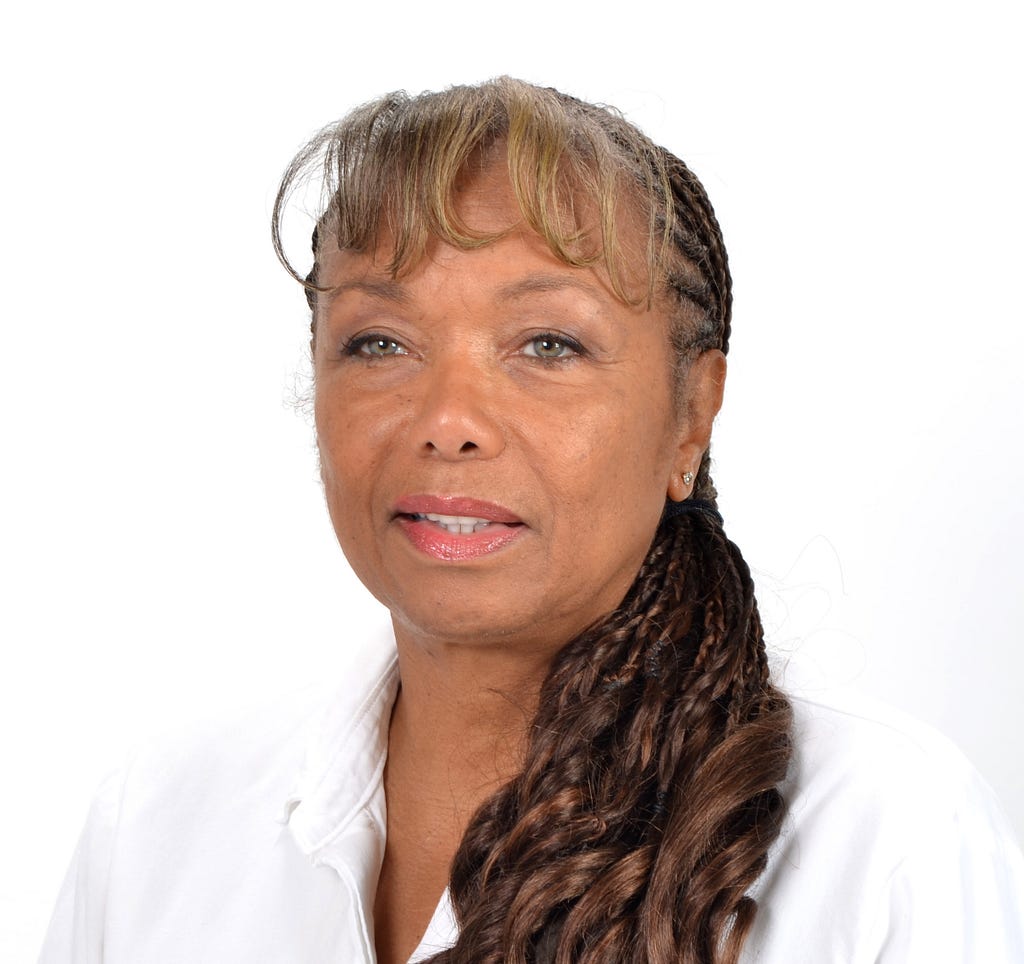
Author Teri Smith-Pickens: 5 Things Anyone Can Do To Optimize Their Mental Wellness

Stop being a control freak by surrendering to the plans of a power greater than yourself. It is true that having complete control keeps our anxiety at bay but it is a myth that we have any control of our life much less others; we end up repressing other’s free will which only causes the repressed anger we see playing out at school and mall shootings.

As a part of my series about the “5 Things Anyone Can Do To Optimize Their Mental Wellness”, I had the pleasure of interviewing Teri Smith-Pickens.

Teri Smith-Pickens is an award-winning and best-selling author and speaker, in addition to her work as a mental health practitioner and coach. She has inspired and transformed many lives through her coaching, speaking and media appearances.

Thank you so much for doing this with us! Our readers would love to “get to know you” a bit better. Can you share with us the backstory about what brought you to your specific career path?

As a child I had prophetic dreams including knowing when people I love was about to die and for a long time, I was afraid to go to sleep. The human mind/psyche always intrigued me, so Psychology was my chosen career path. I went the direction of a Master’s in Counseling where I learned a lot about the subconscious mind then I had the revelation in 2007, which gave me an inside look at our brain and its functioning that even the most brilliant scientists still can’t figure out. This gave birth to The Fear Cure in Four Miraculous Steps.

Can you share the most interesting story that happened to you since you started your career?

While working in a jail providing counseling and group therapy to incarcerated men; one of the men, a 26-year-old who had a history of childhood rape by a male family member, had multiple physical ailments his entire life, one in particular was that he would bang his head while sleeping until it bled. His cellmate told me how he tries to wake him up from what seems like a nightmare to no avail. I got permission to give him a Walkman (back in the day) and a CD from Emmett Fox called the “Sermon on the Mount”. I instructed him to use earplugs and listen to it when he went to bed. Almost immediately, the nightmare and head-banging stopped, never to return. He found peace.

Can you share a story with us about the most humorous mistake you made when you were first starting? What lesson or take-away did you learn from that?

In this field it is hard to pair mistake with humor since mistakes are usually costly and damaging to one’s career. I was treating a family where 4 girls were abandoned by their mother and were being raised by their grandmother, a Jehovah’s Witness. It happened that their next appointment fell on the birthday of one of the girls who was turning 16. She told me she had never had a birthday celebration because of her grandmother’s religion which she didn’t share, because it frowns upon celebrations, gifts, etc. My mistake was providing a cake and having her, and her siblings celebrate in my office. The grandmother found out and almost sued me and the agency. I got off with a warning. The take-away lesson is you can never know people so well that you know how they will behave in a crisis, and, not every belief in Jesus Christ is compassionate.

None of us are able to achieve success without some help along the way. Is there a particular person who you are grateful towards who helped get you to where you are? Can you share a story about that?

Debbie Riddle was the CEO of one of the agencies I worked for, and I do believe, she helped save my career by bringing me to a place of grace and tolerance in a tough office politics situation. When the “piranha-like” staff meant me evil, she stood by me for my good, allowing me to stay on the job with people who were my superiors and had tried to get rid of me.

What advice would you suggest to your colleagues in your industry to thrive and avoid burnout?

The moment you step out of your office, leave the day and the clients there, do not take in your head, or your car, or talk to your family about the stuff that happened that day. Especially, do not try to resolve tomorrow’s issues after work. Without proper boundaries you will arrive at burnout rapidly.

What advice would you give to other leaders about how to create a fantastic work culture?

The apostle Paul talks about the Fruit of the Holy Spirit, a biblical term that sums up 9 attributes of a person or community living in accord with the Holy Spirit, according to Galatians Chap. 5. These attributes are — love, joy, peace, patience, kindness, goodness, faithfulness, gentleness, and self-control. Living in Survival Mode gives us attributes of the opposite nature which causes friction and discontent. When we personally adopt the Fruit of the Spirit, we can still be assertive, but we grow up emotionally and are able to create a fantastic work culture because deep down humans just want to feel loved and be accepted.

Ok thank you for all that. Now let’s move to the main focus of our interview. Mental health is often looked at in binary terms; those who are healthy and those who have mental illness. The truth, however, is that mental wellness is a huge spectrum. Even those who are “mentally healthy” can still improve their mental wellness. From your experience or research, what are five steps that each of us can take to improve or optimize our mental wellness. Can you please share a story or example for each?

  1. Your mental health is just as important as your physical health so come out of denial and get some therapy early to stop repeating negative family patterns and fear-based thinking at the root of all mental health issues.
  2. Honestly take a look in the mirror or listen to what those closest to your say about those character patterns (gossip, anger, fear, cheating, dishonesty, lack of integrity, immaturity), which keep disrupting your life and relationships as a result of living in Survival Mode.
  3. Stop being a control freak by surrendering to the plans of a power greater than yourself. It is true that having complete control keeps our anxiety at bay but it is a myth that we have any control of our life much less others; we end up repressing other’s free will which only causes the repressed anger we see playing out at school and mall shootings.
  4. Stop tuning into everything and getting nothing done — this is what Attention Deficit (ADD) causes. How many times do you start cooking the stew in your head before you arrive at the supermarket to buy the ingredients, or think you can multitask resulting in errors?
  5. Ask yourself and honestly answer this question, what is my beef with God/Jesus Christ, and mental health? According to a Pew study, 1 in 4 Americans do not believe in God and 1 in 5 suffers from a mental health issue. Many ethnicities, Afro-Americans for example, fail to address signs of mental illness because as one said, “Black people don’t go to therapy, if you go you are crazy.” We must let go of this stigma/phobia and encourage people to be honest when they are not feeling like they can cope.

Much of my expertise focuses on helping people to plan for after retirement. Retirement is a dramatic ‘life course transition’ that can impact one’s health. In addition to the ideas you mentioned earlier, are there things that one should do to optimize mental wellness after retirement? Please share a story or an example for each.

See a mental health professional early for past trauma which we all have. The longer you go without addressing your mental health issues, it’s like honing a skill and the character patterns only get worse and stronger. For example, ADHD is running everywhere and getting nowhere as if someone is chasing you. ADD is tuning into everything and getting nothing done resulting in things like Alzheimer’s. These symptoms are brought over from our childhood and if not addressed, will prevent you from having “peace” in retirement. You will not be able to be still and will go crazy when you stop working because of your need to be always “running” and/or multitasking.

How about teens and pre-teens? Are there any specific new ideas you would suggest for teens and pre-teens to optimize their mental wellness?

  1. This is critical because they are the future. First, get help for their parents by way of parenting coaching, etc., to stop the negative generational patterns.
  2. As long as children live in an environment with parents who exhibit authoritarian parenting, a style that is defined by high demand but low responsiveness, requiring their teens to meet high standards, yet they are cold and aloof to their children’s emotional needs, yelling and berating them, repressing their free will, etc. This results in children who are living in Survival Mode with symptoms of poor self-esteem, ADHD, ADD, anger and other mental health issues, because they don’t feel like they have any control over their own lives or are allowed to express their feelings. When feelings are not expressed emotionally, they come out behaviorally — some parents put their kids in therapy, but this is only a band-aid because the environment they are living in has not changed from being the toxic cause of their poor mental health.

Is there a particular book that made a significant impact on you? Can you share a story?

Emmet Fox’s, The Sermon on the Mount. I did a friend a favor and offered accommodations in my home to a visitor from Hawaii who literally wreaked havoc on my home causing me to seek shelter elsewhere. However, when she left, she gave me a CD, the above-mentioned book on tape and it was to alter my spiritual life forever.

You are a person of great influence. If you could start a movement that would bring the most amount of good to the most amount of people, what would that be? You never know what your idea can trigger. 🙂

The “Center for healthy kids and Schools K-12” in CA started an initiative of peer-reviewed research on the emerging field of mindfulness education in schools to counteract ADD, ADHD, anxiety, conduct disorder, etc. Instead of this initiative, let us start a movement at the birth of a child, warning parents and the society at large of the dangers of failing to protect a child from their irrational fears during the primal period. This way we prevent their Fight/flight/freeze defense system from going on auto pilot leaving them in Survival Mode with its host of negative symptoms like ADHD, ADD, Autism spectrum, mood imbalance, etc.. Refer to Chapters, 1, 2, 3 of The Irrational Fear Cure.

Can you please give us your favorite “Life Lesson Quote”? Do you have a story about how that was relevant in your life?

My father taught me, “You always get what you pay for.” It is an abundant universe but when people grow up in poverty, they tend to develop a poverty mentality, hiding it under words like frugal, thrifty, economical, resulting in being so cheap they do without in an abundant universe or buy the things they need multiple times because they buy poor quality and end up replacing it over and over, which eventually cost more. I experienced this in a past relationship, and it was costly. Buy the best, not the cheapest the first time around. It really is spiritual unbelief that God will care of us.

What is the best way our readers can follow you on social media?

Author’s Website: www.thefearcure.com

Author’s LinkedIn: www.linkedin.com/in/teri-pickens-b9387a13/

Author’s Instagram: www.instagram.com/fushia18/

Author’s Twitter: www.twitter.com/TeriPickens

Author’s Facebook: www.facebook.com/centerforeducationandhealing/

Author’s Pinterest: www.pinterest.com/teri_pickens/

Author’s YouTube: www.youtube.com/channel/UCp1eKtZdi37ZfFDjZsK9drQ

Thank you for these fantastic insights. We wish you only continued success in your great work!


Author Teri Smith-Pickens: 5 Things Anyone Can Do To Optimize Their Mental Wellness was originally published in Authority Magazine on Medium, where people are continuing the conversation by highlighting and responding to this story.

Female Disruptors: Serenity Carr of Serenity Kids On The Three Things You Need To Shake Up Your…

Female Disruptors: Serenity Carr of Serenity Kids On The Three Things You Need To Shake Up Your Industry

Bring on good talent to fill roles early on. Early on, I wore many hats and played multiple roles. Luckily, several of our advisors mentioned that I needed to learn how to let go of some of the control and bring on help to manage all the different, growing responsibilities. I thought they were going to say that I should step down and find someone who had experience to run the place, but instead, they trusted me and my instincts on how to run the company and suggested that I bring on experts in their individual fields.

As a part of our series about women who are shaking things up in their industry, I had the pleasure of interviewing Serenity Carr.

As the co-founder and CEO of Serenity Kids, Serenity Carr’s commitment to starting and growing the brand was motivated by her and her husband’s desire to create nutrient-dense, low sugar, and high fat baby food for their daughter, Della. Serenity Kids launched in Austin, TX on August 5, 2018 — the same day their baby girl, Della, was born. This rapidly growing natural baby food company is dedicated to making the world healthier, one baby at a time.

Serenity’s mom became a vegetarian when she became pregnant with Serenity because she thought that was the healthiest diet she could be on. Unfortunately, the lack of nutrients from the vegetarian diet coupled with too much sugar, wheat, and dairy led to health issues for Serenity starting with an ear infection at two weeks old. Throughout childhood, she ate a lot of sugary, processed foods and suffered through repeated infections and subsequent antibiotics that gave her terrible heartburn. Carr attended the University of Tennessee-Knoxville and graduated with a Bachelor’s Degree in Logistics, Materials, and Supply Chain Management. After school, she started working at John Deere and gained experience through the ranks for nine years. She then went on to receive her Master’s Degree in Higher Education and Student Affairs from Ohio State University. Carr went on to work as a Procurement Advisor at Dell for three years. While attending graduate school, she got another ear infection and the antibiotics harmed her stomach even further. Her doctor’s only solution was to prescribe her a pill she would have to take for the rest of her life. This ultimatum didn’t sit well with Carr — her dad suggested she read the book on the Paleo Diet he had given her for Christmas. Carr leaned heavily into Paleo and found that she was able to heal her medical issues through changing the food she ate. This realization inspired her to become a health coach and start a Paleo lifestyle company called Joy of Paleo to help other people heal themselves through this diet. During her two years leading Joy of Paleo, Carr went to speak to a local personal growth start-up business where she met her future husband and business partner, Joe Carr.

As they began planning their family, they looked for baby foods that matched their dietary standards, and were outraged by how much sugar and how little nutrition was available. So they made their own! Created to mimic the macronutrients of breast milk, Serenity Kids’ baby food is made from pasture raised meats sourced from small American family farms and high-quality organic vegetables and oils. Serenity Kids’ purees are balanced, blended, savory meals that contain the most nutrition per bite for your little one. Having healed her digestive issues through a lifestyle diet change, Serenity is transforming the baby food industry by developing innovative nutrient-dense products because every bite counts.

Carr and her husband are passionate about expanding their one-of-a-kind baby food brand. At Serenity Kids, Carr leads product innovation, operations, and financial management. During her free time Carr enjoys playing outside with her family, testing out new baby food innovations and flavors, weight-lifting, creating Paleo-compliant recipes, and enjoying fine dining.

Thank you so much for doing this with us! Before we dig in, our readers would like to get to know you a bit more. Can you tell us a bit about your “backstory”? What led you to this particular career path?

Like many stories out there, it really begins with my mom! While pregnant with me, and with the best intentions, my mom took on a vegetarian diet, thinking it was the healthiest diet she could be on. Unfortunately, a vegetarian diet can lack many essential nutrients for fetal development, plus her diet contained sugar, wheat, and dairy. As a result, I had immediate health issues starting with an ear infection at only two weeks old. As a kid, I ate a lot of sugary processed foods (doughnuts and cool ranch doritos were two of my favorites), which caused chronic infections and repeated doses of antibiotics that led to daily heartburn.

I didn’t intend to go into the baby food business. I received my Bachelor’s Degree in Supply Chain Management and spent the first 9 years of my professional career working at John Deere. I then got my Master’s in Higher Education at Ohio State. During grad school, I suffered another ear infection, started another round of antibiotics, and that was the last time. Those antibiotics destroyed my stomach to the point where my doctor’s only solution was to prescribe a pill that I would take for the rest of my life. I hated the idea of having to be on medication forever! Luckily, in venting out my frustrations, my dad recommended that I read a book on the Paleo diet. I tried it out and found that I was actually able to heal many of the medical issues by changing the foods I ate.

Along with this new healthy eating lifestyle change, I decided to leave the tech industry and become a health coach to help others heal themselves through food… which is how I met my now-husband, Joe Carr.

When we started family planning, we began searching for baby foods that aligned with our personal dietary standards — high in nutrients and low in the junk and fillers. What we found was astonishing and frankly made me angry! There was so much sugar and little nutrition in baby food products available in the market. Why wasn’t there something healthier and better for babies? With my history of illnesses stemming from eating unhealthy foods as a child, I was determined to create a better option for babies so that they didn’t have to go through the same experience I did. So Joe and I started our mission to create a different kind of baby food. On August 5, 2018, Joe and I launched Serenity Kids which coincidentally was also the same day our baby girl, Della, was born!

Joe and I are dedicated to making the world healthier, one baby at a time, and my mission is to truly transform the baby food industry by developing innovative, nutrient-dense products. I am so proud of what we have accomplished so far at Serenity Kids, and I’m excited about our future options for babies and toddlers.

Can you tell our readers what it is about the work you’re doing that’s disruptive?

I believe a few things make Serenity Kids stand out:

1) The idea for our company is born from a real life struggle, fueling our passion to make the world better.

2) Our brand proposition is focused on providing nutrient-dense foods for babies and toddlers featuring clean proteins and healthy fats. This was missing in the marketplace.

3) We’ve created healthy products for babies that actually taste GOOD and parents trust feeding to their little ones.

Many well-known baby food brands are selling products based on outdated nutrition data, as evidenced by the baby food aisle being filled with unbalanced products containing primarily carbohydrates that are high in sugar with little to no fat or protein. Our research has shown that meat is an ideal first food for babies, and they need at least 30g of fat per day for their developing bodies. Serenity Kids products are focused on pureed meats, organic vegetables, and healthy fats for babies. It’s exciting because we launched our product two years ago and the USDA recently released their first-ever nutrition guidelines for kids under two years old, and their recommendations are the same as ours. Babies and toddlers should be eating a balanced, low-sugar diet of meat-based proteins, fat, and veggies.

Can you share a story about the funniest mistake you made when you were first starting? Can you tell us what lesson you learned from that?

Honestly, when Joe and I first started the company, we were so excited! It was a new venture for us! Joe is an innovator with lots of ideas and had no experience in manufacturing. I come from an operations background and am more cautious by nature. You could say that the two of us create a perfect balance; however, in this case, it caused a few snafus.

Joe was certain our manufacturing tests would work out, so we decided to take pre-orders of our products without a final confirmed product. We ran into a few unexpected manufacturing issues with the equipment, because it was normally used for fruit purees, which behave differently on the production line. The products weren’t actually ready for over a year after we started taking pre-orders. By the time we finally had the products ready, many of the babies on our pre-order list had already aged out! Managing those pre-orders was so stressful! We were dealing with refunds, incorrect email addresses, and customer service inquiries like never before.

We learned to not make promises we can’t keep. It’s better to underpromise and overdeliver.

We all need a little help along the journey. Who have been some of your mentors? Can you share a story about how they made an impact?

Some of my greatest mentors are Rachael Jayne Groover, my former business coach, and Taylor Collins and Katie Forrest, the founders of EPIC.

Rachael taught me that business can be a spiritual practice. She taught me to trust my instincts and muster the courage in order to achieve my life’s mission and dream. Starting Serenity Kids was hard. We ran into a lot of obstacles like trial runs failing and our co-packer not being able to meet our needs. But Rachael’s guidance kept reminding me to not let those failures or obstacles keep me down. I had to keep finding the courage to solve the next problem- and the next- in order to fulfill my mission to provide healthier baby food for babies.

Taylor & Katie played a significant role in the formation of Serenity Kids. Without their validation that this product was one that the world needed, we might still be a teeny online company. They encouraged us to go big. They also taught us how to build a company culture that would be unique to our business- from the space we work in, to the people we hire, to the company outings we have, and more. The co-founding duo of EPIC built their company culture and products around their personal values of authenticity and honoring the planet. They taught us about regenerative agriculture, the importance of well-sourced meats, and how we can help improve earth’s ecosystem. Serenity Kids would only be a fraction of where we are today without their initial guidance.

In today’s parlance, being disruptive is usually a positive adjective. But is disrupting always good? When do we say the converse, that a system or structure has ‘withstood the test of time’? Can you articulate to our readers when disrupting an industry is positive, and when disrupting an industry is ‘not so positive’? Can you share some examples of what you mean?

In my opinion, it ultimately comes down to intent. If you have a positive, mission-oriented reason for disrupting the industry, that’s not all about just making money, I would say that’s a good disruption. Within the natural consumer packaged goods space, there are many successful mission-based brands where customers are willing to purchase a premium product because they truly believe in the mission and the company that’s behind it.

For us, we are disruptive in our nutrition and our sourcing. One of our hardships is not having the organic certification on our all baby foods, even though most other baby food brands on the market are all certified organic. We source from small American family farmers that raise their animals exclusively on pasture in sustainable and regenerative ways, which means they rotate the grazing land to avoid overgrazing any one area. This practice makes organic certification extremely costly because every inch of pasture on their large farms and ranches would have to be certified. For these reasons, we chose to forgo the organic certification in order to support small American family farmers and use regeneratively raised meat, which is ultimately better for babies and better for the planet. But it makes my heart feel good to know that our products are way better than just organic!

Can you share 3 of the best pieces of advice you’ve gotten along your journey? Please give a story or example for each.

The best pieces of advice that I have received:

  • Bring on good talent to fill roles early on.

Early on, I wore many hats and played multiple roles. Luckily, several of our advisors mentioned that I needed to learn how to let go of some of the control and bring on help to manage all the different, growing responsibilities. I thought they were going to say that I should step down and find someone who had experience to run the place, but instead, they trusted me and my instincts on how to run the company and suggested that I bring on experts in their individual fields.

  • Take care of yourself first.

Serenity Kids launched the same day Della was born. Imagine that. Becoming a new mom while also balancing a company and product launch! It got to the point where I couldn’t fathom running a company because I was missing some morning meetings due to sleepless nights. However, once I started setting boundaries, giving myself grace, and knowing my limits, I was able to get creative about my work schedule and keep our rocketship going.

  • Create a company culture that you want to work in and contributes to individual success.

I’ve never run a company before. I’ve also never had employees directly report to me. Building a culture and team were totally foreign concepts. However, I have learned that founders should make their company culture one they personally want to work in. It’s why we have on-site childcare for employees, and why Serenity Kids is shut down between Christmas and New Year’s. It’s why we don’t have dress codes or work in a big industrial office with an elevator and sliding doors. It’s why we have a maternity and paternity leave that I feel good about offering. We want our team to feel like when they’re coming to work, they are coming to an environment where they can feel comfortable to be themselves.

We are sure you aren’t done. How are you going to shake things up next?

We have lots of fun, new innovative products in our pipeline! We’re launching new formats that will expand our target age range. And while we’re doing that, we are going to keep marching forward to challenge the biggest food companies in the world and show them that companies actually can make super nutritious, tasty products while treating our employees well and helping the environment. We want to change government policy so that all women, infants, and children have access to nutrient dense options.

In your opinion, what are the biggest challenges faced by ‘women disruptors’ that aren’t typically faced by their male counterparts?

This is an easy answer for me: my desire to become a mother. When Della was a newborn, I was so out of the loop trying to manage everything- from nursing Della, to making sure she was sleeping, to getting enough skin-to-skin contact, to trying to remember if I actually responded to that email or is it just a draft…? Luckily, I own the business and came back part-time within a few months, but I made the decision to not come back full-time until Della was sleeping through the night at about 1 year. I consider myself extremely lucky to have had this opportunity, when most women in the US don’t. Most European countries are far more generous with maternity and paternity leave. In the US, most women have to choose between going back to work full-time within 4 months or putting their careers on pause. Milk supply often drops after going back to work due to stress and pumping being less productive than nursing, which forces them to start using infant formula. It would be AMAZING if more companies were able to implement part-time roles for new moms to get through that critical first year of nursing. Women should be able to break the glass ceiling without having to sacrifice their baby’s nutrition.

Another one is our society’s tendency to prioritize men’s voices over women, and it definitely happens in the workplace. I recently read an inspiring article called 10 Simple Words Every Girl Should Learn, which opened my eyes to today’s workplace sexism. For example, a woman might say something during a meeting and no one seems to really hear her, but a male counterpart repeats what she said and meeting attendees all nod their heads in agreement. Even though I’m CEO, I’ve noticed this happening to me inside my organization. So I started practicing the lines: “I just said that.” “Stop interrupting me.” and “No explanation needed.” I’ve also called attention to that pattern within our leadership team, because I want to interrupt this societal norm.

Do you have a book/podcast/talk that’s had a deep impact on your thinking? Can you share a story with us?

I highly recommend Brene Brown’s new podcast, Dare to Lead! In one of the episodes, she mentioned that in Texas people don’t want to have hard conversations. Our business is based in Austin, TX, and I totally resonate with her assertion that Texans have a “nice problem”! Hard conversations are critical for teams to perform at their fullest, so I must learn how to find the courage to speak up when things are wrong and to say no.

Some of the hardest internal conversations we have as a team are about which new products to launch. It’s especially difficult for me, because my husband is the head of sales and marketing. I lead operations and finance, so we have different goals. For example, he wants to be the first to market, while I want better margins. Over the years, we’ve gotten better at talking about new innovation, but we still struggle. I believe that the process of working through the struggle and weighing all factors actually helps us launch the best products at the right time. Finding the courage to be vulnerable, truly listen to the other’s point of view, and most importantly take the time for the difficult conversation is what keeps our brand alive for consumers and is the heart of our rapid growth.

You are a person of great influence. If you could inspire a movement that would bring the most amount of good to the most amount of people, what would that be? You never know what your idea can trigger. 🙂

For me, it would be to bring down Big Food and provide more transparency, simpler ingredients, and better nutrition for everyone. It’s been mentioned a few times in this interview, but Big Food has done so much harm to the bodies of Americans nationwide. From lobbying for hyperpalatable food that tricks your brain into wanting more, to allowing harmful but cheap ingredients into the food supply, to the lack of oversight when it comes to genetically modified ingredients. As the brands who feed the nation, we should want the best foods sourced from the best ingredients. This should be a non-starter. We, as brands, need to feed our fellow citizens better and in our case, babies.

Can you please give us your favorite “Life Lesson Quote”? Can you share how that was relevant to you in your life?

My favorite quote comes from Gay & Kathlyn Hendricks’ book Consious Loving: “fear is frozen fun”. It reminds me that when I’m feeling fear, the best next step is to head straight towards the fear so I can find the fun on the other side. I had a ton of fear starting my company and putting so much money and time and vulnerability and energy into it… On the other side, it’s the best job I’ve ever had, and I know that thousands of babies are eating better every single day!

The day that we launched our website felt like I was stripped down naked and running through the street. It was full of my personal stories with some photos of my bare, pregnant belly. I was truly sharing a piece of my private life with the world to see… and to judge. But now, look at where I am — on the fun side — where other moms get to feel seen and heard and be vulnerable with themselves in our community. Fear can feel like a barrier that’s impossible to move through. But for me, the fun on the other side is worth the effort it takes to conquer that fear.

How can our readers follow you online?

To learn more about Serenity Kids, check out our website at www.myserenitykids.com or follow us on Instagram or Facebook at @myserenitykids.

This was very inspiring. Thank you so much for joining us!


Female Disruptors: Serenity Carr of Serenity Kids On The Three Things You Need To Shake Up Your… was originally published in Authority Magazine on Medium, where people are continuing the conversation by highlighting and responding to this story.
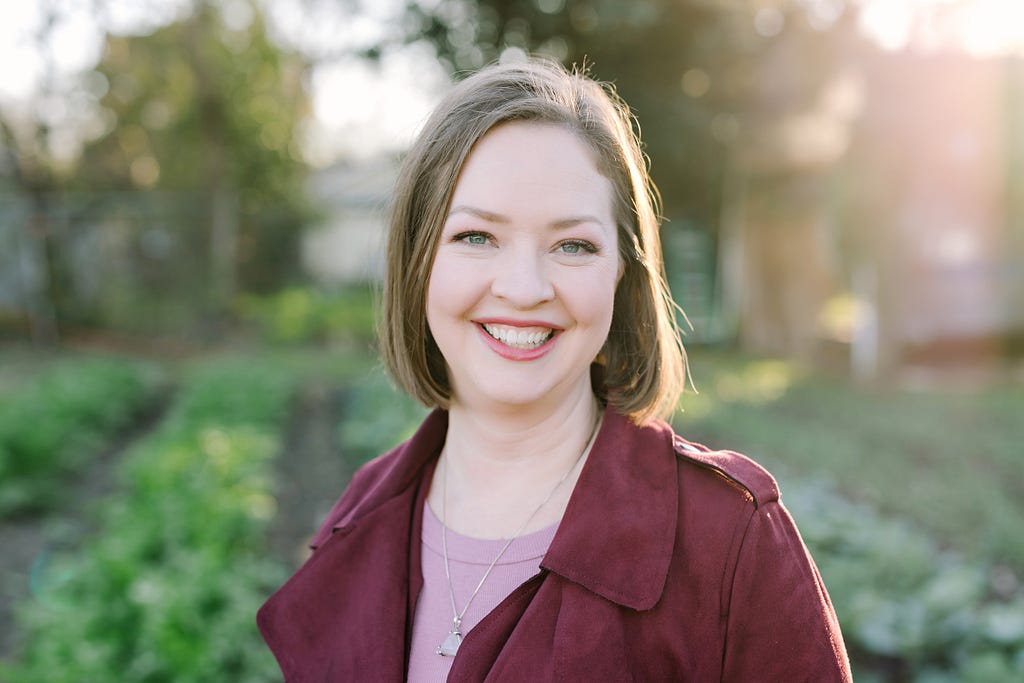
Karl Swannie of Echosec Systems: 5 Things I Wish Someone Told Me Before I Became a CEO

Learn every day. I started as a product guy and ended up a communicator to boards, advisors and bankers. Every step along the way I had to learn something new. You have to love that.

As part of my series about the leadership lessons of accomplished business leaders, I had the pleasure of interviewing Karl Swannie.

Karl has been the creative, persuasive and decisive force behind many successful SaaS companies before successfully founding Echosec Systems in 2014 and exiting in 2020.

Karl is a well-known technical thought leader, project director, business developer and former CTO with a 20+-year career. He is an expert in massive data aggregation, advanced analytics, AI, NLP and advanced visualization.

Echosec Systems delivers real-time security and threat data analysis generated by media, news, social networks, and dark websites. The Echosec Systems Platform uses proprietary triaging techniques to clearly visualize data, as well as machine learning to contextualize data into actionable intelligence. This enables users to quickly adapt their security strategies and mitigate threats targeting their organization.

Karl is an excellent presenter and is often requested to speak on SaaS, business, intelligence, privacy, and emerging technologies. He has delivered talks around the world on a variety of topics, including presentations at TEDx, NATO and SMi-London, where the audience consisted exclusively of European national security agencies.

Thank you so much for joining us! Can you tell us a story about what brought you to this specific career path?

I became a CEO out of necessity, not necessarily desire. At the time of Echosec’s foundation, my network did not include people who could build a company around the software I envisioned. I come from a small city on an island in the Pacific Northwest. We simply did not have CEOs on hand to make this company happen, so I naively stepped forward.

As soon as I stepped forward and became the CEO I started to meet so many people who wanted to help. It was truly inspiring. We were very fortunate to find advisors, investors and a community who wanted to help.

Can you tell us a story about the hard times that you faced when you first started your journey?

Hard is when you are pre-revenue. But it’s also when you have the most freedom to make big bets, change things and constantly test.

Where did you get the drive to continue even though things were so hard?

I surrounded myself with the very best people that I could find, like my business partners. The four of us shared a very small space with a beer fridge that was left behind from a previous startup that had been in the same space. We worked long hours on building the product, but inadvertently also built up an incredible amount of trust between us all. In the end, the partnership was more valuable than anything. We helped each other push through by staying focused, while not taking ourselves or each other too seriously.

So, how are things going today? How did grit and resilience lead to your eventual success?

We were acquired by The Tusker Fund late last year.

U.S. firm buys Victoria software company Echosec — Andrew Duffy — Times Colonist

“Swannie would not disclose the purchase price, but said his investors are extremely happy.”

Things are going quite well today. We’ve focused on finding the right customers and making sure we serve them with the most useful product possible. It’s important to say that this was never my success. This took an entire team!

Can you share a story about the funniest mistake you made when you were first starting? Can you tell us what lesson you learned from that?

Because we were a startup, we’d often work with other startups in the portfolio. Some of these startups were better than others. One, in particular, was a teleconferencing solution that never seemed to work. If you have ever watched Silicon Valley, the TV show, and remember Gavin’s Holographic teleconference with Bighead, keep that in mind. If you have never seen it I would highly recommend you look it up on YouTube (NSFW). https://www.youtube.com/watch?v=9YOEEpWAXgU

We would try to have meetings with investors and teams through this technology. It was a truly horrifying experience and nothing can adequately explain the excuses we heard for its constant failure.

Needless to say, we learned the importance of not shipping crap, never making excuses and laughing about our own blunders.

What do you think makes your company stand out? Can you share a story?

Extreme teamwork cannot be stressed enough. The acquisition took months. And when it came down to it, each team ran as an autonomous unit and could be counted on to deliver. This was critical as more of our management team were pulled into the process. In the end, we could have never increased leads, increased sales and delivered the product without everyone taking ownership, staying in their own lane and still going in the same direction.

Which tips would you recommend to your colleagues in your industry to help them to thrive and not “burn out”?

I’ve never been burned out. Or, perhaps I live in a steady state of burnout.

What has kept me sane is that I’ve always been able to talk to my friends who are very good listeners and forgive me when I put my foot in my mouth, which is inevitable. I’m also fortunate to live in a city with great resources, get-togethers and associations to help you get through things, communicate with or validate your approach.

None of us are able to achieve success without some help along the way. Is there a particular person who you are grateful towards who helped get you to where you are? Can you share a story?

Some people are “ideas” guys, like myself, and some are connectors — like Owen Matthews.

When I met Owen I asked him for help connecting me to a sale. Within a month, he had funded the company, connected me with my business partners, found us a space to work from and helped position our security software in one of the largest events of world leaders.

Chamath Palihapitiya, CEO of Social Capital, has an interview where he speaks about Terry Matthews, Owen’s father. To paraphrase the interview, the Matthews see money as an instrument of change. Since I’ve known them they have changed many people’s lives, including my own, and I’ll be forever grateful.

How have you used your success to bring goodness to the world?

Not as much as I plan to. 🙂

What are your “5 things I wish someone told me before I started leading my company” and why. Please share a story or example for each.

Lead. Seriously, it took a while to realize that the title “CEO” does not imply leadership.

MRR. Revenue means everything. Money can’t fix everything, but it can surely help.

Team. This doesn’t mean that everyone is your friend, but they all have to be going in the same direction.

Make most decisions quick and fast with an eye on the exit. Know that you might have to fix some of today’s decisions tomorrow.

Learn every day. I started as a product guy and ended up a communicator to boards, advisors and bankers. Every step along the way I had to learn something new. You have to love that.

You are a person of great influence. If you could start a movement that would bring the most amount of good to the most amount of people, what would that be? You never know what your idea can trigger.

Success was never a guarantee. But I tried to instil as much knowledge and autonomy as possible into my team. Everyone knew what we were facing and what growth looked like. They took it upon themselves to create a special company.

I feel like this is beyond “my movement” and I’m curious to see the movement of those I’ve helped grow.

How can our readers follow you on social media?

https://www.linkedin.com/in/karlswannie/

https://twitter.com/KarlSwannie

Thank you so much for joining us!


Karl Swannie of Echosec Systems: 5 Things I Wish Someone Told Me Before I Became a CEO was originally published in Authority Magazine on Medium, where people are continuing the conversation by highlighting and responding to this story.

Bruce Lehrman of Involta: 5 Things I Wish Someone Told Me Before I Became A CEO

You always need to raise more money than you initially believe. Technology businesses require capital for human and technology infrastructure. In growing businesses, the goal line to be cash-flow positive continues to move due to the growth and additional investment required. Not only is it important to understand this, but you must enjoy being in the game of raising capital. If you dread this part, you’ll have a hard time inspiring investors to take a chance on your company.

As part of my series about the leadership lessons of accomplished business leaders, I had the pleasure of interviewing Bruce Lehrman, Founder and CEO of Involta.

Bruce Lehrman is the CEO of Involta, an award-winning, hybrid IT solutions provider offering cloud, consulting, and data center services to help clients undertake powerful digital transformation.

Lehrman founded Involta in 2007, seizing an opportunity to bring modern IT solutions to the forefront of business strategy. His vision to blend colocation data center solutions with expert IT services has grown Involta from an Iowa-based tech services company to a nationally recognized hybrid solutions provider serving six markets across the U.S.

Under Lehrman’s strategic leadership, Involta offers IT consulting, a full suite of cloud and IT monitoring services, and colocation solutions that transform clients’ technology infrastructure, incorporating IT into business plans that support strategic growth goals.

Before founding Involta, Lehrman was involved in three greenfield business startups and also worked with large well-recognized brands. Lehrman is an active investor in entrepreneurial ventures and currently sits on the Board of the Entrepreneurial Development Center, Technology Association of Iowa (as 2013 Chairman), Iowa Seed Fund, Iowa Startup Accelerator Ventures, Geacom, Higher Learning Technology, and Van Meter Industrial. Prior to Involta, he was CIO of RuffaloCODY and CEO of LIVEware5.

Thank you so much for joining us! Can you tell us a story about what brought you to this specific career path?

In my first startup, LIVEware5, we used data center space in the world’s first internet data center, the Palo Alto Internet eXchange (PAIX), owned and operated by Digital Equipment Corporation. I really enjoyed both the market and the space. Soon after, a colleague called me — he didn’t know what to do with his data center, and we built a growth strategy together. That’s when I knew I’d found my niche.

Can you tell us a story about the hard times that you faced when you first started your journey?

Early in my career, I found myself raising capital around Christmas. We didn’t know if we would raise enough during the round to fund ourselves into the following year — or what it would mean to our young families around the holiday. We were fortunate the Chairman of the Board took a hardline with investors and encouraged people to make a decision, so we knew where we stood. Luckily, the investments came in, and we didn’t have to worry about Christmas. I’ll never forget that feeling of uncertainty. It has pushed me to think bigger and achieve more for my team, my family, and myself.

Where did you get the drive to continue even though things were so hard?

I suppose I was born with the ability to keep pushing through difficult times. I don’t like to fail. Persistence and determination are essential in my role. Being raised by a family with a strong Midwest work ethic also helped.

So, how are things going today? How did grit and resilience lead to your eventual success?

Things are going great. I’m fortunate to be leading our company through consistent growth — but that’s not a result of luck. We have a strong culture led by an engaged and experienced leadership team. We continue to build the next generation of management within our organization, and we have clients who value our team. Involta is taking on a life of its own beyond the founders. Great things are happening that don’t require my handholding.

Dedication and persistence have certainly been part of our success — as was striving for excellence. We push hard for excellence. In the end, though, it really comes down to people and the culture of an organization.

Can you share a story about the funniest mistake you made when you were first starting? Can you tell us what lesson you learned from that?

This is hard. I typically don’t think there’s really anything funny about my mistakes.

The mistake I make, and I make it repeatedly, is believing new market opportunities will evolve faster than they do. Big trends, like Edge, for example, take longer to emerge, but they often offer more opportunities than I anticipated.

What do you think makes your company stand out? Can you share a story?

Without a doubt, it’s our People Who Deliver. This notion is part of Involta’s brand promise, and it speaks to how we hire, train, and retain our team. We empower our employees to take good care of and earn the trust of our clients and the communities we serve.

Our communities have been tested with multiple natural disasters — most recently, the devastating derecho storm that tore through central Iowa in August 2020. The storm destroyed nearly everything in its path — power lines, buildings, silos, farmlands, and more. Fortunately, our team was practiced at responding to devastation — 12 years earlier, we responded to the Cedar Rapids flood.

The Cedar Rapids area, home to Involta’s headquarters, sustained some of the most intense storm damage it had ever seen, taking the brunt of the derecho storm’s 140 mph winds. According to NOAA, an estimated 90% of structures in Cedar Rapids were damaged by the storm, and more than 1,000 homes were destroyed.

Once the derecho storm passed, our employees worked tirelessly to stabilize businesses’ work environments from the physical to the virtual. Meanwhile, Involtans from our Duluth, Minnesota, and Youngstown, Ohio, offices traveled to Cedar Rapids to support and aid the work of our headquarters’ employees. They also brought essential and much-needed supplies, including cases of water, power strips, and generators.

Involta’s community support went beyond our customers to our neighbors, as well. Our employees volunteered for organizations, including the Iowa Derecho Relief Center in Cedar Rapids, where they provided physical and emotional support. As volunteers, they worked on unpacking and sorting donations. In addition, our team spent time in various neighborhoods surveying needs, listening to personal stories, and directing people to the right places for help.

Which tips would you recommend to your colleagues in your industry to help them to thrive and not “burn out”?

Take care of your body — eat well, exercise, and laugh often. Stop and celebrate wins — even for a moment. Milestones are important to celebrate with those people who helped you get there.

None of us are able to achieve success without some help along the way. Is there a particular person who you are grateful towards who helped get you to where you are? Can you share a story?

There are many people — it’s hard to identify only one. If I must pick, I’d say my wife, Kim, who has been with me through each step of my career. She’s been a successful businesswoman her entire career and leads an innovative company today. Kim’s advice and counsel have been essential to my success over the years.

How have you used your success to bring goodness to the world?

This is an important aspect of the work we do at Involta. We volunteer and contribute support to the communities we serve throughout the country. Each month, we devote time, talent, and money through Involta Cares to many organizations and nonprofits, including Kids on Course through the Zach Johnson Foundation, Salvation Army, Toys for Tots, and many more. Involta also encourages employees to get involved on local Boards of Directors or Advisory Boards of interest. We offer paid time off to support these efforts and have a company match available for financial contributions.

What are your “5 things I wish someone told me before I started leading my company” and why. Please share a story or example for each.

  1. You always need to raise more money than you initially believe. Technology businesses require capital for human and technology infrastructure. In growing businesses, the goal line to be cash-flow positive continues to move due to the growth and additional investment required. Not only is it important to understand this, but you must enjoy being in the game of raising capital. If you dread this part, you’ll have a hard time inspiring investors to take a chance on your company.
  2. Think big. When I first started LIVEware5, I was thinking too small. It wasn’t long before reality sunk in that I needed to strive for a grander vision. It’s the “shoot for the stars to get to the moon” concept. So, I encourage entrepreneurs to map out the biggest ambition they can possibly imagine and then develop strategies to make it happen.
  3. Create the right culture. People are paramount to success, and having an authentic culture creates the environment for people to thrive. It’s important first to define strong company core values, and then to live and breathe those values in the work you do every day. Lastly, staying committed to your values as the company grows is essential to staying on track.
  4. Ensure everyone is committed to the vision — especially in early-stage companies. There are speed bumps with all businesses, and some of them are more significant than others. It’s important to build a team with staying power and a shared commitment to your end-goal. When you’re all heading in the same direction, the journey will go much smoother.
  5. Leading a company akin to being on a roller coaster. There are highs and lows as the company evolves. Learn to roll with the ride while celebrating the highs and addressing the lows with composure and consistent leadership. That takes time and energy to set a consistent direction, but that’s what leadership is all about.

You are a person of great influence. If you could start a movement that would bring the most amount of good to the most amount of people, what would that be? You never know what your idea can trigger. 🙂

Clean, fresh water for everyone in the world. It’s the number one thing that could position every person in the world for better health and a more prosperous life.

How can our readers follow you on social media?

Yes — we are active on LinkedIn, Twitter, and Facebook.

This was very inspiring. Thank you so much for joining us!


Bruce Lehrman of Involta: 5 Things I Wish Someone Told Me Before I Became A CEO was originally published in Authority Magazine on Medium, where people are continuing the conversation by highlighting and responding to this story.
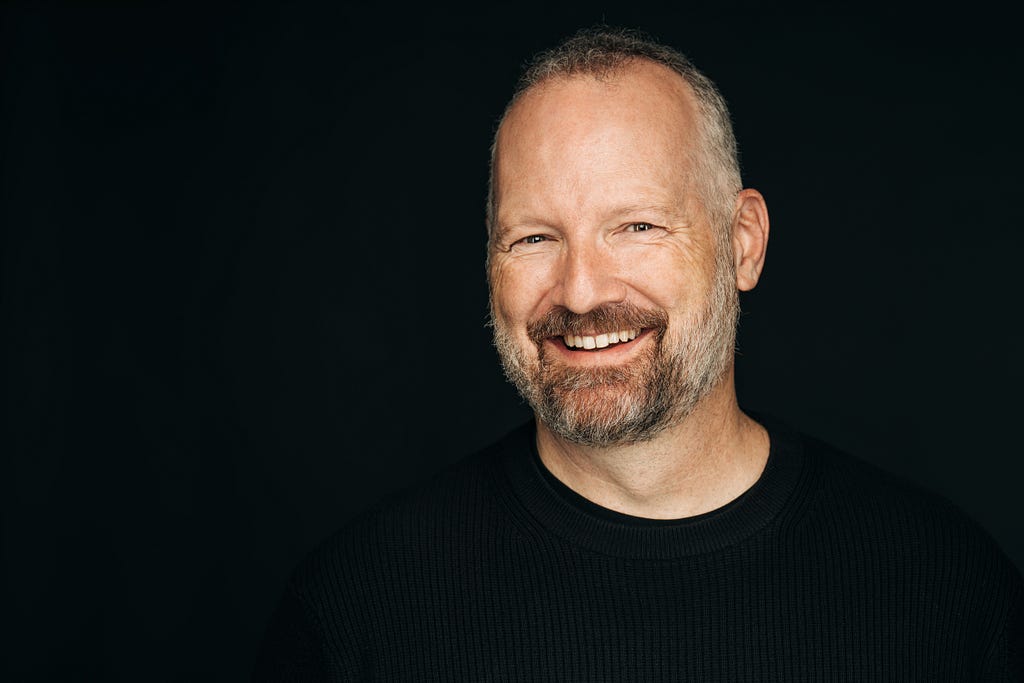
Women In Wellness: Sarah Vie on the Five Lifestyle Tweaks That Will Help Support People’s Journey…

Women In Wellness: Sarah Vie on the Five Lifestyle Tweaks That Will Help Support People’s Journey Towards Better Wellbeing

Connect with nature-breathing in the pureness of outside air can not only feel good in our bodies, but it can also teach us to become one with nature.

As a part of my series about the women in wellness, I had the pleasure of interviewing Sarah Vie.

Sarah Vie is a children’s book author, energy healer, meditation guide and embodiment mentor, who supports her clients to heal their hearts through the power of their infinite truth. Sarah Vie is an expert at clearing out old limiting identities, so that individuals who come to her can live a life of clarity, joy, and abundance. Sarah Vie’s mission is to help adults to heal themselves in order to heal their children.

Can you share with us the backstory about what brought you to your specific career path?

As far back as I can remember, I have always been passionate about the mind and understanding how powerful it can be in our lives. It can be such a positive light or we can be held back by limitations and lies that we tell ourselves.

Can you share the most interesting story that happened to you since you started your career?

There have been so many interesting stories that have shaped me since I started my career. I would have to say that the story that was the pivotal point in my identity, was when I overcame one of my biggest fears. The fear that held me back was speaking in-front of large audiences. I was frozen by the story that I told myself. With loving support and guidance, I over came this fear by “leaning in” and doing it anyway. I spoke in front of one thousand coaches from around the world. What I learned from that was, there is nothing on the other side of fear. Unless of course there is a tiger chasing you. That is real fear!

What advice would you give to other leaders about how to create a fantastic work culture?

I believe it starts with a positive attitude and a willingness to listen to others. A high attention to detail to produce the best product or service is what we get to be committed to.

Is there a particular book that made a significant impact on you? Can you share a story or explain why it resonated with you so much?

The Untethered Soul would be the book that made the most significant impact on me. The author explained about the “mud from others that is thrown onto our clean windshield”. In my coaching, I use this phrase to help my clients understand that the trauma and pain of others doesn’t belong to them.

From your experience or research, how would you define and describe the state of being mindful?

The way I define mindfulness is that it is a state of active and open attention to the present moment.

Can you share with our readers a few of the physical, mental, and emotional benefits of becoming mindful?

Meditation is the practice that teaches us to become mindful. When we are able to slow down and “pay attention”, we experience life in a completely different way. Our bodies are able to energetically connect to our parasympathetic nervous system, which is the rest and relax response, creating a symphony of health benefits. We too are also able to focus and to notice the smallest of joys in life.

From your experience or research what are five steps that each of us can take to develop mindfulness during such uncertain times? Can you please share a story or example for each.

My 5 steps would have to be:

1. Begin a meditation practice-this practice will not only change your life but will save your life allowing you to be more present

2. Practice the simplicity of breath-our breathe is simple yet very powerful.

3. Develop an awareness of your body-our bodies are constantly giving us signals but sometimes we are too busy to notice.

4. Exercise to release tension-good exercise can produce healthy endorphins for daily focus and positivity.

5. Connect with nature-breathing in the pureness of outside air can not only feel good in our bodies, but it can also teach us to become one with nature.

From your experience or research what are five steps that each of us can take to effectively offer support to those around us who are feeling anxious? Can you explain?

If we are healed within ourselves that’s when we can heal others. The 5 steps again would have to be”

Meditation, breath, body awareness, exercise and connecting with nature.

What are the best resources you would suggest for someone to learn how to be more mindful and serene in their everyday life?

The most powerful resource is to find someone who practices meditation. To have someone gently hold your hand when you begin to make a habit in your everyday life. I have helped countless men and women to create their personal practice.

Can you please give us your favorite “Life Lesson Quote”? Do you have a story about how that was relevant in your life?

My favorite quote was “What you think you become.” Who I thought I was was limited and now I think completely different and I have become who I was meant to be.

If you could start a movement that would bring the most amount of good to the most amount of people, what would that be? You never know what your idea can trigger. 🙂

In my new children’s book,” Let your Inner Golden Sparkle Shine”, my movement has begun. Heal ourselves from our pain, so we can heal our children.

What is the best way our readers can follow you online?

Your readers can follow me on my website Sarahvie.com or on Facebook@sarahvandersteur or Facebook@EnlightenedLife group/Instagram@sensuallivingsarahvie


Women In Wellness: Sarah Vie on the Five Lifestyle Tweaks That Will Help Support People’s Journey… was originally published in Authority Magazine on Medium, where people are continuing the conversation by highlighting and responding to this story.

Dr. Jason Loth of Spine Align: 5 Lifestyle Tweaks That Can Dramatically Improve Your Wellbeing

Compliment someone every day. More specifically tell them how grateful you are for something they have done for you. This is great to be done in general but also gets you to start thinking of positive thoughts and loving others.

As a part of my series about “5 Lifestyle Tweaks That Will Dramatically Improve One’s Wellbeing,” I had the pleasure of interviewing Dr. Jason Loth.

Dr. Jason Loth, CCSP, CSCS, CMTA, received his B.S. (Cum Laude) at Midland Lutheran College in Fremont, NE, his Doctorate of Chiropractic (Cum Laude) from Palmer College of Chiropractic in Davenport, IA, and has also received his Certified Chiropractic Sports Physician degree from Logan College of Chiropractic. Dr. Loth understands the absolute importance of sleeping in correct posture. It’s just as important to sleep in correct posture as it is to walk and sit in correct posture. He is a co-founder of SpineAlign, a pillow and mattress company that helps people achieve a healthy, restful and restorative night’s sleep so people will operate at peak performance the following day.

Thank you so much for doing this with us! Our readers would love to “get to know you” a bit better. Can you share with us the story about how you first got involved in fitness and wellness?

It all started in college when I was playing baseball and had an injury. I was fortunate to have a friend on my team whose father was the chiropractor in the town where we played. I went to see him, and he not only helped my injury, but changed my life. I’ve always had a passion to help people and combined with my personal experience, it all led me to where I am today. I feel that I’ve been extremely blessed to be able to use these talents to help thousands of people. Being a sports chiropractor and a certified strength and conditioning specialist, I am able to help patients in many ways to improve their health and well-being.

Can you share the most interesting story that happened to you since you started your career?

The story I would like to share with you is not only interesting, but amazing. It shows the power of Chiropractic care. I was fortunate enough to work with many athletes throughout my career. However, one year I was able to help a professional golfer that had hurt his back when he lifted a mower. There was a major tournament coming up, and he could hardly stand up straight — let alone play golf. I was able to work with him a couple of times and within a week he went on to place in the top 10 in his next PGA tournament. This is only one of many stories of people’s life being changed with Chiropractic care.

Can you share a story with us about the most humorous mistake you made when you were first starting? What lesson or take-away did you learn from that?

During my first year of practice, I was going to adjust a patient. I gave him instructions to lay on his right side and he ended up laying on his left side, and I wasn’t paying attention. I ended up adjusting the patient in the wrong position. Fortunately, nothing bad happened to the patient. I learned two lessons with this. The first thing is that people a lot of times don’t listen very well, and that listening is one of the most important skill sets you can learn. I also learned that paying attention is extremely important, as I obviously didn’t pay close attention when he laid on the wrong side before adjusting him. Both listening and paying attention are important skill sets.

Can you share with our readers a bit about why you are an authority in the fitness and wellness field? In your opinion, what is your unique contribution to the world of wellness?

I believe I’ve been blessed with many skills to help people. So, I would say my uniqueness is that I have the capability to use many tools to better their health and wellness. Some of those tools are Chiropractic Care, strength and conditioning, core and posture stability exercise, muscle flexibility, muscle therapeutic mobilization, and positive mental encouragement just to name a few. All of these elements lead to health, wellness and better performance. I also have been fortunate to play multiple sports, including baseball, at the collegiate level. I’ve also been able to coach at multiple levels and multiple sports to be able to have many experiences with competition successes and failures.

None of us are able to achieve success without some help along the way. Is there a particular person who you are grateful towards who helped get you to where you are? Can you share a story about that?

I was blessed to have a mentor in chiropractic school that taught me a lot of what I know when it comes to taking great care of people on the practical level. He gave me the ability to start my career and I am truly blessed and thank him for that. I believe anyone who truly wants to be successful needs to have a mentor or coach in their life. But more than anything, I’m a follower of Jesus Christ and I would not be where I am today without Him in my life.

Ok thank you for all that. Now let’s move to the main focus of our interview. We all know that it’s important to eat more vegetables, eat less sugar, exercise more, and get better sleep etc. But while we know it intellectually, it’s often difficult to put it into practice and make it a part of our daily habits. In your opinion what are the 3 main blockages that prevent us from taking the information that we all know, and integrating it into our lives?

Good question. The three main blocking points in my opinion are value, priority, and will. Let me explain. Most people don’t see the true value of staying healthy. Usually, lack of health occurs gradually over time and it’s a slow process that many pople fail to recognize until it’s actually too late. Fortunately, in my practice I get to see firsthand many unhealthy people that have waited too long and it’s a great reminder for me personally to see the value of good health. The second reason is making your health a priority. Everybody is extremely busy in this life and they tend to put many things ahead of their health on the priority scale. When this happens, health takes a back seat and when there’s not enough time in the day, the things that they would typically do for their health go by the wayside. The third thing is the will. We are typically weak individuals and when something triggers our mind to have satisfaction, we make poor decisions when it comes to foods that we eat as well as other decisions for the betterment of our health.

Can you please share your “5 Non-Intuitive Lifestyle Tweaks That Will Dramatically Improve One’s Wellbeing”? (Please share a story or an example for each, and feel free to share ideas for mental, emotional and physical health.)

1. Drink at least 75% of your body weight in ounces of water per day

2. Make sure you sleep with correct posture in either the side or back position but never on your stomach.

3. Don’t wear shoes that have a heel higher than the forefoot. This leads to poor biomechanics and stress on your whole body. This includes most tennis shoes as well.

4. Minimize the use of technology. Most phones, tablets and some computers will also put you in poor posture and stress the muscles and joints of your body. Also dealing with the electromagnetic frequencies of these devices can be harmful for long periods and in close proximity.

5. Compliment someone every day. More specifically tell them how grateful you are for something they have done for you. This is great to be done in general but also gets you to start thinking of positive thoughts and loving others.

If I can add a number 6 to this list. Make sure you sleep well with the proper pillow and mattress. It is one of the reasons that I co-founded SpineAlign. SpineAlign’s Luxury Hybrid mattress, along with the SpineAlign pillow, support proper posture for sleep that is not only comfortable, but encourages healing and recovery as well. This one-of-a-kind sleep system was specifically engineered to put your body in its most natural, relaxed position to allow maximum recovery and energy regeneration.

As an expert, this might be obvious to you, but I think it would be instructive to articulate this for the public. Aside from weight loss, what are 3 benefits of daily exercise? Can you explain?

There are actually many benefits from exercise but here are the three most common in my opinion.

1. Motion is lotion, if you don’t use it you lose it. These phrases along with others of the like are so true. Keep moving, keep mobile and keep allowing your body to function. Motion helps to work the muscles and lubricate the joints. Over time if muscles don’t get used, they will wear out. On the flip side, overuse and abuse can also be detrimental as well so exercise on a regular basis moderately.

2. Exercise releases many hormones in the body and also can help you feel better. One of the main hormones it releases is endorphins. These hormones are the feel-good hormones. Some have felt what’s called the runner’s high. When you exercise, you release these endorphins which actually make your body feel good.

3. Exercise helps to improve metabolic function. This means that when you exercise, your heart beats faster and you pump more blood. And as more blood moves throughout your system, it helps to deliver more oxygen and nutrients to the cells while stimulating your body to flush out toxins. These toxins can be released through breathing and sweating during exercise.

For someone who is looking to add exercise to their daily routine, which 3 exercises would you recommend that are absolutely critical?

This is a very difficult question to answer. I don’t think there are three specific exercises that are the best for every individual because everyone is different. What is good for one person may not be good for another. My recommendation for each individual is finding the types of exercises that work the best for you in both how you respond to it and what you enjoy doing. The two things I always recommend when it comes to exercise is cardiovascular effort and performing musculature resistance in the exercise.

Is there a particular book that made a significant impact on you? Can you share a story?

There are a few books that have had a significant impact on me, but I would have to say that the first book was “How to Run Your Business by THE BOOK” by Dave Anderson. The information I learned in this book on how to truly run your business with a moral/ ethical/ people first mentality has been extremely beneficial. One of the things it specifically taught me is how to hire the correct people and that you specifically hire character not skill. You can train skills, but you can’t change a person’s character. The second book that has had a drastic impact on my life is the Bible. The lesson of forgiveness that Jesus offers has had a drastic impact on how I try to live my life and truly forgive others as I have been forgiven by Him.

You are a person of enormous influence. If you could start a movement that would bring the most amount of good to the most amount of people, what would that be? You never know what your idea can trigger. 🙂

I would start a movement called bless one. The concept of this movement would be to love others but specifically and intentionally bless one person each day with something that means something to that person or individual. The goal behind this is to try to think and love others first before ourselves. I would say this is very similar to the Pay It Forward concept.

Can you please give us your favorite “Life Lesson Quote”? Do you have a story about how that was relevant in your life?

Whatever you do, never give up. This I can say has been relevant in many aspects of my life. Some of the best successes in my career in sports, business, and relationships came after much difficulty and perceived failures. Many people don’t get to see some of the successes come to fruition because they give up too soon.

We are very blessed that some of the biggest names in Business, VC funding, Sports, and Entertainment read this column. Is there a person in the world, or in the US whom you would love to have a private breakfast or lunch with, and why? He or she might just see this if we tag them 🙂

Dr. Joseph Mercola. He has been an inspiration to me in his digging deep into research of what true health is. Most people think health comes from being free from symptoms, but he truly understands that True Health is much more than that and has to do with many things you do and don’t do throughout your day. Physically/ Mentally and Chemically. I admire all the information and education he has given to the public that is backed by research.

What is the best way our readers can follow you online?

https://www.spinealign.com/

https://www.facebook.com/spinealignsleep/

https://www.instagram.com/spinealignsleep/

Thank you for these fantastic insights. We wish you only continued success in your great work!


Dr. Jason Loth of Spine Align: 5 Lifestyle Tweaks That Can Dramatically Improve Your Wellbeing was originally published in Authority Magazine on Medium, where people are continuing the conversation by highlighting and responding to this story.
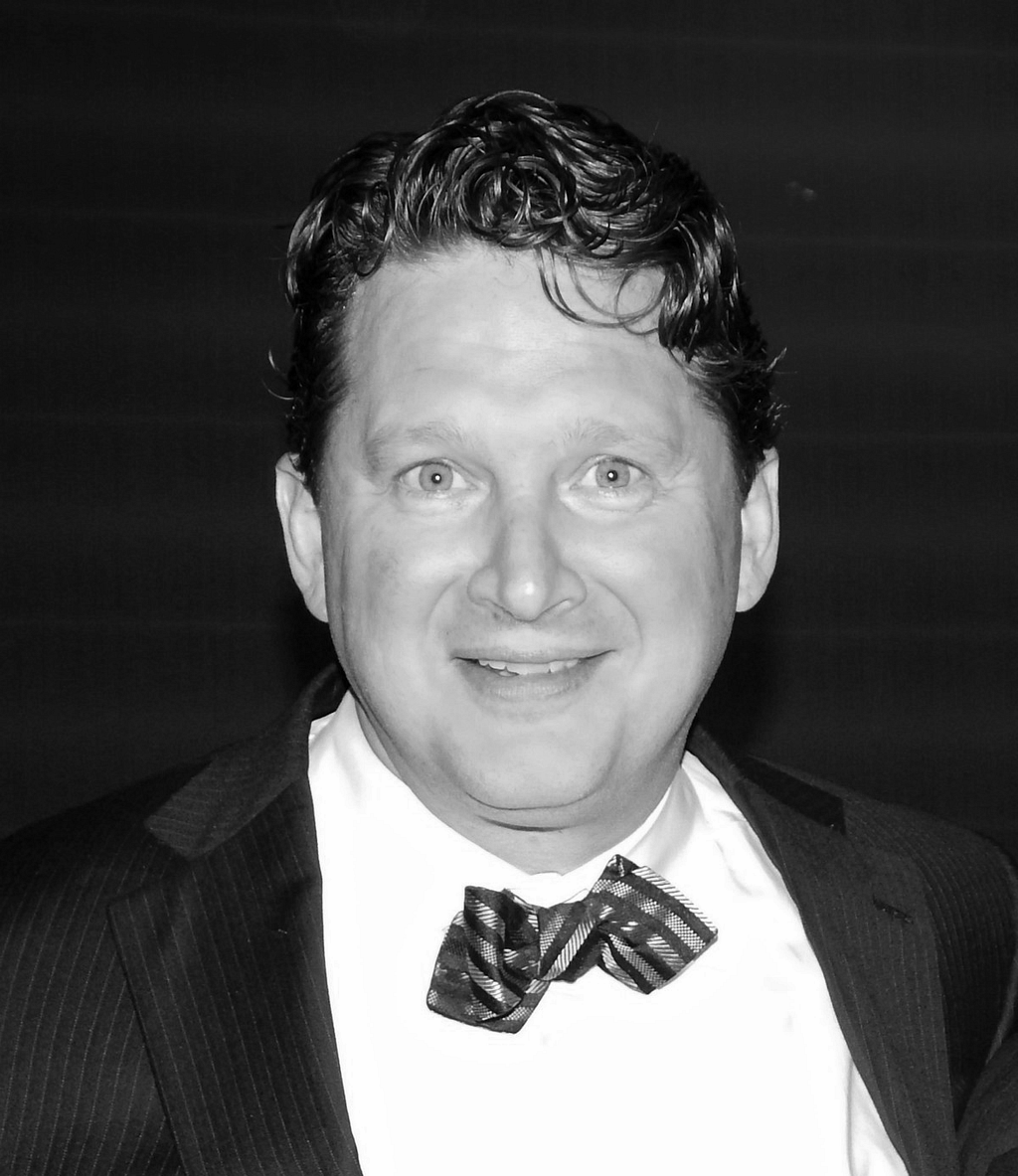
Scott W Milne of Rocky Mountain Efficiency Group: “Why the world will go touchless”

The world will go touchless. Billing systems, front desk activities, bellhop and valet services, dining and public bathroom will all be touchless. There are already enough devices on the market to open doors and stalls, flush, wash, soap and dry, a completely touchless bathroom experience. I explain to a restaurant owner that her bathroom experience might soon seem “icky” when the other restaurants in town install their touchless fixtures.

As part of my series about “developments in the travel industry over the next five years”, I had the pleasure of interviewing Scott Milne.

Scott Milne is the sole owner and operator of Rocky Mountain Efficiency Group, He is the Author of the book Win the War on Covid-19 and the founder of the Elite Room hotel room disinfection and luxury upgrade program. Scott is certified by three of the Nation’s leading authorities of building energy inspection; BPI, RESNET, LEED, as well as being educated by NORMI the premier Air Quality educational organization. Scott serves as; an Facility Efficiency and Air Quality Consultant, successful solar consultant, energy auditor and an energy technologist. He is the editor of the popular “Efficiency Matters” blog, and the founder of the Denver Lodging Engineers Association. Scott is also a skilled public speaker and educator. He has been featured as a key-note speaker in large paid events and has organized free public Conservation Expos.

Thank you so much for joining us! Can you tell us a story about what brought you to this specific career path?

I never imagined that I would be spending my days attempting to create strategy that would save American lives. I guess things have come full circle as I had my first taste of helping people in trouble as a lifeguard on the Ocean City NJ Beach Patrol. After working as a home energy auditor and a home solar consultant I had decided that my skills and effort to reduce global warming impact led me directly to large facilities, specifically those where people sleep. Facilities like hotels, resorts, senior living, apartments and condominiums, consume enormous resources, but must maintain excellent customer services and comfort. My efficiency services and consulting specialty focused on installations that would enhance facility services, and would improve customer experience rather than detract from it. These services include, Window Film, LED Lighting, EV Car Charging Stations, Touchless Fixtures, Advanced thermostats, Refrigeration and Air Conditioning Improvement as well as Air Quality. When Covid-19 broke out my future was pre-determined, I must help individuals and facility operators understand how to manage contagion.

Can you share the most interesting story that happened to you since you started your career?

Years ago, I had received a call from the operator of a retirement community. He explained that the normal seasonal illness was causing County Heath Dept temporary floor restrictions to new residents, and that was costing them unwanted financial losses every year. The community engineer brough in 6 air purifiers with advanced disinfection features. The Problem was solved, forced closures from the Health Dept had stopped and these are the same machines that they are using to protect the facility from contagion today. I am delighted to report that that facility has not had a Covid-19 breakout.

Can you share a story about the funniest mistake you made when you were first starting? Can you tell us what lesson you learned from that?

Years ago, I had been awarded a job to replace the inefficient lighting within the entire the 47 story Sheraton Hotel building, including stairwells. I was determined to do a great job and was flying through the massive corridors clicking away with my palm counter. Then came the 4 stairwells, and no quality lighting consultant would guess at the type and quantity of fixtures within. So there I went, around and around and around, counting clicking and moving as fast as I could. Needless to say, about half way thru my head was spinning as fast as my stomach. That was a broken day.

Which tips would you recommend to your colleagues in your industry to help them to thrive and not “burn out”? Can you share a story about that?

What I find about my industry is that most of the companies will specialize in only one or two facility efficiency strategies. This is how most avoid becoming overwhelmed. I have however decided to specialize in multiple efficiency strategies and products to be able to help facility owners decide between many. It is not easy to research and maintain so many excellent options, but I am determined to be the consultant with full knowledge and a full tool bag. To those entering the industry it will be much easier to focus on a group of conservation remedies such as water conservation, refrigerating efficiency or lighting replacement.

None of us are able to achieve success without some help along the way. Is there a particular person who you are grateful towards who helped get you to where you are? Can you share a story?

Over a decade ago, I was serving as a home energy auditor, helping homeowners understand how save energy by properly sealing and insulating their homes. I wanted more! I knew that the greatest energy waste came from commercial buildings, but I knew they were not insulated like a house and thought that only lighting was the best way for them to save. I then met a man who is my mentor to this day, He introduced me to 4 advanced retrofit technologies for public facilities and the rest was history. It quickly dawned on me that it was not so much insulation that drives huge saving in these buildings but strategy, coupled with advanced retrofit equipment. These retrofit efficiency projects, are able to save so much energy or water in a building that they often pay for themselves with savings within a year. One of these aggressive strategies was about using equipment to generate the natural disinfectant Ozone, which brings higher levels of disinfection in laundry than soap and uses cold water. This is what opened my eyes to molecular destruction of harmful bacteria and virus and Air Quality Control.

Thank you for that. Let’s jump to the core of our discussion. Can you share with our readers about the innovations that you are bringing to the travel and hospitality industries?

Because of the Covid-19 Pandemic, the travel industry has been impacted immensely. Some research shows that the travel industry is down over 50% with hotel usage statistics considerably worse. American Virus fear is understandable, knowing that over 400,000 of our citizens have died and this illness has proven to impair some survivors permanently. Considering this, a hotelier must ask themselves, what (if anything) can make people feel safer in my hotel room than in their own home? This answer might come easily to a contagion expert, but that question has not been considered for 100 years, since the outbreak of the Spanish flu. I believe the answer is, that a hotel could layer advanced disinfection, and then describe with pride and in detail the methods used. My Elite Room Product is offered at the front desk as an option for an extra fee. The Elite Room description card, offed upon guest arrival, will describe the 10-step disinfection and luxury upgrades included in the package.

Which “pain point” are you trying to address by introducing this innovation?

The Elite Room was fully developed patented and completed in 2020, to assure fearful travelers that they can safely stay in a hotel room, that has been completely disinfected from virus. This fear has contributed to a major decline in hotel room usage. Our goal is to increase the protections and luxury amenities available in a hotel room, to ease the concern of infection and increase the enjoyment of the visit. This product however was developed well before the pandemic to reduce or eliminate a major concern that has been made worse by universal internet, Negative Reviews. Upset customers and bad reviews can severely impact the success of any business in a competitive industry, especially hotels. The Elite Room is sold to a hotel in a 10 or 20 room block. When properly offered at the front desk the room upgrade can serve as a customer service giveaway or a sincere apology for any lack of service. No reasonable guest could maintain a complaint after a room upgrade is offered.

How do you envision that this might disrupt the status quo?

Most hotels throughout the country have done an excellent job providing a clean, comfortable environment at a reasonable cost. However, because of the pandemic and a new fear of contagion hoteliers are finding that they must step up their game. Clean and comfortable are no longer nearly enough as guests are now learning about the risk, understanding disinfection, and seeking out resorts that somehow make them feel safer. This is what was considered in the development of the Elite Room. It provides for a fully disinfected, and a near hypoallergenic hotel room. It features ozone treatment, and a fogged botanical leave-on disinfectant between guests, as well as room air purifiers featuring negative ionization and UV sanitation. It also includes hypoallergenic insect protection bedding encasements and a hydrotherapy shower head that neutralizes chlorine and adds essential oils with a delightful scent. The upgrade includes specialized relaxing LED lighting with a dawn simulation alarm clock, along with a sealed amenity pack that includes naturally-based quality cosmetics, PPE-like gloves, personal hand sanitizer, k-95 masks, and a branded, satin sleep mask. For additional assurance, the package comes with a front desk UV sanitation lamp, as well as Elite Room door seals designed to be broken upon entry.

Once in place the program will ease the nerves of fearful guests, attract new guests looking for Elite Room protections and will ultimately be paid for by the guests that use it.

As you know, COVID19 changed the world as we know it. Can you share 5 examples of how travel and hospitality companies will be adjusting over the next five years to the new ways that consumers will prefer to travel?

I believe that you will see multiple changes within public facilities to decrease contagion risk. Hospitality, senior living and Cruse travel have been severely impacted by fear, which will not be easy to erase. I believe that as the population re-emerges many will make important choices based on personal safety. The following are highly visible suggestions will prevent the spread of contagion, and could or should be shared and marketed to perspective customers.

  1. Entry systems are fun low impact approach to facility protection and customer reassurance. Affordable devices hung by the front door to any building can take temperature from the palm, give a touchless squirt of sanitizer and verbally greet the guest. A more complex digital face-pad system can deliver temperature, recognize identity, confirm mask, control the door, communicate to the front desk and provide security.
  2. The world will go touchless. Billing systems, front desk activities, bellhop and valet services, dining and public bathroom will all be touchless. There are already enough devices on the market to open doors and stalls, flush, wash, soap and dry, a completely touchless bathroom experience. I explain to a restaurant owner that her bathroom experience might soon seem “icky” when the other restaurants in town install their touchless fixtures.
  3. Hotel owner operators must quickly understand and embrace advanced molecular disinfection strategy. These methods can bring protection to lobby’s, indoor dinning, meeting rooms, health clubs, pools, spas and locker rooms. These methods include UV-C light, negative ionization, photocatalytic oxidation (PCO) and Ozone. These strategies are affordable and are effective when used at the right times and in the proper combinations through out the facility.
  4. Facility design and traffic control. Some covid-19 protocol will become more permanent like plastic dividers and hand sanitizer stations everywhere. Designers and architects, are now also understanding the importance of social distancing and attempting to direct pedestrian traffic in a safer way. I use an example of extreme window modification in a restaurant in a way to dogmatically impact exterior ventilation, and to attract guests back to a newer, safer, indoor outdoor setting.
  5. Cleanliness Theatre: To impress concerned customers, hotels are beginning to use housekeeping differently. Rooms are no longer disturbed if the guest stay is longer than one night. Instead the housekeeping staff is being used to clean public areas visibly in front of guests.

You are a “travel insider”. How would you describe your “perfect vacation experience”?

I mostly enjoy traveling by plane to tropical destinations with a beautiful beach and a rich history.

For this reason, I have become a Mexican Resident Alien and do work with the resorts in the Yucatan Peninsula. Since the outbreak I have been enjoying motorcycling through the Rocky Mountains and surrounding states searching for the worlds best camping, hot springs, waterfalls and mountain lakes.

Can you share with our readers how have you used your success to bring goodness to the world?

I am not sure that I purposely selected an industry that can help our planet and those that occupy it. I truly believe however that efficiency for our commercial facilities will go a long way to reduce the heat trapping emissions that lead to global warming. I feel that I owe it to others, my beautiful kids and our wonderful planet to do my part. Now we have a novel murderous pandemic ripping thru the American population, and very few seem to understand the mechanical means by which to kill it. So, I have written my book and emersed myself in everything related to public facility contagion control and facility defense.

You are a person of great influence. If you could start a movement that would bring the most amount of good to the most amount of people, what would that be? You never know what your idea can trigger. 🙂

There is currently no US association that I know of to advance the research and development and public awareness of advanced molecular disinfection. Specifically, the amazing naturally sanitizing and easy to make Ozone O3, and Photocatalytic Oxidation (PCO) which creates the unnoticeable molecular element H2O2. (hydrogen peroxide).

How can our readers follow you on social media?

www.VirusDEpot.com

www.Elite-Room.com

www.Linkedin.com/in/RMEfficiency

This was very inspiring. Thank you so much for joining us!


Scott W Milne of Rocky Mountain Efficiency Group: “Why the world will go touchless” was originally published in Authority Magazine on Medium, where people are continuing the conversation by highlighting and responding to this story.

Women In Wellness: Fahti Khosrow on the Five Lifestyle Tweaks That Will Help Support People’s…

Women In Wellness: Fahti Khosrowshah of Ceek Women’s Health on the Five Lifestyle Tweaks That Will Help Support People’s Journey Towards Better Wellbeing

For me mental health is really important. I feel we live in a society where one way or another we suppress mental health and it impacts all of us at one point or another in our lifetime. I’ve gone through certain periods of my life especially after I had my 2nd daughter that I was extremely anxious. I also think finding good support when we need it is not easily available and accessible

As a part of my series about the women in wellness, I had the pleasure of interviewing Fahti Khosrowshah.

Fahti Khosrowshah is the CEO of Ceek Women’s Health focused on developing products that make the gynecological exam easier for patients. Before that, she worked for 15-years as a management consultant in the Life Sciences working across companies and disease states. She is the mom or 2 girls and lives in Portland, Oregon.

Thank you so much for joining us in this interview series! Our readers would love to “get to know you” better. Can you share your “backstory” with us?

Fahti is an Iranian American who came to the US to attend university. After getting her graduate degree, she started doing management consulting and loved it. She was working on challenging projects across different disease states and with different companies. However, after getting married and going through 3-years of infertility she became extremely passionate about women’s health. Realizing the inadequacies in the care women receive, she resigned from her job and started Ceek to first update the vaginal speculum and then introduce other innovative products that make the pelvic exam easier and more comfortable for women.

Can you share the most interesting story that happened to you since you started your career? What were the main lessons or takeaways from that story?

About 3-years ago when we were very early in our R&D stage, I bought a copy of Time and gave it to my Chief Design Officer. I told her that I wanted our products to be in TIME as part of their annual innovation recognition. In December of 2020, we were featured in TIME as one of the best innovations of the year. The takeaway is to set your goals high and work towards it. As a little girl who was born in Iran amidst the Iranian revolution, I never ever thought that one day I would develop a women’s health product that would be featured in TIME.

Can you share a story about the biggest mistake you made when you were first starting? Can you tell us what lesson you learned from that?

When I first started my work, I was eager, super excited to learn, and super excited to please. However, in my eagerness to learn and to please, I also allowed others to treat me like a doormat. It took me a few years to learn my lesson and pull myself out of it.

None of us are able to achieve success without some help along the way. Is there a particular person who you are grateful towards who helped get you to where you are? Can you share a story about that?

However, after going through 3-years of infertility she became extremely passionate about women’s health. Realizing the inadequacies in the care women receive, she resigned from her job and started Ceek to bring innovative medical devices to frontline gynecological care.

People now based on a host of factors but the most important one for me is if I like them and if I can work with them.

Ok perfect. Now let’s jump to our main focus. When it comes to health and wellness, how is the work you are doing helping to make a bigger impact in the world?

At Ceek Women’s Health we’ve developed a new vaginal speculum that is more comfortable for women and is easier to use by providers. Our Nella Nuspec is design to replace the existing metal speculum that was designed over 150-years ago. Most women have some level of anxiety before getting a pelvic exam and some women also suffer physically including having soreness after the exam, bleeding, and difficulty walking or sitting. Our device is designed to make the exam easier for women across all life stages and body types.

Can you share your top five “lifestyle tweaks” that you believe will help support people’s journey towards better wellbeing? Please give an example or story for each.

  1. I try to have balance between work and taking care of my family. It’s not always easy but it is important to me. If either is not going well, it impacts me.
  2. I try to go for a walk, exercise, or just get fresh air every day. It has a huge impact on me.
  3. I always make the time to speak to someone close to me every day — for me it’s either my husband, a friend, my mom or my sister. A 15-minute heart-to-heart puts my head back where it needs to be
  4. I drink plenty of water every day. I actually don’t like water but if I don’t drink it, I feel yucky. So I do it.
  5. I get dressed and put some minimal make-up on every day. It puts me in the right mood to start the day

If you could start a movement that would bring the most amount of wellness to the most amount of people, what would that be?

  • Drink water and go for a walk — every day

What are your “5 Things I Wish Someone Told Me before I Started” and why?

  • Be happy with who you are, really accept yourself both physically and intellectually
  • Being shy or an introvert is a strength (not a weakness)
  • Being different is okay and sometimes even cool
  • Don’t be passive-aggressive and don’t surround yourself with passive-aggressive people

Sustainability, veganism, mental health and environmental changes are big topics at the moment. Which one of these causes is dearest to you, and why?

For me mental health is really important. I feel we live in a society where one way or another we suppress mental health and it impacts all of us at one point or another in our lifetime. I’ve gone through certain periods of my life especially after I had my 2nd daughter that I was extremely anxious. I also think finding good support when we need it is not easily available and accessible

What is the best way our readers can follow you on social media?

https://www.instagram.com/ceekwomenshealth/

https://www.linkedin.com/in/fahti-khosrowshahi-5223265/

Thank you for these fantastic insights. We wish you only continued success in your great work!


Women In Wellness: Fahti Khosrow on the Five Lifestyle Tweaks That Will Help Support People’s… was originally published in Authority Magazine on Medium, where people are continuing the conversation by highlighting and responding to this story.
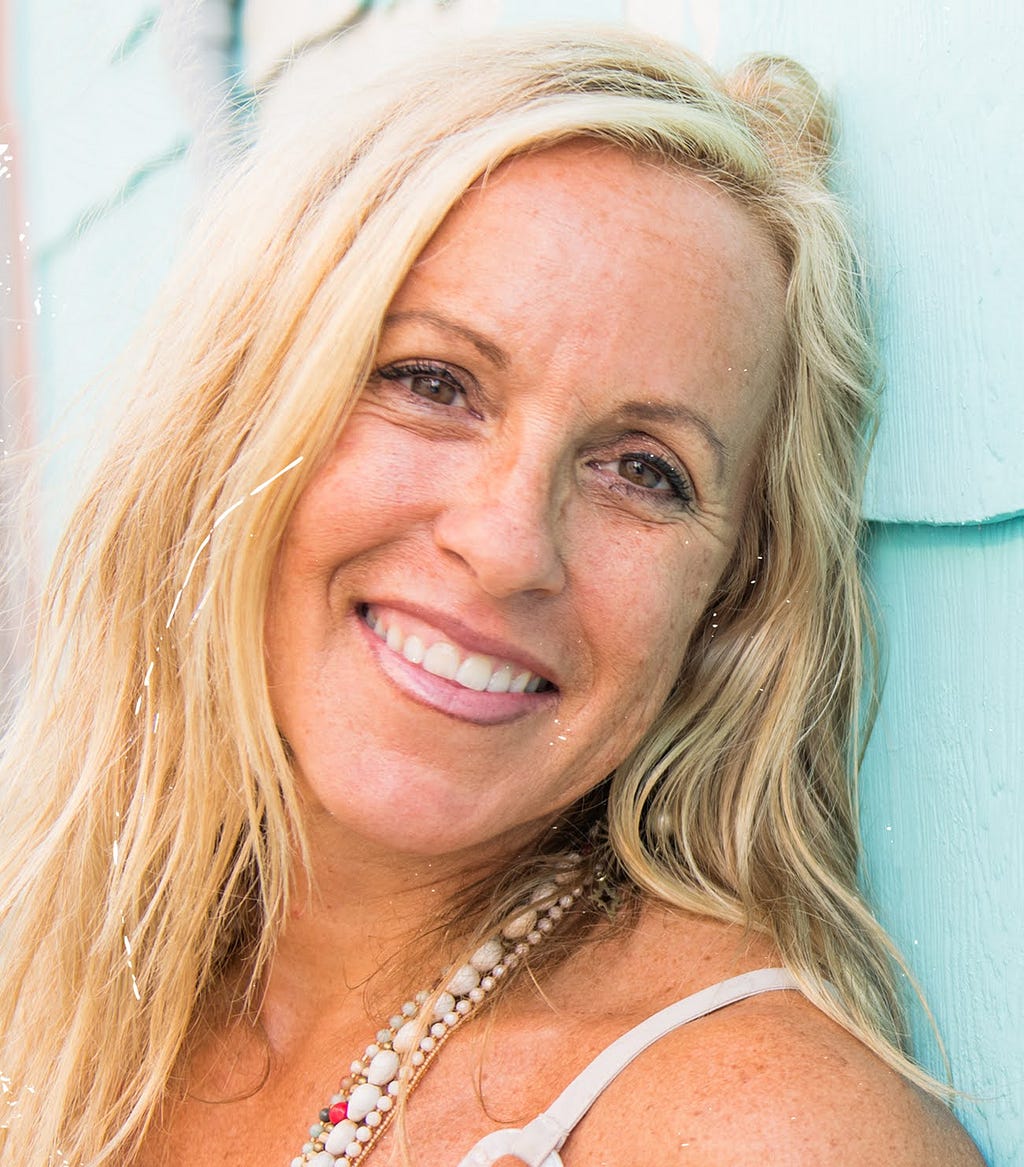
Sasha Jackson: 5 Things Anyone Can Do To Optimize Their Mental Wellness

Create an authentic inner narrative. If you experienced negative, toxic, and demeaning relationships in the past you may be carrying around the words of your perpetrator. Identify if you are using the hurtful words of your past as a map to your future self.

As a part of my series about the “5 Things Anyone Can Do To Optimize Their Mental Wellness”, I had the pleasure of interviewing Sasha Jackson, MSW, LCSW

Sasha Jackson, LCSW, is a licensed therapist and author who specializes in helping individuals build empowerment. She is a graduate of the University of Southern California with a Master of Social Work degree. In her practice, she has helped individuals work through trauma, depression, anxiety, and relationship issues.

Thank you so much for doing this with us! Our readers would love to “get to know you” a bit better. Can you share with us the backstory about what brought you to your specific career path?

It was 2014, and I was sitting in my living room. I had just bought my house, and I was seeking the next step in my life. I didn’t know exactly what that would be, but I did know that I needed to go back to my purpose. That purpose was to help people. During this time, I felt that I had learned so much. I needed to get into a field that I could share my knowledge with others. Also, I wanted to be in a profession that supported me as I continuously evolved in my own journey. I decided that I wanted to become a licensed therapist. How was the next question? My search led me to numerous Google results and Indeed job descriptions that took me to the career of Social Work. When I found my calling, I initially knew it was a good fit, while at the same time I was baffled it had not come to me sooner. However, I am a firm believer that things present themselves when it is time. I enrolled at USC in 2015 spring semester and started my journey to become a therapist. That day in 2014 has led me into a beautiful profession and purpose that has changed my life forever. I believe that we all know what we need to be happy. I encourage everyone to follow the voice that urges them to do something different. Most importantly, to trust your intuition when you are being guided to new phases.

Can you share the most interesting story that happened to you since you started your career?

Working in mental health and working with people in general you experience a lot of interesting things. I can say that this is one of the benefits of what I do, and there is never a dull moment. An interesting phenomenon that I have seen is how the mental health industry adapted to the needs during COVID-19. In the current environment of isolation, social restrictions, and new norms the need for mental wellness has grown more prevalent in the public eye. When I thought about my first practice, I was set on getting an office and trying to map out the perfect location. Now, my office is virtual, and I can reach out too many more people. In the career of mental health, you must be flexible. It is interesting to see how we continue to evolve and express that flexibility during this time.

Can you share a story with us about the most humorous mistake you made when you were first starting? What lesson or take-away did you learn from that?

Humor is part of life that allows us to grow from mistakes. When you can find humor in your journey, then you can find spaces of growth and understanding. A mistake I made when I first started my career was during one of my interview processes. I was so excited and nervous that I forgot the foundational components of a mental status exam. The mental status exam is a set of characteristics mental health professionals look for to evaluate a client. It is basically like knowing what a wrench is to a mechanic. Embarrassment was an understatement. I was mortified that I could not remember a simple component of my profession. The next day I got a call back for my second interview. I was stunned because I thought I completely bombed my chance. I learned that mistakes are not as detrimental as we assume. More importantly, the experience taught me to not be so hard on myself. Everyone has experienced that one interview they wish they could rewind. Remember that every experience allows you a chance to learn, evolve, and grow. As I look back at my own experience, I laugh. I laugh because I don’t ever want to doubt myself that much again, even if I make a mistake.

None of us are able to achieve success without some help along the way. Is there a particular person who you are grateful towards who helped get you to where you are? Can you share a story about that?

Many people have helped me on my journey to become a professional therapist. However, three individuals stick out. My previous internship supervisor and clinical director, Dani Marchman LCSW. My previous deputy director of San Joaquin county, Genevieve Valentine LMFT. Lastly, my current deputy director of San Joaquin County, Tiffany Dewitte LCSW. These three powerful women supported, guided, encouraged, and believed in me throughout my entire journey. I appreciate that I could grow and trust myself through each stage of my profession. They have truly taught me how to be a therapist also, what it means to be a leader in this industry. Overall, I can say that their help has been a tremendous influence on my development and drive.

What advice would you suggest to your colleagues in your industry to thrive and avoid burnout?

Burnout can happen within any profession and, it is vital to find ways to protect yourself from the impact. You can tell if you are suffering from burnout if you have chronic stress at your job, increased exhaustion, find yourself less motivated, and experience feelings of helplessness in your ability to have a positive impact. To help prevent this from happening you must first, check-in with yourself. Be honest about how you are feeling about your job. If you think about your job and it emotionally triggers you ( frustration, sadness, resentment, anger, nervousness, or irritability) this is a sign that you may be experiencing burnout. If these feelings do surface take time to journal about it, find a creative outlet to express your feelings, talk to a support person, create better time management around your job, and implement self-care routines in your life. The second tip to buffering the effects of your job is to practice radical acceptance. Radical acceptance is the practice of understanding what you have control over and what you do not. It does not mean you are helpless instead; it provides a pathway to what you can fix versus what may be in someone else’s control. An example: is knowing that you can turn in your assignments and work on your project. However, it may be the manager’s duty to get everyone else to do their projects. Sometimes not taking responsibility for everything can make you feel less stressed and hopeful about what you can do personally.

What advice would you give to other leaders about how to create a fantastic work culture?

A powerful way a leader can transform their work culture is to cultivate intrinsic motivation within employees. Intrinsic motivation is defined as the act of doing something without an external motivator ( such as money, status, or rewards). An individual can genuinely enjoy performing an activity/job duty because it makes them feel good, gives them a sense of purpose, boosts their self-esteem, and adds to what they consider a valuable characteristic. The benefit of helping individuals create intrinsic motivation is that they can take pride and ownership in the outcome of their work. Which in turn, benefits the entire company, clients, and community. A way a leader can help promote intrinsic motivation is to 1) see how the company mission resonates with the employee on a personal level; 2) explore and identify the employee’s strengths; 3) find out what motivates the employee; 4) lastly, create a way that the employee can highlight the following identified areas within their work duties.

Ok thank you for all that. Now let’s move to the main focus of our interview. Mental health is often looked at in binary terms; those who are healthy and those who have mental illness. The truth, however, is that mental wellness is a huge spectrum. Even those who are “mentally healthy” can still improve their mental wellness. From your experience or research, what are five steps that each of us can take to improve or optimize our mental wellness. Can you please share a story or example for each.

Here are five steps that anyone can use on their journey to create mental wellness. 1) Is to recognize when you are self-rejecting. Self-rejection comes from doubt about your ability to be successful or your right to happiness. When you self-reject you limit your ability to engage in activities or thoughts that make you feel good about yourself. 2) Start to reframe the process of change as an opportunity versus a threat. When you view change as a threat you tend to stagnate yourself and limit yourself from accessing different opportunities. Learn to see the unknown as a chance to grow and expand. 3) Begin to make choices in your life. You can begin to feel powerless when you allow others to make choices for you or you opt-out of making choices. It’s important to take accountability in your life and be an active participant in your life journey. 4) Start challenging the notion of learned helplessness. Learned helplessness is created from a history of invalidation, rejection, and limitations. It limits you from taking risks and makes you question if you are going to be successful. Learn how to trust yourself and have faith that you will reach your goals. Lastly, 5) Create an authentic inner narrative. If you experienced negative, toxic, and demeaning relationships in the past you may be carrying around the words of your perpetrator. Identify if you are using the hurtful words of your past as a map to your future self. These five steps will allow you to take control of your life and live confidently.

Much of my expertise focuses on helping people to plan for after retirement. Retirement is a dramatic ‘life course transition’ that can impact one’s health. In addition to the ideas you mentioned earlier, are there things that one should do to optimize mental wellness after retirement? Please share a story or an example for each.

Retirement is a life transition. The key to managing a new life transition is to be ready for the change of identity roles. An identity role can be a parent, a spouse, or a job position/title. They all have significant meaning to a person’s life. When a person transitions into a new identity role there is a grieving process that occurs while they learn to accept their new identity. Since most retirements are planned an individual can make this process easier by doing the following: 1) exploring the change the new identity role will have on the person’s current lifestyle, 2) finding ways to incorporate old identity roles into the retired life role, and 3) being flexible with the natural grieving process that comes along with changing roles. By doing the following a person can visualize their new life, feel more comfortable about the changes, and feel more in control of the outcome.

How about teens and pre teens. Are there any specific new ideas you would suggest for teens and pre teens to optimize their mental wellness?

The era of teenagers and pre-teens is all about peer validation and identity formation. A key to creating mental wellness is to have a healthy balance between these two important influences. To help you create balance during this time, you should first identify your values and beliefs. Write down what is important to you and what makes you unique. Find ways to celebrate these aspects of yourself and share them with people. The next step is to see how these values and beliefs resonate with your peer group. We tend to hang out with people who have similar interests to us. It is necessary to identify these aspects to help you search if your current peer group is helpful or harmful. If you find that your personal values collide with your current peer group. You can always find more ways that you can be authentic with them or how you can create another supportive peer group. Remember that communication and boundaries are important skills to use during this time as you find yourself and cultivate friendships.

Is there a particular book that made a significant impact on you? Can you share a story?

A particular book that has helped me is Influence: The Psychology of Persuasion by Robert B. Cialdini, PH.D. I have learned about the dynamics of human nature, why we continue to repeat the same mistakes, and how to break the cycle. There are many important elements in this book. One that stands out to me is the impact of consistency. We are creatures of habit. This can be a good thing but a barrier in breaking out of toxic thinking and situations. Consistency ties us to behavior and people that we should leave. However, the notion of the time we put into a situation, and the hope that our consistency will change the outcome tethers us to our commitment. You can become aware of this silent bond, and then you can make a conscious choice to do something different. One of the biggest things we can do that makes us feel powerful is to make a choice.

You are a person of great influence. If you could start a movement that would bring the most amount of good to the most amount of people, what would that be? You never know what your idea can trigger. 🙂

I would like to see a TV network/channel dedicated to mental health. Really! I see that there are talk shows that discuss mental health, youtube channels, tik-toks, and podcasts. But I would like all these great platforms to be in one dedicated place. It will make information accessible to all as well as continue to help normalize the need for mental health. I also believe that this will transform the need for mental health on a global level.

Can you please give us your favorite “Life Lesson Quote”? Do you have a story about how that was relevant in your life?

One of my favorite life lesson quotes is by Steve Jobs. He states, “Your time is limited, so don’t waste it living someone else’s life.” Being authentic and true to your self is sometimes a difficult journey. This quote reminds of the importance of showing up as yourself and for yourself. As a therapist I see how many of my clients sacrifice their life, happiness, and chances at success because they are afraid to live for themselves. That is why my goal is to help people become empowered by taking ownership and responsibility of their life. Once you are able to do this then you can truly live free and at peace.

What is the best way our readers can follow you on social media?

Please follow me on IG: @I_Am_SashaJackson, on FB: @SashaJacksonTherapy, and on Linkedin: Sasha-Jackson-MSW-LCSW. I appreciate everyone’s support and I look forward to continuing to build my community.

Thank you for these fantastic insights. We wish you only continued success in your great work!


Sasha Jackson: 5 Things Anyone Can Do To Optimize Their Mental Wellness was originally published in Authority Magazine on Medium, where people are continuing the conversation by highlighting and responding to this story.