
Female Founders: Katy Thorbahn of Shiny On The Five Things You Need To Thrive and Succeed as a Woman Founder
An Interview With Candice Georgiadis
Enjoy the ride. There will always be something nagging at you and you’ll always want to do more, faster. But don’t let that stop you from pausing now and again to appreciate all that you’ve accomplished and take stock in the good.
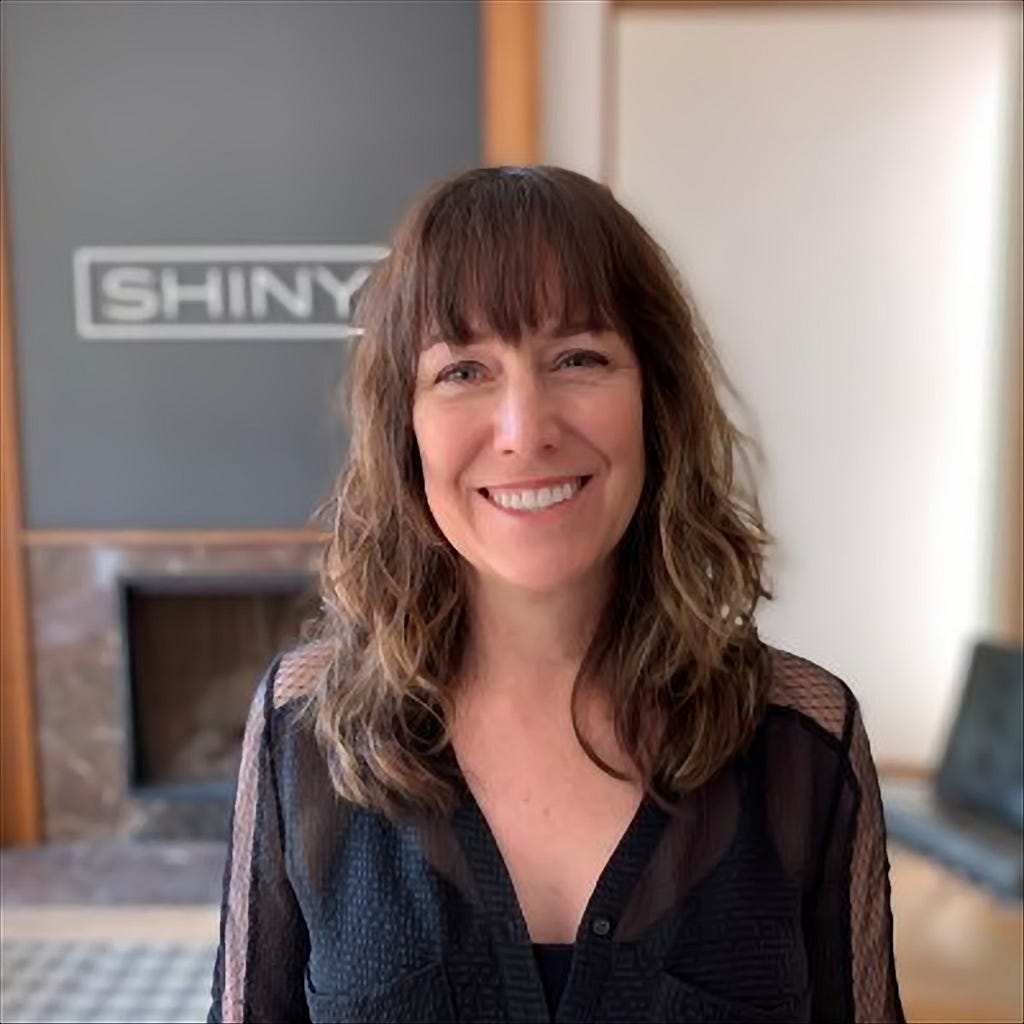
As a part of our series about “Why We Need More Women Founders”, I had the pleasure of interviewing Katy Thorbahn — Partner, Managing Director, Shiny.
Katy is a dynamic and inspiring leader who has spent over 30 years serving as a trusted advisor for some of the world’s most respected brands.
Her big agency experience at reputable firms like Razorfish paired with co-founding strategic creative agency, Shiny, allows her to forecast on-trend branding and execute best-in-class directions for her teams and clients.
Katy’s strategic thinking and game-changing results have garnered her recognition as a Woman of Distinction in the Philadelphia Business Journal, Best Executive in the Services Business for the Stevie Awards, and several honors with the Addys and Dead Work Awards.
Over the course of her career, she has created award-winning campaigns recognized for their effectiveness. She has led work for brands like JPMorgan Chase, Lutron Electronics, Johnson & Johnson, Pfizer, and Rite-Aid, to name a few. Katy continues to drive transformative growth in the industry through her passion for empowering women.
Thank you so much for doing this with us! Before we dig in, our readers would like to get to know you a bit more. Can you tell us a bit about your “backstory”? What led you to this particular career path?
Thank you for having me. The short story is that I grew up surrounded by advertising. My father owned an outdoor advertising company, my older sister started her career at an agency, and my uncle directed commercials. By the time I graduated high school I knew it was what I wanted to do, though I thought I’d be a copywriter. Literally one day at my first internship in college disabused me of that idea, and luckily I quickly found client services was the fit for me. And the rest just went from there.
Can you share the most interesting story that happened to you since you began leading your company?
One that springs to mind has to do with our name. My agency’s name is Shiny, and an unintended but beloved result of that is that our clients often say “oh hi Shiny people” or “we get to work with the Shiny people” and so our name becomes a descriptor of our team. It always makes me smile when I hear it, and I know it does the same for everyone on our team.
Can you share a story about the funniest mistake you made when you were first starting? Can you tell us what lesson you learned from that?
One funny, and highly instructional story, comes from my second job. For context, one of my terrible faults is that I cannot remember people’s names — it’s a real flaw of mine. So I’m working one day and out of the blue a client calls to introduce me to someone on her team who was going to be covering for her during a vacation. We do a quick set of introductions and I scribble down the new contact’s first name, and totally miss her last name, which I don’t realize until after I hang up and need to send her something. Panic sets in, amplified by the knowledge that I’m just the worst at names, and so I concoct an approach that I think will cleverly cover up that fact. I called her back, asking if she could spell her last name. There was a pause and then she said, “You need me to spell Smith?” and I had some ridiculous comeback like “Yes, is that with a Y?” It was horrible — so incredibly cringeworthy. But it was a great lesson about not ever trying to be untruthful or sneaky or whatever word you want to use. It always backfires.
None of us are able to achieve success without some help along the way. Is there a particular person who you are grateful towards who helped get you to where you are? Can you share a story about that?
That is so true. And there are many, many people who have been helpful to me along the way but if I had to choose just one it would be Brad Aronson. Brad was the founder of i-FRONTIER, one of the first digital agencies in the US. He saw something in me and brought me on to lead Client Services and then pushed me into an Operations role a couple of years later. I did not think I had it in me to do that job and told him so. He listened to me, let me decline, but kept coming back to it, reassuring me that I could indeed do it. I eventually agreed to try and he was right — it was a very good fit for me and helped propel my career. I’m eternally grateful that he saw something in me that I did not, and didn’t take no for an answer.
Ok, thank you for that. Let’s now jump to the primary focus of our interview. According to this EY report, only about 20 percent of funded companies have women founders. This reflects great historical progress, but it also shows that more work still has to be done to empower women to create companies. In your opinion and experience what is currently holding back women from founding companies?
The fact that 20% is great progress underscores what a significant challenge it is for women to become founders. In my opinion, there are a host of external factors at play. The first is that it is simply harder for women to be taken seriously by VCs and other financial institutions so getting seed money to launch a business is not nearly as easy for women as it is for men. So if you want to do something, you often need to self-fund it (as I did) which is simply not an available option for many, many women. And then there are other very big issues like she may have children to care for, or aging parents to support. The ability to do something entrepreneurial that involves financial risk and an enormous amount of time and focus may be impossible without an extremely strong support system which, again, a lot of women simply do not have. Because those issues reduce the number of women founders, it also creates this terrible ecosystem where there are fewer role models. It creates this false narrative that it’s not possible to do. It’s a vicious cycle that is really challenging to break.
Can you help articulate a few things that can be done as individuals, as a society, or by the government, to help overcome those obstacles?
Individuals who are founders or who support them need to act as mentors and sounding boards for people who are considering taking the leap. VCs and other financial institutions need to take real, concrete, and focused steps on eliminating their ingrained biases against women and other groups like people of color. The government, at the federal and local levels, needs to offer financial incentives to increase the number of women starting their own businesses. As a nation, we need a more stable and affordable solution for childcare. And efforts like those that Authority is doing help a lot, by shedding light on what it takes to be a founder to help demystify it for people who are curious.
This might be intuitive to you as a woman founder but I think it will be helpful to spell this out. Can you share a few reasons why more women should become founders?
First and foremost, society benefits when more people are in roles of job creation and innovation. So from a purely mercenary standpoint, it’s better for all of us if females, who make up over half of the US population, are creating businesses to drive our economy. On a more human level, women should become founders because for the right person, being your own boss and having more direct control over your future is what ultimately will give them financial success and personal satisfaction.
What are the “myths” that you would like to dispel about being a founder? Can you explain what you mean?
That you need to be somehow outrageously smart, have an enormous ego, be a raging extrovert, and be ready to do whatever it takes, even if that means mowing people down in the process. There’s just way too much focus on people who fit that bill which then gives the idea that that’s the only path. Successful founders can come from many different walks of life, with many different personalities.
Is everyone cut out to be a founder? In your opinion, which specific traits increase the likelihood that a person will be a successful founder and what type of person should perhaps seek a “regular job” as an employee? Can you explain what you mean?
I don’t think everyone is cut out to be a founder, because there is no single career or job that is the right choice for every person on this planet. To start your own company requires a level of hubris, entrepreneurial spirit, and a strong stomach that not all people have. That said, I bristle a bit at the notion that working for someone is a “regular job” implying that being a founder is somehow more important or special. I don’t think that’s the case; it’s just that for some people taking the risk of creating your own business makes sense, and for many people, it doesn’t.
Ok super. Here is the main question of our interview. What are your “5 Things I Wish Someone Told Me Before I Started” and why? (Please share a story or example for each.)
Only five? I’m sure there are many more but here goes:
- There’s more below the surface than you realize. There is a huge amount of running a business that has absolutely nothing to do with the business you think you’re in. Things like figuring out insurance, stocking the kitchen, dealing with legal documents…the list goes on. It’s all stuff that needs to be done, but it’s not why you started the business. Prepare thyself.
- You will be wrong more often than you think. And that’s okay, but you have to be prepared to zig when you planned to zag, or ask for help to untangle an issue you find yourself snagged in. The secret is not to make the same error twice, so make the decision, deal with the fallout, and take it all as a critical learning opportunity for the future.
- Never underestimate the power of a single person. They can make or break you. Hire the right person, and the business becomes so much easier. Hire the wrong person and there’s a pain you cannot even begin to fathom.
- Hire a great accountant who understands your business. They’ll save you time, money, and heartache.
- Enjoy the ride. There will always be something nagging at you and you’ll always want to do more, faster. But don’t let that stop you from pausing now and again to appreciate all that you’ve accomplished and take stock in the good.
How have you used your success to make the world a better place?
I’d like to believe I’ve had a tangible impact on my team’s lives through giving them interesting work, a financially rewarding job, and a great culture and colleagues. Beyond that, I’ve tried to share my experience and offer my support, particularly to women in advertising and marketing, as a way to both open more professional doors for them and act as a sounding board for those moments when they need another perspective. I would be happy if my work legacy were as much about helping other women achieve their success as it would be for me to reach my full potential.
You are a person of great influence. If you could inspire a movement that would bring the most amount of good for the greatest number of people, what would that be? You never know what your idea can trigger.
What an interesting question. Lately, I’ve been thinking a lot about the notion of people’s worth and how so much of our culture and systems have been created to hinder what individuals can accomplish because they aren’t deemed “worthy.” We’ve touched on that in this interview about women and how we’ve been marginalized as one example, and the other that has been very in the forefront for me of late is the same for people of color. It is infuriating how much effort has been made to keep people down, when all of us would be so much better off if we found ways to hold each other up and let people fly. I would love to find a way to really dismantle the structures that were purposefully created to limit opportunity and growth and instead, work to build the scaffold that people could scale to reach their full potential.
We are very blessed that some very prominent names in Business, VC funding, Sports, and Entertainment read this column. Is there a person in the world, or in the US with whom you would love to have a private breakfast or lunch with, and why? He or she might just see this if we tag them.
Without hesitation, it would be Sara Blakely. Not only has she created a product that I love, but she also created an entire category and did it her way, bucking the system. As a mother, I am deeply moved by how she has put her motherhood front and center in her professional life, including her children in really critical moments of Spanx, and shining a light on that as part of who she is. Through her foundation and other efforts, she’s a clear champion of women. She is whipsmart and seems incredibly empathetic as well. I’m sure a conversation with her would be one I would remember and go back to for inspiration many times over.
Thank you for these fantastic insights. We greatly appreciate the time you spent on this
Female Founders: Katy Thorbahn of Shiny On The Five Things You Need To Thrive and Succeed as a… was originally published in Authority Magazine on Medium, where people are continuing the conversation by highlighting and responding to this story.