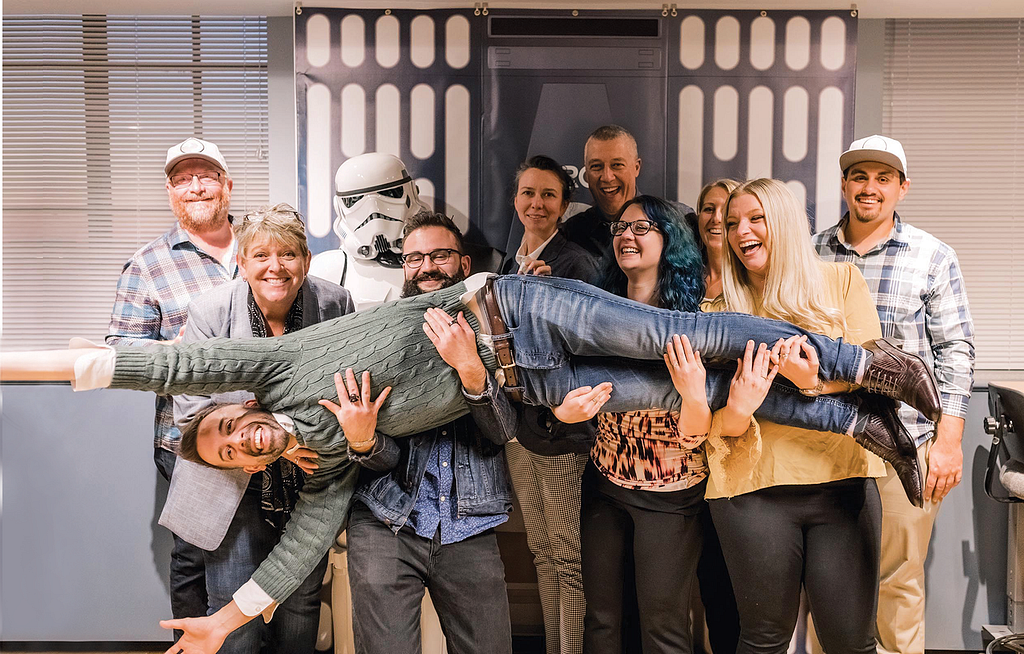
Tom Newmaster of FORCEpkg: “The pandemic has shined a spotlight on the smart people, the thinkers, the innovators, and the problem solvers; I thought I knew who they were, but now I know who they are”
This whole situation has shined a spotlight on the smart people, the thinkers, the innovators, and the problem solvers. I thought I knew who they were, but now I know who they are. There are a lot of us out here and, as long as we keep pushing forward, the future is bright. I guess it relates to Ayn Rand’s philosophy so brilliantly captured in her book Atlas Shrugged. More simply stated as “Objectivism” and the idea that human knowledge and values are objective. Reality, reason, self-interest, and capitalism. I was actually re-listening to the audio book over the past several weeks, in place of listening to the news . . . it was a very strange experience.
I had the pleasure of interviewing Tom Newmaster of FORCEpkg.
Over the past 30+ years Tom has proven himself where it counts — in the trenches. Tom has managed multiple titles, including head of new business development, account service representative, chief operations officer, art director, and designer. In 2017 he started FORCEpkg, a design and branding concept agency that combines real collaboration and real mobility.
From 1998–2016 he was a principal and co-owner of WFM. During that time, Tom worked with numerous challenger brands, helping them develop effective branding marketing and packaging solutions. These companies include Dieffenbach’s Chips, eatKeenwa, Fresh Solutions Network, Klamath Basin Fresh Organics, Koch’s Turkey, Tom Sturgis Pretzels, and Wolfgang Candy. In addition, Tom’s award-winning package/brand design firm served national and global clients including The Hershey Company, Pfizer, Stoner Car Care, W.L. Gore, and Zippo.
He and his former company were also featured in Fast Company Magazine, Inc. Magazine, the noAH Directory of International Package Design Vol. 8 & 9, Market Smart Design, and Package Design China.
As the founder of FORCEpkg, Tom has become a leading voice in the packaging industry and has written for publications such as Brand Packaging, BXP, Flexo Magazine, Food Safety Strategies, Packaging Digest, Packaging Strategies, and Prepared Foods. In addition, he serves as an adjunct instructor teaching packaging design at the Pennsylvania College of Art & Design, and his students are consistently recognized in National design competitions.
Tom has been honored with over 50 design awards, GDUSA Educator to Watch 2019–20, awarded Berks County Shining Star 2012, Project 2020 Finalist 2011 & 2010, Flexo Magazine Author’s Excellence Award 2006, and #16 in Fast Company Fast 50 2005.
Thank you so much for doing this with us! Before we dig in, our readers would like to get to know you a bit. Can you tell us a bit about how and where you grew up?
Born and raised in Lebanon, PA, I moved out of the area for a few years, and actually went back to Lebanon County almost 20 years ago to raise my family. Growing up, I did all of the usual stuff . . . played sports, played a musical instrument in the band, sang in chorus, and maybe did some dancing in musicals, but not sure if there is any real proof of that last part. Always had an interest in art and spent a lot of time drawing at home. My Dad actually showed me how to draw three dimensional looking WWII airplanes when I was drawing everything from a “straight-on view”, so now that I think about it, maybe he is the original inspiration for my career. I vividly remember thinking that the dream job would be to design the Monday Night Football intro sequence . . . never did it, but I’m still available if my services are needed.
Is there a particular book that made a significant impact on you? Can you share a story or explain why it resonated with you so much?
That’s an easy one . . . Creativity, Inc. (Overcoming the Unseen Forces That Stand in the Way of True Inspiration) The behind-the-scenes story of Pixar Animation Studios is amazing when you realize what they started out as and thought they were, and then what they evolved into. After reading the book, I’ve often made the statement “If I ever start a new company, it will be required reading for every employee.” You might be officially hired, but you can’t start until you finish the book. Just the fact that Ed Catmull, Steve Jobs, John Lasseter and George Lucas are all connected is an amazing piece of creative business history.
There are so many inspiring bits of information about originality, creative culture, emotional authenticity, and how to completely change the direction of a company. Two things Ed Catmull said in the book that are always in the back of my mind, “Give a good idea to a mediocre team, and they will screw it up. But give a mediocre idea to a great team, and they will either fix it or come up with something better.” and ““Even the smartest people can form an ineffective team if they are mismatched. That means it is better to focus on how a team is performing, not on the talents of the individuals within it.”
One of the reasons I sold my previous company was because I thought it was stuck in the past. I needed to do it a different way, for both my personal sanity and to see if the right team could do it better and more efficiently. Creativity, Inc. inspired me to go out on my own and try to build a new company from the ground up. Basically, went from my dining room table to the top floor of the tallest historical building in Lancaster City in just under 2 years. Maybe that’s a big deal, maybe it’s not, but it sure does make me feel like anything is possible.
Do you have a favorite “Life Lesson Quote”? Do you have a story about how that was relevant in your life or your work?
I should probably drop a Star Wars quote here, but “Relationships matter” always seems to jump to the front of the line. Actually, it reminds me of a very specific incident and goes back to the early 90s, when a very young Tom was sent to The Hershey Company for the first time. I had to meet Pat, the owner of the printing company we were using back then, and he was a close personal friend of my boss. We had to take a set of press proofs to the client for review and approval. Should have been simple, but remember this was my “first time” at a big client office. So, I got out my suit and dress shoes and headed to 1 East Chocolate Avenue. Of course, I was early so I had to nervously wait in the lobby until Pat arrived. When he arrived, he knew the receptionist by name, they made some small talk and then we headed for the elevator. Very casual, he had obviously done this a hundred times before. We got on the elevator and just before the doors closed, another man got on, and I could tell this was someone important. No words were spoken, but the two men did exchange a cordial nod. As the man got off on the next floor, just as the doors begin to close he says “Fuck you Sullivan”, and Pat immediately says “Fuck you Kenny”. I was stunned. . . what just happened? I looked at Pat and I asked “Who was that guy?” Pat responds with a very casual “that was Ken, he’s the Hershey CEO.” That’s it, I’m dead, my young career is over, time to update my portfolio.
Later I found out that the next day, Ken asked Pat . . . “Do you think we scared him? He sure looked nervous standing there with his briefcase.” Turns out that the two men were high school buddies, still good friends, and thought it would be fun to see if they could rattle the young guy. Until that moment, I never really thought about how you could be friends with a client, or how you might become friends as you worked together. Some may look at this as an example of the “good old boy network”, but it’s really about relationships, and “relationships matter”.

Ok, thank you for all that. Now let’s move to the main focus of our interview. You are currently leading a social impact organization that has stepped up during the COVID-19 Pandemic. Can you tell us a bit about what you and your organization are trying to address?
It all revolves around how we set-up FORCE back in 2017–18. The whole business operation is built on a mobility concept, and every member of the design team is a standalone system. We can work from anywhere at any time of day, together or apart. To be honest, we are almost never all together as a group; sometimes it’s several weeks until we see everyone together at the same time.
When we were told to stay home because of COVID-19, we shrugged and said OK. I don’t mean to downplay the severity of the whole situation, but we are built for this. The fact that we didn’t need to prep and make special accommodations for working from home, allowed us to respond quickly to the requests for FDA compliant hand sanitizer packaging.
On March 23, Ben McGlaughlin of K2 Kinetics emailed me with a Drug Facts panel and a request to design five different label sizes — and a new branding and graphics system. Oh, and by the way, they needed it “last Friday.” In less than three weeks, we were able to pull all of it together, as well as FDA approval. That included brand name generation, parent company and brand logo creation — KO-Safe and KO-Industries. Keep in mind, this company idea did not even exist until mid/late March. The real challenge came when KO needed actual labels for their bottles . . . printers were closed or running with limited capacity. Just by chance, one of our comping/prototyping printers is still in my home studio (which was the FORCE studio for the first 2 years), so I immediately began printing and die-cutting labels. I think the first order was for 1200 labels, which I personally delivered the next day. Since then, we’ve printed over 35,000 hand sanitizer labels, and in the grand scheme of things that’s not a lot of labels, but it allowed KO to deliver product to retailers when no one else could.
During the same time, we finally got our 3D printer up and running. I remember running to the FORCE studio to grab the 3D printer in route to deliver hand sanitizer labels, which allowed us to help supply 3D printed PPE. Although we’d never really printed anything serious before the shut-down, only test models and a few Star Wars-related pieces, we immediately were able to help the Berks PPE Resource Network. Through this amazing organization of almost 100 volunteers, the group went from producing 20 face shields per day to several hundred per day. Our small printer was running 24/7 alongside of the machine printing hand sanitizer labels. Printing all day and overnight, sometimes getting up at 3:00am to check on material, ink and filament supplies. I think I worked 6–8 weeks without a full day off. Part of it was personal for me since we have a few healthcare workers and first responders in the family. And my future daughter-in-law recently started her nursing career, so I wanted to make sure that if she needed something, I was able to help provide it.
In your opinion, what does it mean to be a hero?
The real definition is something like “a person who is admired for courage and outstanding achievements”, for me it’s weighted much more to the side of courage. It’s the big and dangerous stuff like going to war or trying to stop an armed robbery or running into a burning building, ya know, physically putting your life at risk to save another life. During the recent pandemic, many of our healthcare professionals moved to the frontlines, and in many cases put themselves in physical danger. Sure, it’s they’re job and they knew all the risks going into their career of choice, but this virus thing happened so quickly. That whole first responder group (fire & rescue, law enforcement, hospital/medical) were now going to work with a completely new set of threats, because their job tasks could not wait for the end of COVID-19. Bottom line for me . . . a hero doesn’t hesitate, they do what they gotta do when they gotta do it.
In your opinion or experience, what are 5 characteristics of a hero?
- An inner calling to help others
- Putting others lives ahead of their own
- Not afraid of danger
- Blind to differences
- Humility
If heroism is rooted in doing something difficult, scary, or even self-sacrificing, what do you think drives some people — ordinary people — to become heroes?
That’s easy . . . a meaningful personal event presents itself, and they act. Most people do not know what they are capable of until they are in the situation. When it’s a family member or close friend, there is no limit to what the human body or mind can accomplish. Feats of strength like lifting a car or wading into swift water when you can’t swim or shielding another person with your body are examples that pop into my head. Usually involves some aspect of “mind over matter” and when they look back, they can’t explain how they did it, and sometimes do not remember doing it.
What was the specific catalyst for you or your organization to take heroic action? At what point did you personally decide that heroic action needed to be taken?
Simple . . . friends/colleagues needed help and it was the kind of help that fit within our expertise, so we did it. It may sound a little cliché, but if a friend asks for help, you help them. If it’s important to them, it’s important to me, at least on some level. Ask questions later, solve the immediate problem now, fine tune the response as you go. We didn’t really spend a lot of time talking about what we had to do, we just started doing it.
When it came to 3D printing face shields and mask straps, we saw a post on Facebook and within minutes we were downloading the files and doing test prints. I never really gave any thought to the time, money or supplies needed. We just started printing. If it helps one person feel safer doing their job, or keeps one person from getting sick, it’s worth it. Like I said before, until that moment, we never really printed anything lifesaving, and in the end, we were printing stacks of 10 face shields 24/7, and eventually switched over to printing 52 mask straps per print run. The group we initially helped was the Berks PPE Resource Network, which eventually produced over 62,000 pieces of PPE and helped supply over 230 local organizations.
Who are your heroes, or who do you see as heroes today?
Not much of a “hero worship” kinda guy, but anyone that saves another life while risking their own life would be considered a hero to me. One of the moments that left a mark on me and so many others is 9/11. A lot of first responders rushed into those buildings to help people they didn’t know, and never came back out. I know it happens every day, but the magnitude of what happened that day, and the number of people that lost their lives in a matter of minutes, is unparalleled in my memory. Another kind of hero is the individual or group who stands-up for what is right, even if it endangers their life or career.
Let’s talk a bit about what is happening in the world today. What specifically frightened or frightens you most about the pandemic?
How slowly people reacted to what was happening in China and then how quickly they were willing to “stay at home”. I’m not saying there should not have been quarantining or mask wearing, but I felt like people panicked and then simply complied without question. I remember being in Los Angeles in mid February and watching John’s Hopkins University Interactive Dashboard. I shared it with several friends and told them it will happen here and most thought I was crazy. I also have a business friend in Hong Kong that I had been communicating with and asking questions about his situation there since December. He strongly encouraged me to “get masks now”. He also warned that toilet paper would be the first thing to disappear in stores. So, I followed his advice, ordered a few masks and grabbed an extra pack of TP at COSTCO. Again, all of my family and friends thought I was crazy. By the time masks were deemed appropriate and none were to be found, I had a few. I think I drove around with that TP in my truck for four weeks, but then the day came where I had to bring it in the house. I guess my point is more about “personal responsibility”. What if you needed a mask to travel or leave your area? I took care of that. What if there was a brief and silly TP shortage? I took care of that. I did what I thought was necessary for me and my family. Seems simple, but this lack of practical pre-planning by millions of people really concerns me. Both today and even more so in the future.
Despite that, what gives you hope for the future? Can you explain?
This whole situation has shined a spotlight on the smart people, the thinkers, the innovators, and the problem solvers. I thought I knew who they were, but now I know who they are. There are a lot of us out here and, as long as we keep pushing forward, the future is bright. I guess it relates to Ayn Rand’s philosophy so brilliantly captured in her book Atlas Shrugged. More simply stated as “Objectivism” and the idea that human knowledge and values are objective. Reality, reason, self-interest, and capitalism. I was actually re-listening to the audio book over the past several weeks, in place of listening to the news . . . it was a very strange experience.
What has inspired you the most about the behavior of people during the pandemic, and what behaviors do you find most disappointing?
People really do care about other people and for the most part will do anything to help a friend or neighbor, even if they don’t necessarily agree with everything that person thinks. If they think they need help, they will do whatever they can to help them. That goes for business and personal life. The problem is that, as Americans, we do not like being told what to do, or how to do it. Give us the challenge, not the rules, not the guidelines. It’s in the overall DNA of the Nation. You can’t go to the moon . . . how’s that?! You can’t land the first stage of a rocket standing upright on a floating platform in the ocean . . . really, watch this! You can’t actually send a human to Mars . . . hold my beer!
The most disappointing behavior is how quickly this whole mess became political, and that disappointment is equally spread across both political parties. Local, State, and Federal, they just couldn’t help themselves. “Never let a good crisis go to waste.” is such a horrible quote and what makes it even worse is it works. Then a lot of people just fall in line and stop thinking. It’s really sad.
Has this crisis caused you to reassess your view of the world or of society? We would love to hear what you mean.
Not really a “reassessment”, more like a “confirmation”. I believe that most people are inherently good and that the bad are of a very small minority. That’s not to say that those few can’t do damage or harm others, but there is great strength in numbers. The most kind, most thoughtful, most caring people are not necessarily those that speak the loudest, donate the most money, or “carry the banner”; they are the ones that show who they really are by their personal actions. Our society and our freedoms are very fragile, and we must do whatever is needed to preserve them. This country is great, it’s not perfect, it never has been perfect, but we need to understand where we came from and where we are going. It’s a process of constant reassessment and then adjustment. Look back at history, understand what happened, continue the good and make sure we don’t repeat the bad. COVID-19 (SARS-CoV2) is/was a test . . . did we pass or fail? Either way we’ll be better at dealing with this the next time, whether it’s a second wave, third wave, or COVID-20 . . . we got this.
What permanent societal changes would you like to see come out of this crisis?
In a crisis, society needs to set aside political differences and unite to solve the problem — natural disaster, pandemic, environment, or even war. We can get back to the conservative vs. liberal debate later. It’s society’s responsibility to hold political leaders accountable for their actions, regardless of their political affiliation. Because of the political nature of everything in America today, this will not be easy.
If you could tell other young people one thing about why they should consider making a positive impact on our environment or society, like you, what would you tell them?
Look at the whole situation, consider the pros and cons, and then go with your gut. Your “inner compass” is usually pointing in the right direction. Also, it’s not always a black or white answer, or an absolute. Most solutions are hiding in the grey areas.
You are a person of great influence. If you could start a movement that would bring the most amount of good to the most amount of people, what would that be? You never know what your idea can trigger.
“Term Limits For All” . . . I really hate to dive deeper into politics, but without term limits at the Federal and State level, major change is never going to happen. The current elected official is always campaigning to keep their job and that’s got to stop. If you want to help a lot of people, you must clean-up government and take out the trash. We need to cycle more people and more ideas through the system, and limit the impact of money and lobbyists. Nothing happens fast enough, but if the elected official knew they only had 4–8 years to get stuff done . . . stuff would happen, trust me.
Is there a person in the world, or in the US, with whom you would like to have a private breakfast or lunch, and why? He or she might just see this, especially if we tag them.
That would have to be George Lucas. I know, totally nerdy response, but I got lots of questions. What did he fear most about going into the original movie project? Did he really believe the licensing and merchandising would be as big? What did he want to do and could never make it happen? What would he change about any of the story lines? How would those changes evolve in the future story line? I want to hear details about the creative development process, working with the illustrators and prop makers. He had to explain things that never existed before, so what techniques did he use to guide them through the visualization process. And how he really pitched the idea to the movie studio(s) and were there any little lies told along the way to make his vision a reality. I want it to be totally casual, with a burger and beers by the pool.
How can our readers follow you online?
I’m on Facebook, Instagram, Twitter, and LinkedIn personally.
And you can find and follow FORCE at:
www.FORCEpkg.com
https://www.facebook.com/FORCEpkg
https://www.linkedin.com/company/force-pkg-inc.
https://www.instagram.com/forcepkg
Tom Newmaster of FORCEpkg: “The pandemic has shined a spotlight on the smart people, the thinkers… was originally published in Authority Magazine on Medium, where people are continuing the conversation by highlighting and responding to this story.