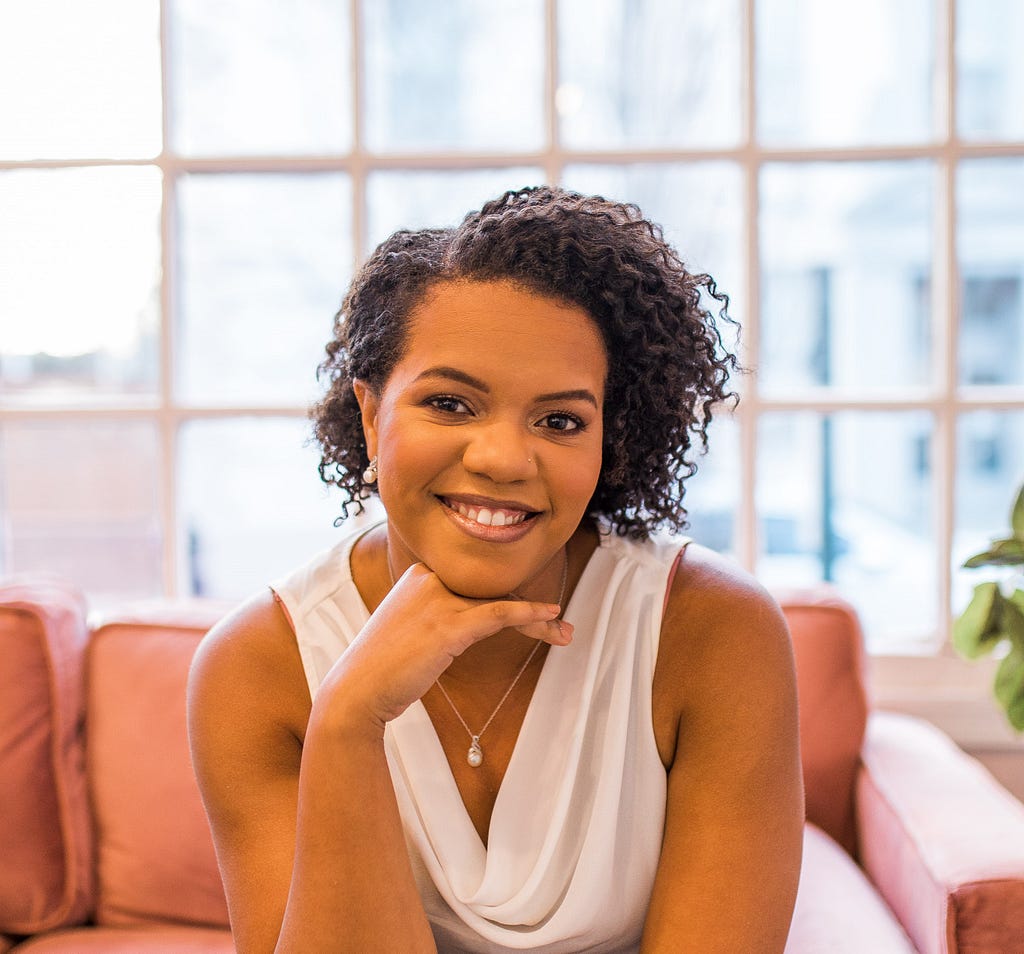
Female Founders: Tiffany Hardin On The Five Things You Need To Thrive and Succeed as a Woman Founder
An Interview With Candice Georgiadis
Ambition — Recognizing that your ambition does not mean your work ethic. Knowing that your ambition is a deep desire to build something radical that only you can create. Building that ambition with determination to succeed.
Tiffany is the founder of boutique consultancy, Gild Creative Group, and is an award winning marketer focused on elevating the well-being of culture through strategy, partnerships and communications. Her work experience with entertainment, advertising and tech has allowed her to hold positions and consult with world class organizations — such Ovia, Target, HBO, Airbnb, WeWork, digitalundivided, Cobble, and Black Girl in Om. She spends her time working with ambitious brands on procuring diverse talent for branded content partnerships and strategy concepts. Tiffany is a self-proclaimed Conscious Hustler™ — and is launching a professional development course of the same name to help elevate a new generation of mindful leaders.
Thank you so much for doing this with us! Before we dig in, our readers would like to get to know you a bit more. Can you tell us a bit about your “backstory”? What led you to this particular career path?
I always knew I was going to work with creatives — I was one myself constantly writing poetry, song lyrics and would perform in choirs, talent shows,etc. I realized that while I enjoyed my creative pursuits, it was not going to be my career path as a professional performer. I became interested in talent management and even managed a rock band in highschool which was the case study for me to go to Columbia College Chicago to graduate with a degree in Arts, Entertainment and Media Management. It was this experience that kick started my career.
In the early days, I immersed myself in the music business and marketing working for successful Black entrepreneurs and executives like John Monopoly, Mona Scott-Young and Steve Stoute. Working with these executives I learned a lot about people, business, creating opportunity, and getting things done big or small. I learned how to build budgets, manage relationships and delivery expectations. Chicago and New York City were the perfect cityscapes in my 20s where I learned how to harness my hustle. While I was in college I started a social metrics company, but by the time I was 25 years old with more experience under my belt, I started Gild Creative Group. My clients range from brands to startups to agencies to influencers.
My agency is a manifestation of my lessons and experience from working with moguls, talent and developing strategy and implementing tactics to amplify and empower culture.
Can you share the most interesting story that happened to you since you began leading your company?
The biggest plot twist in my career has been moving my company from NYC to Nashville, TN. It was not something I planned, but turns out was the best thing for me and my business — plus no state sales income tax! While I thought my next move was LA, God had other plans and I am blooming where I’ve been planted. The entrepreneur and tech scene here are growing — I love to see it!
Managing a large remote team has been challenging in the best of ways as we all had to over-communicate and be mindful of expressing our needs to get the work done and be collaborative.
Can you share a story about the funniest mistake you made when you were first starting? Can you tell us what lesson you learned from that?
When I first worked for Mona Scott-Young, I was her assistant at Violator Management, and was responsible for Missy Elliott’s travel. It was my first week on the job, and I recently just moved into my new apartment. I went to sleep thinking all was well with Missy’s morning flight, and woke up to missed messages and phone calls. Missy had missed her flight, and I missed fixing it. I was mortified because that meant Mona had to handle it at like 5AM because I was asleep. I called her as soon as I got the messages, and she said ‘I hope you enjoyed your REM sleep. Keep your phone in your bed.’ It was a classic rookie mistake. The bigger lesson is, never assume your plans will go accordingly — and do not sleep unless the job is done! These days I don’t sleep with my phone, but I learned rigor in my work and expect my team to have these values as well.
None of us are able to achieve success without some help along the way. Is there a particular person who you are grateful towards who helped get you to where you are? Can you share a story about that?
As a creative person, who runs a business, there are plenty of times when I was highly resistant to systems. It took me years, but I finally allowed myself to find the beauty in creating operating systems for my work. It has allowed me to grow and expand quickly. I am grateful to my operations team — Amanda, Nicole and Sierra for helping me see how supportive and easeful systems can be to progress the business.
In your opinion and experience what is currently holding back women from founding companies?
While I believe everyone should own a business, I know that entrepreneurship is *NOT* for everyone. I may have an unpopular opinion, but I do believe that the most successful businesses have three parts, a visionary, an operator, and an integrator. I think women who do not want to found, fund, and run a business need to be connected to other women who can support their zone of genius within a shared mission & vision.
Outside of this, I’m less concerned with women starting businesses, but operationalizing and scaling our businesses for peak performance and revenue opportunities. If we are afraid to go BIG, we have to examine what internal programming keeps us complacent?
Can you help articulate a few things that can be done as individuals, as a society, or by the government, to help overcome those obstacles?
If you would rather buy Kim K’s fragrance and not your friend’s products or services, then you need to quit or buy both! Please, buy the ticket, the candle, the membership, the combo package, share the post,provide a testimonial, etc. Be a part of another woman’s success story.
As a society, we should encourage women to grow in their ambition and provide tangible support which includes funding, mentorship, etc. Women need more than a few empowerment brunches, we need operations experts, sales experts, pressure tested systems support, etc. The government has resources, but it can certainly market those resources to keep up with the times, and how people receive and process information.
This might be intuitive to you as a woman founder but I think it will be helpful to spell this out. Can you share a few reasons why more women should become founders?
God Bless the child that has their own! Always have your own money. Get YOURS and inspire your sons, daughters, sisters, nieces and nephews with your ability to provide for yourself and your family — even if it’s ‘side money’.
Women have a lived experience that makes us uniquely qualified to solve problems and a resiliency that is unmatched. Just take a look at Sara Blakely & Spanx for inspiration & a testimony.
We have the ability to tap into the masculine energy of ‘getting it done’ and the feminine energy to ‘nurture’ the business; we have life force energy, and it’s in our nature to create, to care, to build.
What are the “myths” that you would like to dispel about being a founder? Can you explain what you mean?
The myth that you have to have it all figured out before you begin is just one that I cannot disagree with more. I have made mistakes, faced difficulties and came through on the other side with more knowledge and skill sets than if I would have never made the decision to start my own company. I have built a network and team of powerful conscious hustlers that can jump into any situation and figure things out with me. Finding the right people to teach you, mentor you and guide you is all a part of the process of growing your business.
Is everyone cut out to be a founder? In your opinion, which specific traits increase the likelihood that a person will be a successful founder and what type of person should perhaps seek a “regular job” as an employee? Can you explain what you mean?
I don’t know when this happened, but being a 9–5 employee has become villainized in recent years. Listen, I am the beneficiary of a father who worked in upper management for years before he retired. I have never missed a meal because of the consistency of his effort. That 401K money doesn’t hurt!
I do not think running a business full-time is for everyone and there is a spectrum to this depending on the type of business you’re running. There are plenty of entrepreneurs who started as employees and made the switch, or work part time as an employee or as an entrepreneur. Like missy said ‘Ain’t no shame ladies, do your thing, just make sure you’re ahead of the game’
Successful entrepreneurs know that if they are the ‘vision’, then they will need support, employees, contractors, and the like to bring it to life — they can not and should not do everything themselves.
One thing every founder must have is tenacity and emotional agility. As the boss, you are the head coach of the team — when things go wrong, because they will go wrong, can you still see the opportunity? Can you still lead your team of conscious hustlers and encourage them? Can you regulate your own emotions so that you are communicating your expectations?
Ok super. Here is the main question of our interview. Based on your opinion and experience, what are the “Five Things You Need To Thrive and Succeed as a Woman Founder?” (Please share a story or example for each.)
Ambition — Recognizing that your ambition does not mean your work ethic. Knowing that your ambition is a deep desire to build something radical that only you can create. Building that ambition with determination to succeed.
Support — Having the right team in the right positions is key. Your team is the backbone to your business and if they can’t run your business without you for a day, then you don’t have the right support.
Network — The value of your black book is priceless. Always build and maintain professional connections that could eventually come in handy when they’re needed. You never know who knows who and how far a good word can go.
Curiosity — You need to have a mindset of cultural curiosity. What is happening in the world, in the media, and keeping pace will help you evolve and grow. Your ideas will grow and develop over time but sometimes they will pivot and that’s ok. Having the ability to reflect on what matters and making the right adjustments is important.
Heart — Knowing that what you are doing is making a difference and putting your heart into what you do will eventually lead to a successful career or business. And you most definitely need a powerful heart to share it with the world.
How have you used your success to make the world a better place?
For over a decade, we have cultivated relationships with brands who prioritize their impact amongst diverse audiences and all types of talent/ practitioners who lend their craft and voice to execute hundreds of brand influencer campaigns that support innovative ideas, products and movements in the culture. As a nimble and resourceful agency, we best serve clients who thrive on developing culture stories that can be appreciated and shared. The result of this is cutting checks throughout the years for hundreds of thousands of dollars to talent, and being a diverse vendor for brands and agencies.
You are a person of great influence. If you could inspire a movement that would bring the most amount of good for the greatest number of people, what would that be? You never know what your idea can trigger.
It’s my ambition to raise up a generation of mindful leaders with my curriculum for Conscious Hustler. It’s meant to serve as a provocation for self-inquiry to help us align our intention, ambition and pursuit of excellence in the workplace and break down patriarchal ideas of our identity & worth being tied to our productivity.
12. We are very blessed that some very prominent names in Business, VC funding, Sports, and Entertainment read this column. Is there a person in the world, or in the US with whom you would love to have a private breakfast or lunch with, and why? He or she might just see this if we tag them.
I would love to have a private boozy lunch with Brene Brown. She has given relatable language and feeling, based on her research, to the complexities of how we relate to ourselves and others in the various aspects of our lives. Her work has changed my life more than a few times over. Plus, she’s Texan — and I love me a good fellow Texan.
Thank you for these fantastic insights. We greatly appreciate the time you spent on this.
Female Disruptors: Maddy Cretella of Landmark Hospitality On The Three Things You Need To Shake Up Your Industry
An Interview With Candice Georgiadis
The first piece of advice that has resonated with me is “measure once, cut twice.” Sometimes, we are too quick to make decisions or take action, and inevitably we have to use twice the time later to fix mistakes that could have been avoided.
As a part of our series about women who are shaking things up in their industry, I had the pleasure of interviewing Maddy Cretella.
Maddy Cretella serves as Director of Marketing and Engagement with a strategic plan focused on continuing to grow the Landmark brand as both a leader in hospitality and in business. Today, under her guidance, Landmark Hospitality’s reach has grown exponentially through impactful social, digital, and print advertising, as well as email campaigns by utilizing technology platforms and analytics. Inspired by the amazing industry contributions of her parents, Jeanne and Frank, Cretella embraces the opportunity to continue the memory-making culture of Landmark Hospitality as the family-run multidisciplinary firm looks towards the future.
Thank you so much for doing this with us! Before we dig in, our readers would like to get to know you a bit more. Can you tell us a bit about your “backstory”? What led you to this particular career path?
My parents have been in the hospitality industry their entire lives — their first jobs were helping my grandparents with their family businesses. I grew up in the industry, chasing our family’s dream, so it just felt like a natural progression to follow that path.
Since I was already passionate about the hospitality industry, I just needed to find my niche when it came time to decide on college. My father handled the building and development side of the business while my mother was customer-facing, dealing with the day-to-day operations at the properties. I always loved marketing, and, at the time, the world of social media was exploding. This led me to complete my college education at Monmouth University, where I graduated with a double major in business management and public relations.
My lifelong fondness for events and celebrations led to my first industry role: designing wedding cakes. Shortly after, I found my niche in hospitality marketing, which involved embracing the excitement and creative side of the industry. Since my start with Landmark Hospitality in 2015, my role has continued to grow. I’ve learned that being part of a family-run business means wearing many hats and jumping in whenever and wherever needed.
Can you tell our readers what it is about the work you’re doing that’s disruptive?
Landmark Hospitality is a woman-steered organization, making me incredibly proud as we continue to increase our presence in the industry. I feel as if we’re paving the way, not only for companies in this industry but for businesses in general. It’s incredibly important to have women in leading positions to set the tone and act as examples for generations to come. Currently, Landmark Hospitality employs 214 women and counting! We’re proud to invest in the futures of female leaders in this industry by providing resources and giving opportunities to women, which allows them to hone their skills and create success in the future.
I am also the founder of Morgan Stillhouse, a distillery coming soon to Montgomery County, Pennsylvania. The distillery will produce original spirits under the iconic Stork Club label. The liquor industry, much like the hospitality industry, has been male-dominated for too long. I’m ready to bring my skills and expertise to this new venture and create space for more female leaders in another market.
Can you share a story about the funniest mistake you made when you were first starting? Can you tell us what lesson you learned from that?
The first thing that comes to mind is when I posted a photo of my dog, Enzo, that was meant for my personal Instagram account to our main business account for Landmark Hospitality. I didn’t realize for a few minutes until I saw that people were commenting on the post. I was so confused! After that, we deemed Enzo the Landmark mascot — who doesn’t love a golden retriever puppy?!
From this, I learned that accidents could turn into a great storyline. It’s all about what you make of them. Experiencing something and learning from it is always beneficial in the long run. Now, I triple check my work before posting it on the internet!
We all need a little help along the journey. Who have been some of your mentors? Can you share a story about how they made an impact?
My parents have undoubtedly been my mentors throughout my life. When I was a young girl, we fell into some hard times. I was so excited that my parents and I were moving in with my grandparents, too young to understand why we couldn’t live in our own home anymore. We stayed with my grandparents for three years, and it was in that timeframe that I saw just how dedicated my parents were to achieving the American dream. Hospitality ran through their blood, and they were determined to become a success story.
My weekends as a child were filled with learning the ins and outs of the business. On Saturday mornings, I’d be at our latest construction site besides my father, learning how to read plans. I would watch as a simple plot of land transformed into a magnificent structure. Saturday nights were spent by my mother’s side, trailing her through the restaurant. My first memories are from the Boathouse in Central Park, NYC and Lundy’s Brother’s Restaurant in Sheepshead Bay, Brooklyn. I was deemed the “hostess in training” at the mere age of six, as I’d follow behind my mother each time she sat guests. There is so much excitement in the air during service on a jam-packed weekend, which I quickly became obsessed with; witnessing a wedding was just as exciting — seeing the room transform from a blank space to an event in full swing, providing guests with an incredible experience.
In 2001, they started Landmark Hospitality with the opening of Liberty House in Jersey City, New Jersey. A whirlwind after that, fast forward 20 years, and here we are — multiple venues, restaurants, and boutique hotels. Their continuous hard work and dedication are the reason they are where they are today. They are an inspiration, and I hope one day I make them as proud as they make me.
In today’s parlance, being disruptive is usually a positive adjective. But is disrupting always good? When do we say the converse, that a system or structure has ‘withstood the test of time’? Can you articulate to our readers when disrupting an industry is positive, and when disrupting an industry is ‘not so positive’? Can you share some examples of what you mean?
I believe that it’s important to identify areas of industries that need improvement to enhance the field overall. If we don’t make a conscious effort towards change, industries and people will never evolve and improve. For example, at Landmark Hospitality, we pride ourselves on investing in the professional development of our employees. We want to invest in their futures, whether they decide to pursue the hospitality industry long-term or not. So many of these skills are transferable to a wide variety of career paths. Time management, communication, leadership — all of those attributes contribute to career development. We strive to provide our employees with an environment where honing these skills is encouraged and possible. This is our form of disruption. We stray from the “norm” of the endless hustle seen in the restaurant and hospitality industries, and rather seek to transform it into an experience that contributes to the larger picture of someone’s life.
Disruption can become negative when it manifests as an unanticipated obstacle — such as the pandemic. However, it’s about how you decide to tackle the challenge. Many throughout the field, including ourselves, had to quickly come up with solutions to survive. We quickly pivoted and highlighted our outdoor dining spaces as our main draw. We also created experiences for families during the holidays, providing them with fully prepared meals to take home and enjoy, expanding our grasp on the signature memory-making Landmark experience. We are constantly innovating and reevaluating our processes, including the continued integration of technology into our practices. Elements such as remote check-in and virtual keys cater to the sanitization of our facilities and eliminate the more mundane tasks in our practices. This allows us to spend more time on the guest experience and fine-tune our business to live up to our values.
Can you share 3 of the best words of advice you’ve gotten along your journey? Please give a story or example for each.
The first piece of advice that has resonated with me is “measure once, cut twice.” Sometimes, we are too quick to make decisions or take action, and inevitably we have to use twice the time later to fix mistakes that could have been avoided.
Secondly, something that I apply to my everyday work: “say yes and show up.” We miss 100% of the opportunities we don’t take a chance on. Even if it’s out of your comfort zone, go to the networking event — you never know who you’ll meet, the ideas you’ll come up with, or the great things that could come from it.
Lastly, “when you know better, do better.” Never stop learning. It is imperative to continuously be open to learning from others with an open mind. Going off of my last point, you never know what opportunities you’re missing out on when you’re unwilling to hear different perspectives, learn from others, and have new experiences.
We are sure you aren’t done. How are you going to shake things up next?
I believe it is critical to always stay relevant by continuing to learn about the industry. I constantly stay on top of trends in the industry and try to apply them to Landmark Hospitality as a means of exceeding guest expectations. Looking towards the future, I am eager to immerse myself further into the operations side of hospitality. As we grow our brand, we are becoming a lifestyle company, expanding our offerings beyond restaurants and events. I hope to continue this trend as we evolve our company to continuously innovate new ways to create our signature memory-making experiences for our guests.
I’m also excited to expand my real estate portfolio — 2018 marked my first entry into the field with the acquisition of The Farmhouse in Hampton, NJ, and, in turn, adding it to the iconic Landmark Hospitality Portfolio. This historic treasure will soon go under development and will grow to include a second event space, boutique hotel, and restaurant.
I also want to continue to develop the hospitality school we started, Art of Hospitality Workers Alliance. It is a well-
respected Hospitality School that introduces the underemployed and unemployed to entry level positions in
hospitality. This is all reinforced with the inclusion of life skill classes such as Financial Literacy, ESL (English Second
Language) and GED offered to all who participate. Additionally, Art of Hospitality helps those already in the industry unveil their potential and grow their talents and business, thus being afforded the opportunity for advancement through higher-level classes and coaching. The mission of the foundation is to support the needs and dreams of hospitality workers by offering career paths, growth opportunities, and propelling career advancement while offering financial support. We are committed to acting as a safety net for hospitality workers in New Jersey and believe that the hospitality industry is one that provides endless opportunities for all. It is an industry in which an individual’s achievements are limitless so long as they possess a willingness to learn and have a passion for giving.
In your opinion, what are the biggest challenges faced by ‘women disruptors’ that aren’t typically faced by their male counterparts?
I think the biggest challenge is being a woman in a male-dominated field. It’s so important to empower female leaders in these male-led sectors so that future generations have role models, someone’s footsteps to follow. Pioneering new ways of inclusion can be a rocky road at many points, but knowing that the work I do now can impact a young woman breaking into the industry years from now inspires me to continue moving the needle. It’s the same way in the liquor industry, and I hope to continue breaking into new industries to help set a larger precedent for generations of female leaders to come.
Do you have a book/podcast/talk that’s had a deep impact on your thinking? Can you share a story with us?
I recently started listening to the Hospitality Hangout podcast. It is an excellent resource to learn more about trends and technology advances in the field. The podcast hosts touch on so many different avenues, from guest retainage to improving online ordering. Across the board, it’s super informative. It’s always exciting to hear topics that they discuss and be able to relate something that we’re doing. For example, we implemented keyless check-in for our hotels — next thing I know, they’re talking about it on the podcast! I love listening to the show to learn more about how others are navigating the industry, and these different perspectives have been helpful as our company grows.
You are a person of great influence. If you could inspire a movement that would bring the most amount of good to the most amount of people, what would that be? You never know what your idea can trigger.
Landmark Hospitality started an initiative that facilitates schools for adults with Autism to come to our restaurants and learn basic hospitality skills. From polishing silverware, to folding napkins and cutting vegetables, program participants refine skills that we hope they can utilize to get a job in the field of hospitality. We aim for this program to give individuals experience that they can use to build a career for themselves through learning the ropes of hospitality firsthand. My hope is that one day all restaurants partake in a similar program, because you meet so many beautiful people and contribute directly to their success — nothing is better than watching them thrive. One story that we often think of is that of Angel, a line-cook at one of our restaurants, Liberty House; he started coming to Liberty House with his classmates as a part of the program. When he graduated, he was hired as a member of the back of the house team. Fast forward to today, Angel makes every pasta we serve to our guests — from linguine to raviolis and everything in between. It has been incredible to watch him grow and blossom into an integral part of, not only our internal team, but a major contributor to the experiences of our guests.
Can you please give us your favorite “Life Lesson Quote”? Can you share how that was relevant to you in your life?
My favorite quote is, “Want blue skies? Grab a paintbrush.” It’s a saying that my father has been telling me since I was a little girl that I still carry with me today. It simply means that anything you put your mind to, you can achieve — only you are in control of your destiny. He instilled in me that everyone wants the best, but not everyone is willing to put in the work to get there. The only way to get to the top is to start climbing — the view is always worth the blood, sweat, and tears.
Female Founders: Sonia Khemiri of Beautyque NYC On The Five Things You Need To Thrive and Succeed as a Woman Founder
An Interview With Candice Georgiadis
Don’t be afraid of failure: Failure is inevitable at one point or another for every business founder. Learn to appreciate failure as an experience that will lead to something greater. Everyone tends to fear failure, but everyone reacts to it differently. Never let fear hold you back from doing something.
Sonia is the owner and co-founder of Beautyque NYC, the first multi-brand 3D virtual store in the beauty industry. She is a French-born, Tunisian and Canadian female entrepreneur who has started many businesses since the age of 27. In addition to holding an MS in Finance, she is also the founder of her own skincare brand, Sunia K. Cosmetiques Authentiques, and is a mom to a teenage daughter.
Thank you so much for doing this with us! Before we dig in, our readers would like to get to know you a bit more. Can you tell us a bit about your “backstory”? What led you to this particular career path?
My path to becoming an entrepreneur started when I was a child. My father is an entrepreneur, and since a young age I’ve admired his courage in facing challenges and his happiness when his hard work paid off. I knew that someday I wanted to be an entrepreneur since I was 6 years old, but it became clear as I was finishing my master’s degree in finance that entrepreneurship would truly be my path. I chose the beauty industry because I wanted to be in a positive space where I could uplift people and help women feel comfortable in their own skin. I started my own brand, Sunia K. Cosmetiques Authentiques, by supplying the best skincare oil on the market and sourcing it from my hometown in Tunisia. From there came the idea for Beautyque NYC, to help fellow indie brand founders overcome their challenges and market their products. We were originally meant to be a physical store in SoHo NYC, but when the pandemic hit, we pivoted to the innovative 3D virtual storefront that we have today.
Can you share the most interesting story that happened to you since you began leading your company?
The most interesting thing that happened since starting Beautyque was being approached by investors right after our launch — and not being ready for it. Soon after launching, we were approached by major investors with an offer that I’m sure most start-ups would only dream of receiving. We ended up not taking on the investors; we wanted to bootstrap first, and be sure that we had complete control of the direction we would take Beautyque.
Can you share a story about the funniest mistake you made when you were first starting? Can you tell us what lesson you learned from that?
Funnily enough, I would say that not moving forward with the investors (even if we weren’t ready for it) was our biggest mistake. Even if we didn’t have a solid plan at that time, after having to pivot our concept completely to the digital space, we should have taken advantage of the opportunity and figured it out along the way. No regrets here — it just made us tougher!
None of us are able to achieve success without some help along the way. Is there a particular person who you are grateful towards who helped get you to where you are? Can you share a story about that?
I’m always grateful to my dad for instilling the entrepreneurial spirit in me, even if he didn’t mean to — it’s in my DNA, and I’m grateful for that. I’m also grateful to my daughter, for grounding me and driving me to push forward when things don’t go the way I originally planned; to my partner in life, who listens to me and supports me in all my business ventures; and to one of my previous bosses, for the trust he had in the young and inexperienced me.
Ok, thank you for that. Let’s now jump to the primary focus of our interview. According to this EY report, only about 20 percent of funded companies have women founders. This reflects great historical progress, but it also shows that more work still has to be done to empower women to create companies. In your opinion and experience what is currently holding back women from founding companies?
Fear of failure and lack of confidence, as a result of the lack of support women entrepreneurs have received for generations. In many countries, women (including myself) generally are not encouraged to be in business, and especially not business owners. Since my childhood, everybody has had an opinion on what I should be — a doctor, a banker, a housewife, a mother — nobody encouraged me in any way to be an entrepreneur, especially growing up where I come from. I’ve also met many women, young and old, who haven’t pursued their dreams because they believe they aren’t good enough, aren’t capable enough, aren’t educated enough, or are too busy fulfilling their role as a mother, daughter, wife, sister, etc.
I can only speak for myself and what I have observed. For a long time, women have been told what we should be, do, and think. Of course, there have been very powerful and independent women throughout history, but in the patriarchal world we live in, that’s unfortunately not the norm. The road is still being paved for women to take control of our destinies, and I strongly believe that all women should be supportive of one another regardless of our race, age, culture, religion, or anything else. To me, feminism is about standing up for ourselves as women and creating the lives that we envision for ourselves.
Can you help articulate a few things that can be done as individuals, as a society, or by the government, to help overcome those obstacles?
As individuals, I believe that we should encourage any woman who has a dream to pursue it realistically. What I mean is that we should not be blindly supportive and positive just for the sake of doing so, but rather genuinely encourage and uplift women to take on realistic business ventures that will bring them true success and happiness. There’s a saying, ‘You can put hard work into your land, but no matter how hard you work, if the land isn’t fertile, you won’t get anything from it.’ If a woman in your life is seeking advice, or asking for help — offering your guidance and resources is one way to do it. Share in one another’s success and spread your knowledge where you can. Supporting our fellow women is number one! We can be proactive individuals by associating with companies and organizations that support women in business, or even by creating these companies and organizations ourselves.
As a society, I believe that acknowledging the problem is the first step in finding a solution. The next step is to spread support all throughout the country, which requires marketing, and marketing of course requires money — which more private companies should be supporting. We’re starting to see venture capital firms helping women-owned businesses more and more, as well as companies helping women investing and more.
In my opinion, financial support from the government is the number one thing that should be done more. Unfortunately, injecting more money in these important causes are political decisions. But as policymakers, the people in power should recognize the value in supporting women-owned businesses and the job creation and economic growth that come from it. Many men in power support the cause, but more women in power should as well.
This might be intuitive to you as a woman founder, but I think it will be helpful to spell this out. Can you share a few reasons why more women should become founders?
Women in business are inherently different from men in business — not unequal by any means, but different — in terms of the way we think, the way we approach challenges, and the way we lead teams. We can observe this through many successful women-led businesses, for example, SPANX (the underwear/undergarment company) was created because the founder had a deep personal understanding of women’s wants and needs more than any man before her. Women should become founders because we bring a unique and much-needed approach to business and the industries that we work in, especially when it comes to serving women and children.
What are the “myths” that you would like to dispel about being a founder? Can you explain what you mean?
The way I see it, being a founder does not automatically equate to being a CEO, especially for a start-up. You can have an idea, create a business, and fail (many failures often come before success). Don’t get caught up in the fancy titles… build your business to a point of success, and you will certainly become a powerful CEO!
Is everyone cut out to be a founder? In your opinion, which specific traits increase the likelihood that a person will be a successful founder, and what type of person should perhaps seek a “regular job” as an employee? Can you explain what you mean?
As a founder, you are the originator of the company — the name says it all. A successful founder is someone who will lead that company to grow, build an effective team, generate income, and make the company successful. Getting to a point of financial success takes a lot of ups and downs, sleepless nights, problem-solving, predicting trends… It’s much more than a 9-to-5 job, and the icing on cake is that there is no guarantee that you will be successful regardless of the time and money you’ve invested. If the idea of high risk with the potential of high success thrills you, then being a founder is for you — otherwise, it’s best to stick to another job that makes you happy, because this is not always the happiest journey for everyone!
Ok super. Here is the main question of our interview. Based on your opinion and experience, what are the “Five Things You Need To Thrive and Succeed as a Woman Founder?” (Please share a story or example for each.)
Believe in yourself: Even if no one is encouraging you, go for it. Stop hesitating, and you’ll figure it out along the way. Even if everyone says you can’t, listen to your gut and follow your dream. When I speak about guts, I’m talking about pursuing your goal no matter what external factors are working against you. As I mentioned, I was brought up in a very strong patriarchal society, and even within my family, as a girl I didn’t have the same opportunities as boys my age did. I never shared with them that I wanted to be an entrepreneur, because I knew what their reaction would be. No one encouraged me, and at a certain point, I thought that may be they were right — but my gut told me not to give up, and I’m glad I didn’t.
Keep going no matter the challenges you face: The odds are that if you remain perseverant in a space with high potential, you will end up on a different path than you originally thought, and it will be much better than your original plan! The path to where I am now has been far from perfect. My original plan was to finish my master’s degree, work in one specific field for 15 years, and start a business in that field. Needless to say, things didn’t go as planned. I got married, had a child, got divorced, went through unexpected hardships, worked in many industries, and ended up starting a business in an industry I knew little about at the time. I kept going, even though it was different from my original plan — the goal remained the same.
Don’t be afraid of failure: Failure is inevitable at one point or another for every business founder. Learn to appreciate failure as an experience that will lead to something greater. Everyone tends to fear failure, but everyone reacts to it differently. Never let fear hold you back from doing something. Before starting Beautyque and my own beauty brand, I tried a few ventures that didn’t succeed. Of course, it didn’t feel good in the moment, but I refused to let it define me. For example, I started a family venture in the marble industry; I did everything right (or so I thought), secured the funding, locked in wholesale customers before even spending the money for the factory, and in the end, it didn’t work out. Even though I put in the time and effort, in the end there was nothing to show for it, and I ended up having to take responsibility because according to my family, I was not meant to be a businesswoman. And from that experience, I learned not to do business with the family and instead pursue my own ventures — that was a great lesson for me!
Enjoy the ride: It’s easy to enjoy the ups, but don’t forget to appreciate the downs, too. When you get to a room without doors, create a window — there is always a way. Within the first year of starting my own beauty brand, I faced all challenges that start-ups face. Many doors seemed to be closed, but instead of saying “The market is too difficult for my brand,” I saw it as more of a creative problem to solve for my brand and for others in the same position. To my surprise, through starting Beautyque, I ended up helping even bigger brands than my own.
Be ambitious: Dream it, believe it, do it! I was born in France and lived there for 7 amazing years of my childhood before moving to my beautiful home country of Tunisia. However, the town we moved to was my parents’ hometown in the countryside, where there wasn’t too much to do for a young French-born girl. I dreamt a lot during that period — I live in NYC now, doing what I dreamt of doing back then. I guess by doing what my gut told me, I was able to achieve what I always dreamt about.
How have you used your success to make the world a better place?
I haven’t achieved this on the level that I dream of just yet, but compared to a few years ago, I’ve made people happy through my business, I’ve inspired people even when I didn’t realize it — in one way or another, throughout this entire journey I am making the world a better place. I’ve helped people with skin conditions achieve better skin through my beauty brand. At Beautyque, we give people the opportunity to test and review products that they otherwise may not have been able to afford. We support people of all gender identities and celebrate their beauty by curating products and brands that truly work. Beauty is such an amazing outlet to take care of ourselves and feel good — and the more people we reach with exceptional, safe, effective products, the more people will be able to enjoy their beauty and enjoy feeling great in their skin.
You are a person of great influence. If you could inspire a movement that would bring the most amount of good for the greatest number of people, what would that be? You never know what your idea can trigger.
If I were to become a person of great influence, I would make sure that all indie brands with a strong mission, great products, and a business mindset could get off the ground successfully. I would give them the voice to be part of a change in an industry that needs to have more players. I would invest in minority-owned companies. I am talking about any community that is facing barriers — women, immigrants, people of color, LGBTQ+, etc. Clean beauty and mission-driven beauty would be a standard, and brands would have a positive impact on the environment and their communities.
Also on the other hand, I would help people of all genders celebrate their beauty by giving them the space to learn how to feel beautiful, and giving them the voice to be and act beautiful. The world needs beauty. The more beautiful we are inside, the better the world is — and I would throw huge parties to celebrate all this!
We are very blessed that some very prominent names in Business, VC funding, Sports, and Entertainment read this column. Is there a person in the world, or in the US with whom you would love to have a private breakfast or lunch with, and why? He or she might just see this if we tag them.
For me, Gabrielle Chanel will forever be a prime example. Not only was she able to build an empire and change women’s lives, but through her brand she was able to leave behind a legacy for all women. Of course, I’m not Chanel (yet), but I identify with her in many ways. She came from nowhere, she did not follow the rules, she wanted to build an empire, and she changed women’s lives through comfort and luxury. She made her rules and let others follow, instead of the opposite. Since Gabrielle Chanel is no longer with us, lunch with her unfortunately isn’t an option — the closest person to her alive in my opinion is Oprah Winfrey. She’s a living legend!
Thank you for these fantastic insights. We greatly appreciate the time you spent on this.
Women In Wellness: Tammie Chang on the Five Lifestyle Tweaks That Will Help Support People’s Journey Towards Better Wellbeing
An Interview With Candice Georgiadis
Boundaries start with you. Boundaries must come from within, from a strong sense of self, inner worth, your core values, and the core of who you are. Without a strong sense of your inherent worth and your values, setting boundaries is very difficult to accomplish. Start by getting clear on who you are, on your values, what you stand for and what your non-negotiable are as a woman and as a human being.
Tammie Chang, M.D., is a board-certified physician in pediatric hematology/oncology, leadership coach, author and co-founder of Pink Coat, MD, an uplifting community to empower women physicians. She is the program director for ELEVATE, the American Medical Women’s Association’s leadership development program for women physician attendings, and the medical director of Provider Wellness for her healthcare system. She can be reached at her self-titled site, www.tammiechangmd.com.
Using her expertise in coaching, leadership and consulting work, background in wellness and work as a physician, Chang guides women physicians to become the best version of themselves and protect their well-being by helping them to achieve greater balance, prevent burnout and live healthier lives. Dr. Chang is the co-author of How to Thrive as a Woman Physician together with her Brown Medical School classmate, Luisa Duran, MD. Dr. Chang’s upcoming book, The Ultimate Guide to Boundaries for Women Physicians: Release Burnout, Stress and Emotional Exhaustion in 8 Minutes a Day, focuses on the understanding that to heal and serve others, one must first focus on having a healthy body, spirit and mind.
Thank you so much for joining us in this interview series! Our readers would love to “get to know you” better. Can you share your “backstory” with us?
Absolutely! It’s a pleasure and a joy to be here with you and your readers! I’m a pediatric hematologist/oncologist, coach, and medical director of provider wellness in Tacoma, Washington. I’m deeply passionate about helping all physicians to thrive in our personal and professional lives.
My purpose, my mission and my Why, is to change the culture of medicine to one of true wellness, where physicians and healthcare workers prioritize their own well-being and care for themselves, as they care for others. To a culture where asking for and receiving help are viewed as a sign of strength, not weakness. To a culture where leaders courageously share and model their vulnerability and humanity openly. And to a culture of medicine where women and women of color are represented in leadership with equity.
Can you share the most interesting story that happened to you since you started your career? What were the main lessons or takeaways from that story?
I hit the lowest point of my life and career five years after completing my medical training at the age of 38. During a period of collective trauma in my group, including the loss of multiple family members, many to cancer, record numbers of pediatric cancer relapses, deaths and new cancer diagnoses, and during a time when we were already short-staffed and emotionally spent, I hit rock bottom. I took it all on as my own responsibility, and pushed through my own exhaustion, as I had been trained to do in the 15 plus years of medical training it took to become a pediatric hematologist/oncologist. Asking for help was never an option. Asking for help is not encouraged in our medical culture and profession as physicians. Asking for help is considered a sign of failure and weakness.
Finally, one day after a particularly difficult and prolonged end-of-life discussion with a patient’s family, I was done. All I could think about was driving my car off a cliff. And I nearly did that day.
Instead, I chose to ask for help. And this moment has become the catalyst for everything in my life today.
I’ve learned that to be the physicians and leaders we are capable of being, that we must care for ourselves first. If we do not put our own oxygen masks on first, we can’t help anyone else, least of all ourselves. And our families, patients, communities, and world need us to be ok so that we can care for and heal others. As physicians, we enter our profession with deep purpose and passion: to heal the sick and to do no harm. The culture of medicine must change to allow healers to care for ourselves as we are driven to care for others. Do no harm must apply to ourselves, first.
Can you share a story about the biggest mistake you made when you were first starting? Can you tell us what lesson you learned from that?
My biggest mistake was a lack of personal boundaries. In fact, I had never even heard of the term or concept of boundaries as a new attending physician at the age of 33. I took everything on as my responsibility, just as I had as a medical student, intern, resident and fellow. I didn’t know how to say “no.” I had been trained to believe that everything must be sacrificed in the service of our patients, even if that meant we didn’t eat, sleep, or take care of ourselves in the process. This culture and attitude are ingrained in us from the very beginning of our medical training as first year medical students. It’s no wonder that we are facing the largest physician burnout crisis in history now, as the pandemic continues.
I’ve learned the hard way to set firm boundaries for myself. I have to say “no” even when I feel guilty and feel the urge to say “yes.” I must recognize that I can’t help or save everyone around me, and that in many instances giving others the grace of choosing their own path is perhaps even the more compassionate and loving approach. I’ve learned to give myself grace, as I am far from perfect, and struggle with setting boundaries every single day myself, even now. I have learned a lot in the process and want other women to have this same knowledge and power, too.
None of us are able to achieve success without some help along the way. Is there a particular person who you are grateful towards who helped get you to where you are? Can you share a story about that?
I will forever be eternally grateful to my Pink Coat, MD co-founder, Brown Medical School classmate, and life-long friend, Luisa Duran, MD. We had lost touch after we finished our respective fellowship training programs, Luisa in adult endocrinology at the University of Washington and me in pediatric hematology/oncology at St. Jude Children’s Research Hospital. By chance we reconnected while she was in Seattle at a conference just shortly after I had come back from severe burnout and suicidal ideation. In the 30-minute drive between Seattle to SeaTac airport, I shared my struggles, and she shared her own of severe isolation and burnout. We vowed then to create something together so that other women physicians would not have to struggle as we had. We vowed to create a better world and practice of medicine for all present and future women in medicine. This was how Pink Coat, MD was born, in September of 2019.
Through creating our Pink Coat, MD community and platform, we have not only helped other women physicians to transform their lives and careers, but we have also transformed our own. Luisa and I talk often about how Pink Coat, MD has saved us, and how we have saved each other. We not only saved our own medical careers but are now deeply committed to a life-long mission to save the careers of women physicians everywhere.
Ok perfect. Now let’s jump to our main focus. When it comes to health and wellness, how is the work you are doing helping to make a bigger impact in the world?
My Why is the driving force behind everything I do, borne out of that dark period of my life in 2019. Why I have co-founded Pink Coat, MD together with Luisa Duran, a safe, supportive and loving community for women physicians to help us do our best work and live our best lives. Why I wanted to help AMWA to create its first leadership development program for women physicians, ELEVATE. Why Luisa and I have co-authored How to Thrive as a Woman Physician, and why I have also written a second book, The Ultimate Guide to Boundaries for Women Physicians: Release Burnout, Stress and Emotional Exhaustion in 8 Minutes a Day.
Through Pink Coat, MD, we strive to create a safe, loving community and space for women physicians to come together and support each other. We provide easily accessible evidence-based resources taught by experts in each field to help women physicians thrive in all parts of their lives: women’s empowerment and leadership development, mindful self-compassion, parenting support, social and peer support, and professional coaching.
My dream is to inspire us all to create a healthier, kinder, more resilient and more compassionate culture of medicine. One where we prioritize our wellness and well-being so that we can lean on our resilience and each other in difficult times — and create a better world for future generations of physicians, healthcare workers and women in medicine, together.
Can you share your top five “lifestyle tweaks” that you believe will help support people’s journey towards better wellbeing? Please give an example or story for each.
Setting healthy boundaries can be the most difficult challenge of all for women, regardless of our profession or role. We were not raised or socialized to have boundaries, nor were boundaries modeled for us. The concept of boundaries was only introduced by clinical psychologists in the 1980s and popularized by Drs. Henry Cloud and John Townsend in the 1990s. So the vast majority of us as women were never even introduced to this concept until well into adulthood.
Below are five boundary tweaks that can help us as women:
Boundaries start with you. Boundaries must come from within, from a strong sense of self, inner worth, your core values, and the core of who you are. Without a strong sense of your inherent worth and your values, setting boundaries is very difficult to accomplish. Start by getting clear on who you are, on your values, what you stand for and what your non-negotiables are as a woman and as a human being.
We often must create boundaries from ourselves! Notice when you have critical or judgmental thoughts about yourself. What are your thoughts saying to you? Notice when the voice of your inner critic is especially harsh, loud, or overwhelming. Know that you are not your inner thoughts. These are just thoughts. We develop thoughts in response to a neutral situation. Our thoughts then drive our emotions, our behavior and ultimately our results. Start by noticing the voice inside your head that is saying “I’m not good enough,” or “How could you be so stupid?” or “I can’t believe you just did that.” Draw a boundary around those thoughts.
When do you find yourself feeling guilty? When do you notice yourself saying “I should…?” This may be a clue that you are saying “yes” when you actually want to be saying “no.”
For professional women, allow yourself to completely disconnect when you are not at work. Turn your pager, email and phone notifications off when you are not at work. Don’t open your email or your electronic medical records from home, ever. Set this firm boundary for yourself.
For perfectionists and hyper-achievers (myself included), know that not all of your work must to be A+ work. In fact, for women physicians struggling with patient charting overwhelm, I recommend reframing this task so that women only aim to produce B- or even C+ plus work. I help them to recite my favorite phrase, C = MD…! Study after study shows that women endlessly refine their work, and this holds us back from playing big and living more authentic lives.
If you could start a movement that would bring the most amount of wellness to the most amount of people, what would that be?
I think it’s exactly what I’m a part of now — the movement to create a kinder, healthier and more compassionate culture of medicine, so that physicians nationwide are healthy, and thriving. Because if our physicians are not well, are burning out, leaving our profession, and dying by suicide at record rates, who will be left to care for all of us? We need to ensure that the healers are also ok, so that they can continue to care for and heal our communities. There are about 1 million physicians practicing in the United States today for a population of 330 million. We are already expected to have a 139,000 physician shortage by 2033. If we don’t change the way we practice medicine now, we soon will not have enough physicians to care for our population.
What are your “5 Things I Wish Someone Told Me Before I Started” and why?
What I would say to a young woman physician starting your career…
Not everything is your responsibility. You must say no. In fact, it is often the kinder and more compassionate choice to you and to others, when you say no.
Patients do not come first — you do as a physician. If you are not ok, you can’t care for patients, or anyone else for that matter.
Thriving is not the absence of burnout. Merely surviving is not thriving. Do what you need now to take care of yourself and your entire life, so that you can actually thrive in all aspects of your life.
Your identity may be tied to your profession as a physician. But you are a whole person. Not only who you are as a physician. You are a human being first, before you are a physician.
Get clear on your Why and your top core values from the very beginning. Not what you’ve been raised to believe, what you’ve been trained to believe, or what society tells you to believe, but what you believe. When you know your purpose, your values and your Why with clarity, decisions and challenges become much easier. Your life is more in harmony with your deepest and most authentic self, and you are more able to live with ease and in flow.
Sustainability, veganism, mental health and environmental changes are big topics at the moment. Which one of these causes is dearest to you, and why?
I know this is not who we want to have caring for our population of 330 million people, or what is best or for our society. We need a culture of medicine that cares for physicians and healthcare workers the way we care for others.
What is the best way our readers can follow you on social media?
Follow me on Instagram where I post daily insights, tips and tricks, and inspiration to help you thrive and set boundaries as a woman and a leader! You can also find me on LinkedIn, Twitter, and Facebook.
This was very inspiring. Thank you so much for joining us!
Female Founders: Melinda Thomas of Octave Bioscience On The Five Things You Need To Thrive and Succeed as a Woman Founder
An Interview With Candice Georgiadis
Spend time on the documents. A lot of people just want to sign documents really quickly because they’re awkward or they’re complicated and confusing, but the documents can also be there to aid in a difficult conversation and to make sure your expectations are all aligned. Some people think it’s no big deal, I’m just going to sign it, because that bad thing will never happen. Well, guess what? If you don’t address things up front, it is more likely to happen and when it does — that’s when you need the document. So spend a little time and make sure they are done properly.
As a part of our series about “Why We Need More Women Founders”, I had the pleasure of interviewing Melinda Thomas, COO, CO-Founder, Octave Bioscience.
Melinda has over two decades of experience starting and leading health companies. Using her expertise, she wraps a company around a technical/scientific team so they can focus on meeting the company’s milestones. Melinda built CardioDx, a molecular diagnostics company specializing in cardiovascular genomics, and ParAllele, a high-throughput sequencing and SNP discovery company from the foundation point. ParAllele was acquired by Affymetrix in what one investor said was their best investment of the decade. Previously, she served as the Inaugural Entrepreneur in Residence for New York City, solving problems for aspiring entrepreneurs, and as Chair of the Board for the Save the Redwoods League. Prior to ParAllele, she guided Molecular Dynamics Manufacturing, building it from an 8 person to 85 person manufacturing organization. Melinda holds an MBA from Harvard and a BS from UC Berkeley.
Thank you so much for doing this with us! Before we dig in, our readers would like to get to know you a bit more. Can you tell us a bit about your “backstory”? What led you to this particular career path?
I grew up in Palo Alto, a university town in the heart of the Silicon Valley, so I was surrounded by bright people doing amazing things. My father was an engineer/economist with a PhD from MIT who focused his life on how to be the best person he could be and to share those talents to make the world a more just and peaceful place. My mother was all about finding opportunities and making things happen. Both of these role models were critical to my work as an entrepreneur in the life sciences. After graduating from The University of California at Berkeley, I thought I wanted to get my law degree so I could practice public interest law — I wanted to help save the world. I took the LSAT, applied, and got into a good school, but as the time to leave neared, I knew myself well enough to know that I was having doubts about whether that was my path to follow. So, as my way of testing to see if I actually needed the law degree, I picked up and moved to Washington, DC to do public interest work. While I was in DC, I ran into Bob Noyce of Intel, and I had the opportunity to explain to him what I was trying to do. He told me that instead of law, I should go into manufacturing — that bright minds were needed there. Since I’m a STEM girl, and I like science, math, and processes — all represented in manufacturing — I took his advice and moved back to the Bay Area, where I worked at a manufacturing organization while I was applying to business school.
After I graduated from business school, I went back to the Bay Area again, knowing now for sure that I wanted to work in life sciences. I basically apprenticed at a health care manufacturing company, helping to scale that organization while learning my craft and the industry until I was ready to start my own first company.
I was part of the team that launched and led ParAllele and CardioDx before starting Octave Bioscience, my current company. At Octave, we’re developing a care management platform for neurodegenerative diseases — starting with multiple sclerosis — and our goal is to improve patient management decisions and create better outcomes while also lowering costs for the health care system.
Can you share the most interesting story that happened to you since you began leading your company?
When I left ParAllele, I thought I would never have that great an experience — of starting a company — again. Then I felt the same way about CardioDx. It was also terrific. So I was really surprised that Octave is 100 times better than even that. I have an amazing business partner in Bill Hagstrom, our CEO. We have an extraordinary Board of Directors and investors. Really most amazing of all is how each person we hire has felt immediately like a part of the team. We say an Octavian, as we call ourselves, runs at the problem, truly believes that we will figure it out, and is very food motivated. We just have to point people in the right direction and watch the wonderful things that get created.
Can you share a story about the funniest mistake you made when you were first starting? Can you tell us what lesson you learned from that?
This was a hard one for me to answer because I have a hard time calling things ‘mistakes’ — things may have not gone the way I planned when I started, but it’s all a learning experience. I often see how things turn out as it just went a different way. So now you are going down a new path and you learn from that and keep moving forward. This is something you encounter a lot when you found a company or work in the startup world. You have no choice but to move forward.
The funny part is that I once asked my family and friends what funny stories or mistakes they thought I had made in my career, and they had plenty of opinions to share with me about that!
None of us are able to achieve success without some help along the way. Is there a particular person who you are grateful towards who helped get you to where you are? Can you share a story about that?
In my first job out of business school I had a tremendous mentor in Bruce Leisz. Two things he did that were very important. 1) He really knew operations and how to do it well. He was focused on setting up best in class processes so we could always deliver. 2) He let his team try out their ideas for how to do things with one exception. He wouldn’t put us in a situation where we could make a “fatal mistake.” That framework of being surrounded by the best practices with the opportunity to learn by doing was also critical in my training to be an entrepreneur. I was able to bring all that to my first company.
Now to the primary focus of our interview. According to this EY report, only about 20 percent of funded companies have women founders. This reflects great historical progress, but it also shows that more work still has to be done to empower women to create companies. In your opinion and experience what is currently holding back women from founding companies?
My work as the inaugural Entrepreneur In Residence for New York City was about being a mentor and role model to aspiring entrepreneurs in the life sciences in that city, suggesting that a lack of both of those holds anyone back. A big part of the early days of a company is getting funding. Studies show that funding of female founders is not on par with that of male founders. The number of funds being founded recently focused on addressing this disparity is another sign that it is a real problem. Funding is all about assessing risk and reward. People naturally tend toward thinking something is less risky if it is more familiar to them and/or they can pattern match with something that has been successful before. This gives the edge to companies that look, historically, like other companies have.
Can you help articulate a few things that can be done as individuals, as a society, or by the government, to help overcome those obstacles?
To build on my last point, anything that gives the opportunity to someone who maybe isn’t what we are used to seeing being a founder of a company, would create more success stories. We need to focus on the skills and abilities that really make companies successful like strategic thinking, perseverance, adaptability. We need to do the hard work of digging down to understand those factors when assessing an investment rather than just relying on what we have seen before. We as a society are actually pretty adaptable if you think about what has fundamentally changed in the last 10, 20 30 years. We get accustomed to new things over time until they seem “normal”. The reason there are more investment funds being started by women who focus on women led companies is that they, through their own success, know there is untapped potential in the market and they are going after it. Lastly, it’s great that publications like yours are communicating the success stories.
This might be intuitive to you as a woman founder but I think it will be helpful to spell this out. Can you share a few reasons why more women should become founders?
At my current company, Octave Bioscience, one of our areas of work is to map the clinical journey a person living with Multiple Sclerosis goes through; what are the decision points, what are the outcomes. We understand that each journey is different and the data on many peoples’ paths can teach us how to develop better solutions for better outcomes. This idea of learning from different journeys to get to better outcomes suggests that we need to embrace this moment in history where we are hopefully moving beyond group classifiers like gender and race, and moving toward understanding the power of personalization in areas like medicine and startups.
What are the “myths” that you would like to dispel about being a founder. Can you explain what you mean?
The biggest myth I have heard: “If you’re a founder, you have control.” Throw that out the window. Even in everyday life you rarely have control. It is about working with others to get to a common goal. It would be ridiculous to think I could walk in to a meeting, tell everyone what to do, expect them to do it, and expect good outcomes. You need to walk in to that meeting understanding the goal you are trying to achieve and trust you have a team that can work together to figure out how to achieve it. Your view is just one view on how that could happen. Together you usually get an even better result than any one idea alone. As a founder you have more responsibility, not more control.
Is everyone cut out to be a founder? In your opinion, which specific traits increase the likelihood that a person will be a successful founder and what type of person should perhaps seek a “regular job” as an employee? Can you explain what you mean?
The number one trait that is necessary for a founder is initiative. It is looking around you, seeing problems or things that need to change, and taking the initiative to do something about it. Not everyone wants to be challenged like that every day. And it is every single day in a startup. Nothing was there before and now you have to build it all.
Here is the main question of our interview. What are your “5 Things I Wish Someone Told Me Before I Started” and why? (Please share a story or example for each.)
Don’t rush the important decisions. Startups by nature are working at increased speed because you need to accomplish a lot with the money someone else has given you before you go to ask for more money at a higher valuation. This “need for speed” sometimes causes people to think that everything is urgent. Not everything is urgent. Some things are just really important. For example, we fall into the trap of needing a new person “yesterday” because we’re on a deadline, or there’s funding coming up, or a conference. But on the important decisions, you need to take the time to do them well. This includes the people you bring in and maybe most importantly the people you start with. I sometimes get asked why I chose to work with another serial entrepreneur, Bill Hagstrom, and my response is that I knew I could ride the roller coaster with him. The startup world is a real roller coaster ride and whatever your business plan was five years ago, you’re going to laugh looking back at it. Things will change and it’s important not to have rushed the big decisions and to have made sure the right people are on the ride with you.
Think about the long game. For example, a startup rarely does one round of funding. So what should each round look like strategically, in terms of type of investor, and amount raised compared to other similar companies. If you don’t play the long game you can make some mistakes early on in terms of your cap table that will hamper your fund raising efforts later. Bill is brilliant at this.
Spend time on the documents. A lot of people just want to sign documents really quickly because they’re awkward or they’re complicated and confusing, but the documents can also be there to aid in a difficult conversation and to make sure your expectations are all aligned. Some people think it’s no big deal, I’m just going to sign it, because that bad thing will never happen. Well, guess what? If you don’t address things up front, it is more likely to happen and when it does — that’s when you need the document. So spend a little time and make sure they are done properly.
You don’t have control — you have responsibility. I’ve said that one before and I will say it again!
This is really fun. It’s the best! I love building things from scratch; I love doing things that require all my talents. Everything I have ever done in my life has brought me to this moment where it’s taking everything I’ve ever learned to take on this big challenge — and it’s a really big challenge. We are trying to change a care and measurement paradigm for a neurodegenerative disease! It is so enjoyable every day, well almost every day, and I never get tired of it.
How have you used your success to make the world a better place?
Any success I have had in life needs to acknowledge that I was, to use a baseball analogy, born “rounding third”. Not that I haven’t worked really hard at running for Home Plate, but I definitely have been given many gifts in my life that gave me a head start. To me that head start obligates me to do the best I can with it; that sense of responsibility to the greater good. It is part of what drew me to the life sciences and health field. What you are working on is fundamentally about improving the human condition. Outside of my companies I have also been involved with philanthropic organizations, most notably the Save the Redwoods League as Chair of the Board of Directors. I always like to say that when I enter a redwood forest, I really feel like they are saving me, not the other way around. They are terrific at cleaning the air and water as well as bringing a sense of hope and peace to anyone who is lucky enough to spend time in them. They are also extraordinary biologically sound which is why they can grow so tall and live so long. There is a lot we can learn from them. So I brought my business skills to an extremely well run organization and hopefully helped take it up a notch as well as continue to help it with its mission.
You are a person of great influence. If you could inspire a movement that would bring the most amount of good for the greatest number of people, what would that be? You never know what your idea can trigger.
I think great influence is an overstatement although I do have my unique story to tell. Financial literacy is a cause I am really interested in right now. At the end of the day, when people speak of inequality, it is usually around economic inequality. It is about having the resources to do what you want to do in life, and in my case, in a startup as well. How do we educate people to know not only how to access and build resources, but also manage them well? You don’t get this in school, not even business school, if what we are talking about is personal finances. In the early stages of a company, it is about how you manage your cash. You don’t want to run out. In my first company I created some simple charts and spreadsheets around what the drivers of the cash burn were. They showed we understood where we were using the cash, and therefore how we were prioritizing decisions within the company, and most importantly, when we would run out. One of my VCs asked if they could share it with their other portfolio companies. I was surprised because I thought, “Doesn’t everybody do this?” I have used them in every company since the first.
We are very blessed that some very prominent names in Business, VC funding, Sports, and Entertainment read this column. Is there a person in the world, or in the US with whom you would love to have a private breakfast or lunch with, and why? He or she might just see this if we tag them.
My husband and I have actually had this conversation before. We talk about what the best dinner party would be, and our invite list includes President Obama, Stephen Colbert, Steph Curry, and Adele. The reason is because these people are just so smart — they’re value-driven with integrity and authenticity, and they’re funny. So we think we would have a really fun dinner — we wouldn’t be trying to optimize how much information we could get in that moment, but instead we would be building a relationship that would allow us, over time, to do great things together.
Thank you for these fantastic insights. We greatly appreciate the time you spent on this
Inspirational Women in STEM and Tech: Cheryl R Blanchard of Anika Therapeutics On The 5 Leadership Lessons She Learned From Her Experience
An Interview With Candice Georgiadis
Stay curious and listen — Don’t stop learning and being involved in the fundamentals of the business or whatever it is you do. Having an interest in a STEM field will make this natural. Ask hard questions. Science and technology can do great things, but having important and sometimes difficult debate should be part of a healthy culture to ensure problems are solved and progress is made.
As a part of my series about “Lessons From Inspirational Women in STEM and Tech”, I had the pleasure of interviewing Cheryl R. Blanchard, Ph.D., President and Chief Executive Officer, Anika Therapeutics, Inc.
Cheryl R. Blanchard, Ph.D. is the President and Chief Executive Officer at Anika Therapeutics, Inc. (NASDAQ: ANIK), a global joint preservation company focused on early intervention orthopedics. Prior to her work as CEO of Anika, she served as the President and Chief Executive Officer of Microchips Biotech, Inc., a venture-backed biotechnology company developing regenerative medicine and drug delivery products from 2014 until its sale to Daré Bioscience, Inc. in 2019. From 2000 to 2012, she served in multiple officer positions of Zimmer, Inc. (now Zimmer Biomet), a medical device company focused on musculoskeletal products, including as the Senior Vice President, Chief Scientific Officer, and General Manager of Zimmer Biologics. Dr. Blanchard was also a member of Zimmer’s executive committee and founded, built, and led Zimmer’s Joint Preservation/Regenerative Medicine business. She is also a member of the National Academy of Engineering.
Thank you so much for doing this with us! Can you tell us a story about what brought you to this specific career path?
At first, I was going down the path of becoming a musician, but one day my music teacher of 15 years said to me, “I don’t have a lot of students that could go do anything — you should really think about that and if music is really the life you want.” That was a clarifying moment for me that triggered my decision to shift toward my love of math and science and attend engineering school.
After working as an engineer for some years, I realized that as much as I loved science and technology, the engineering career path alone was not going to satisfy me and allow me to make a broad impact on strategy and company culture or provide me an opportunity to build a business. To do so, I would need to be in a leadership position. This is what drove me to develop and move into management and business leadership roles, which are historically less traditional for engineers. I focused on learning as much as I could and surrounding myself with mentors and a network that could help me steer and develop my career path in that direction. That said, my STEM interests and training have always been and continue to be a significant factor in my ability to successfully lead companies whose growth engine is technology driven. I draw on that knowledge and natural curiosity each day to help guide Anika.
Can you share the most interesting story that happened to you since you began at Anika?
I came into this position as CEO of Anika following the unexpected death of the incumbent CEO and two significant acquisitions. The organization had experienced a lot of disruption with all of that and had a need for some real work on the culture. Shortly after I started, COVID hit. For my first 6 months on the job, my main focus necessarily involved managing through COVID and addressing all of the normal turmoil and work of integrating the acquisitions, but I also didn’t wait on doing real work to morph the company culture and engage employees. I spent a lot of time working with my team developing and communicating our mission and values and motivating our employees towards our new, shared vision of a “One Anika.”
Can you share a story about the funniest mistake you made when you were first starting? Can you tell us what lesson you learned from that?
When I was in college, I studied abroad in Switzerland at a French speaking engineering school, The EPFL in Lausanne. This university had yet to accept women into the program and enrolled me as an exchange student not knowing I was female. I lived in a boarding house with 15 male students, and the woman who was running the house. It was quite awkward when I arrived at the house and the school.
I was also still learning how to speak French, and I made two major language gaffes at the dinner table on my very first night. First, I tried to refuse more food by saying I was full. I used a direct translation in my mind, but not knowing any familiar phrases, I instead proclaimed, “I am pregnant.” Then, there was a fireplace behind the table, and it was very warm. As I was taking my sweater off to cool down, I thought I said, “It’s hot in here,” but what I really said was “I’m hot.” So, during my first meal with 15 new male housemates I confidently told them I was pregnant and hot, making for an unusually awkward situation. At the end of the day, they all became like brothers to me, and those stories have lived on always bringing a laugh to a conversation. But what I learned that night was to ensure you know what you’re saying before you confidently say it.
This is a lesson I’ve continued to apply in my work life. I think people who have a lot of technical education are trained to know all the answers and be very confident in those answers. But I have learned throughout my career that often it is better to stop talking and listen, because you probably have more to learn than you have to contribute.
What do you think makes your company stand out? Can you share a story?
At Anika, we’re focused on joint preservation which to us means creating and delivering meaningful advancements in early intervention orthopedic care that will restore active living for people globally. Research shows that the population, while ageing, is becoming increasingly active and health conscious and those suffering from arthritis and joint pain are in turn searching for treatments to allow them to remain active and pain free as they have orthopedic issues arise. In addition, patients prefer to feel better with as little intervention as possible. Patients want to stay active and keep doing the things they love like running, hiking, weightlifting and gardening to name a few. It’s their demand that’s driving orthopedic surgeons to use our joint preservation solutions to keep them moving while avoiding an invasive total hip, total knee replacement or other type of traditional total joint replacement.
We’re in a great space with a demographic that’s really clamoring for the products we’re focused on developing and one of the things that makes Anika stand out is its people. We have a team that is very passionate about joint preservation and is excited to be at a high-growth company with a great culture deploying innovative technologies to keep people active without pain. There is a huge opportunity to serve patients by improving their quality of life while also growing the organization and serving our shareholders well.
For a company of our size and revenue level, we also have a very strong balance sheet and provide an excellent opportunity to invest in a growth company, which makes us a bit of an unusual public company med tech story. People really gravitate toward a great team and invest themselves in building something that’s going to serve patients well and be aligned with building shareholder value.
Are you working on any exciting new projects now? How do you think that will help people?
We have a robust product pipeline that spans osteoarthritis (OA) pain management, regenerative solutions, sports medicine soft tissue repair and bone preserving joint technologies which comprise a comprehensive portfolio and continuum of care in early intervention orthopedic solutions that are used to treat orthopedic issues in all joints.
We currently have a product in a U.S. clinical trial called Cingal®, that we believe has the opportunity to be the best OA pain management product on the market. Cingal is currently sold outside of the U.S. by our international team and benefits patients in over 30 countries with a non-opioid method of treating their OA pain.
We also have an exciting cartilage repair product, Hyalofast®, that is sold in over 30 countries outside the US and is also in a clinical trial to obtain U.S. approval. Currently in the U.S., the market leader in cartilage repair requires two surgeries and is extremely expensive. Our product, Hyalofast, is a minimally invasive, off-the-shelf cartilage repair product that is already clinically proven and we’ll be thrilled to add it to our existing joint preservation portfolio in the U.S. once we receive FDA approval.
Additionally, we have a regenerative solution for repairing a rotator cuff in the pipeline and we recently launched an injectable bone substitute to strengthen weak bone and encourage bone growth to treat insufficiency fractures called Tactoset® that is gaining real traction. Additionally, Tactoset just received expanded clearance for hardware augmentation which expands the capability of Tactoset for augmenting suture anchor fixation in sports medicine surgeries. Furthermore, we have a number of other product development activities in the sports medicine soft tissue repair area as well as in the bone preserving joint technologies space, including a new total wrist product that was launched in June 2021 called the WristMotion® Total Wrist Arthroplasty (TWA) System.
Ok super. Thank you for all that. Let’s now shift to the main focus of our interview. Are you currently satisfied with the status quo regarding women in STEM? What specific changes do you think are needed to change the status quo?
I am absolutely not satisfied with the status quo regarding women in STEM and I don’t know of anyone who is. There are a couple of forces at play with this issue. First, I don’t think that girls and young women are told frequently enough or at a young enough age that STEM options are open to them. In addition, I don’t think that they are encouraged enough to pursue STEM careers, which are often the most lucrative jobs. Don’t get me wrong, exposure, encouragement and opportunities are much better today than when I was a young woman, but we need more exposure, and more mentors and thought leaders as visible role models. As it is said, you can’t be what you can’t see. In fact, The Geena Davis Institute first identified “The Scully Effect” — from the eponymous character on the X-Files who, based on their data, inspired over 60% of those surveyed to pursue STEM careers — showing that representation and role models matter!
The other major factor is on the negative side of the equation. Young women are inundated with negative messaging around what they should look like, act like, wear, etc.., especially today with so many social media platforms, “influencers,” and filters used to skew appearances and promote unhealthy and, frankly, unrealistic and unattainable female body images and other supposed “norms”. I fear that this takes up so much of our promising young women’s mindshare that it becomes difficult for them to pay attention to the meaty, substantive opportunities that would give them an amazing and exciting life, especially during such a formative and vulnerable period of their personal development. I, of course, am speaking in broad strokes here and that is not to negate the significant progress that I have seen during my 35-year career, but we have a long way to go before, for example, 50% of management teams are women, 50% of the CEOs are women, and 50% of directors on boards are women. I would make the same statement about all other measures of diversity including race, religion, ethnicity, sexual orientation, among other attributes, not just gender. Companies, universities, and the government simply need true diversity in leadership positions across the board. It matters to outcomes for all stakeholders.
I have spent much of my volunteer time outside of work trying to create and present STEM opportunities to women and underrepresented minorities. But I’ve come to understand that those efforts are up against pervasive negative messages and it’s a tough thing to battle. I can’t tell you how many times I have had a young woman walk up to me after speaking at her school and say, “I didn’t know a scientist or an engineer or a CEO could look like you.”
I’m a member of the National Academy of Engineering (NAE) which was a huge and unexpected honor for me. When I was inducted just a few years ago, about 2.5% of NAE members were women. I’ve learned that the problem surrounding women in STEM is typically not access and opportunities, it’s actually that girls won’t even consider a STEM career because they don’t think that an engineer, scientist, PhD or a CEO can be someone that looks, acts or dresses a certain way and they think that they have to focus more on how they look than who they are and the massive value they can bring to the world. This needs to change and it likely won’t be fast because these images are so firmly embedded in our toxic media and social media driven culture. In fact, a recent Wall Street Journal article deemed Instagram toxic for teenage girls citing data from Instagram’s own research. The Geena Davis Institute is also working to improve the quality and visibility of how women are represented in entertainment and the media. Thank you for your leadership Ms. Davis, this is what it will take to address the issue and much more!
There are also significant issues that women who enter STEM fields face once they are there, but I wanted to focus my thoughts on the pipeline. Those other dynamics are real and continue to exist and it is upon all of us who are in leadership and decision-making positions to ensure progress continues to be made. For example, I applaud the #MeToo movement and the many women and men using their platforms to address systemic issues with sexual abuse and harassment. It was greatly needed. #MeToo
In your opinion, what are the biggest challenges faced by women in STEM or Tech that aren’t typically faced by their male counterparts? What would you suggest to address this?
I am going to focus my comments on what we, as women, can do to put ourselves in better positions to thrive. Make no mistake, there continue to be systemic issues and individual bad actors that make it more difficult for women to reach their goals.
In general, and the research shows this, men tend to be better than women at promoting themselves and sometimes I think at certain points in my career I was almost punished for putting my head down, working hard and delivering results because I wasn’t thinking about how to represent myself. I also think women must get better at building non-traditional relationships within and outside the organization. We must be better networkers and step up and do things that are outside our comfort zone.
Additionally, I think (and research shows) women tend to think they’re not ready for the next step before they have “all” the right skills and experience to do the next job, whereas men can generally tend to feel more comfortable stepping up with less experience or skills. I mentor a lot of young women and I’ll hear them say things like, “I don’t think I’m ready for that, I think I need to do this, this and this first.” But their male counterparts already said they’re ready to do it, even if they haven’t trained or done it before. This can result in real lost opportunities that get compounded over the course of a career.
Some years ago, I remember reading a paper describing a study performed with both female and male surgeons. They were asked questions like: Do you think you’re good at what you do; do you think you need more training? Then they analyzed competency by looking at their outcomes and surgical results to provide a quantitative measure of how good the surgeon actually was. The data were striking. The women thought they had much more to learn and experience to be a good surgeon, but their outcomes were significantly better than their male counterparts, who didn’t think they needed anymore training. These same data have been studied in other fields including science and business. Much has been written on this topic in recent years describing this “imposter” syndrome and the confidence gap between men and women and how it limits the ultimate success of well trained and high performing women. The studies have revealed that confidence is just as important as competence, if not more so, in measures of success. These elements that women face more often than men are likely both genetic and social and will take a very different approach to how we raise our children to change this dynamic. Even just making men and women aware of the data so there is sensitivity around it can make us all better self-advocates and leaders.
What are the “myths” that you would like to dispel about being a woman in STEM or Tech. Can you explain what you mean?
One of the myths is that you can’t be “feminine”, if that is what you want, and compete on an even playing field. Another myth is you can’t have a family or fully live the personal life you want. I mentioned earlier that often when I speak at schools about STEM, a lot of young women will say, “I didn’t know you could be a scientist or engineer or a CEO and look like that.” Young women often make decisions about what careers to pursue and what not to pursue based on how they think the outside world will perceive and accept them. Social media only augments this thinking by proliferating unrealistic physical ideals and linking them to some idea of happiness and success. But I am here to say, it turns out you can be feminine, stylish, have a wonderful life partner, have children, live an interesting life, do meaningful work, make a great living, contribute to the world, and excel in a STEM industry — if that is what you want!
What are your “5 Leadership Lessons I Learned From My Experience as a Woman in STEM or Tech” and why. (Please share a story or example for each.)
Stay curious and listen — Don’t stop learning and being involved in the fundamentals of the business or whatever it is you do. Having an interest in a STEM field will make this natural. Ask hard questions. Science and technology can do great things, but having important and sometimes difficult debate should be part of a healthy culture to ensure problems are solved and progress is made.
Be a servant leader — Get in the trenches, know your employees and customers, what they do, how they do it, and what they need to succeed, then lead by example with empathy and integrity. For me, leading a technology-based company, being able to talk tech with employees is a great asset. I have been told that people appreciate that I understand what they do and the problems they are trying to solve.
Focus on people and culture — Hire the right people, develop them, and focus your team’s actions on building a healthy culture so people will feel engaged, thrive, and perform.
Be genuine, transparent, and ethical — Build trust and be approachable so people will communicate with you so you can stay curious and listen. Include other’s perspectives to ensure your decision making is inclusive and not harmful to any stakeholder.
Communicate — Be informative, decisive, and give feedback to drive accountability and alignment, and express thanks and gratitude. People choose a STEM field knowing it takes dedication and work to pursue, but they are very purpose driven and want to know their contributions are recognized and appreciated.
What advice would you give to other women leaders to help their team to thrive?
Be genuine, approachable, real, and true to yourself. Use your heart as much as your head and trust your instincts and what you know about how to lead. Know when it’s time to listen, when it’s time to be decisive, and when it’s time to talk. I think that women do those things with a different mix of those elements than men tend to, and when we’re true to ourselves and listen to our gut about how to go about those things, we find out we can be pretty darn effective at leading teams to thrive.
What advice would you give to other women leaders about the best way to manage a large team?
Hire the right people and empower them: This is the leadership team that will implement the strategy and set cultural tone with the company.
Build deep relationships: Deep relationships across the team will enhance the efficacy of communications, build trust, enable transparency, and result in a high performing organization.
Seek out, listen and be responsive to feedback: The larger organization will model this critical tone at the top leadership success factor. Team members will know you are genuine and sincere, reciprocate, and model that behavior with their teams.
Communicate, communicate, communicate: Communicate with all levels of the organization. Communicate vision, mission and values, cascade clear goals and objectives by which to measure performance and communicate key information about the business to ensure alignment. Use these elements in your language repetitively and link back to successes and learnings.
Be clear and decisive on direction and delegate effectively: You can’t do it all yourself, but make clear decisions so people don’t waste time with ambiguity. Delegate, then go to #1 and repeat.
None of us are able to achieve success without some help along the way. Is there a particular person who you are grateful towards who helped get you to where you are? Can you share a story about that?
I would count a few people as mentors that really helped me along the way. One professor in school stands out. I was really struggling with his class and he looked at me and said, “You’re better than you think you are, and you just have to keep going,” which got me through some of the rocky spots in college. In my first job, I had a great mentor who helped me overcome a bad manager for the first few years of my career. Eventually he became my boss, and he was the first person to promote me into management. Just having somebody believe in you is incredibly powerful and being entrusted with a significant responsibility and succeeding at it is extremely motivating.
Years later I worked for a CEO who early in my tenure with him said, “You’re going to be a CEO someday.” I thought that was the most ridiculous thing that I had ever heard because that wasn’t a career path that had even crossed my mind, but he taught me a lot, and I learned on the job what it took to lead an organization and build a business. I feel lucky to have had great mentors. They entrusted me with responsibility, but they also gave me feedback. And if you’re willing to listen to that feedback (even if it’s not easy to truly hear) and respond positively, it can make all the difference in how you move ahead.
I’ve also had great board chairs who mentored and helped me understand what it really meant to be a CEO, what it means to have and manage a board, to have and manage investors, and to stay focused on driving the value proposition. My first board chair said, “Nothing happens at this company unless you make it happen and bad things will happen at this company if you let them happen.” I think about that almost every day because it’s true. The leadership and tone at the top determine company culture and whether it promotes a healthy atmosphere and motivates employees to get their jobs done. With the right strategy, employees getting their jobs done is what drives value. More so, if they are happy, challenged and trusted in those jobs, they will step up in ways that are meaningful and game changing to the company’s success.
How have you used your success to bring goodness to the world?
I have always worked at companies that are in the medical field and to me, that is a big motivator. Anika’s products do great things to relieve pain and help people stay active. It feels good to bring that kind of goodness to the world while adding value to the economic ecosystem in which we all must live.
In my first job after college, I had top secret clearance doing government work that wasn’t necessarily helping people every day. After doing that for a couple of years, I thought to myself, this is not why I became an engineer and after that revelation, I shifted gears and got into the biomedical space. To me, one of the most exciting things is when your work on a therapy or product finally reaches a patient and you can see the direct benefit that your hard work provided to people. I love the fact that I can combine bringing goodness to the world with what I do for a living. I am grateful as I know not everyone gets to do that. I would like more women to realize that there are many, many STEM careers available to them that feed our innate desire to make the world a better place for the generations to follow and to do work that gives them pride.
Outside of work I strongly believe that it’s upon all of us to support STEM education and philanthropic activities that improve the community in which our employees live and work. You have to pay it forward.
You are a person of enormous influence. If you could inspire a movement that would bring the most amount of good to the most amount of people, what would that be?
I would start the #youarebetterthanyouthinkyouare movement. I have seen in myself and so many smart, talented, hard-working and capable people, the struggle to move ahead because of self-doubt planted by today’s toxic media and social media environment and sometimes from negative people in their lives. The “you’re better than you think you are movement” would encourage people to remember what they have always known deep down inside — that they have so much to offer and are so valuable, even when they are doubting themselves. Media and social media have done so much damage to so many, not just women, by showing unrealistic images of what people should look like, what they should achieve, and who they should be, that people allow it to negatively influence their lives. Add that to the fact that we have all had people in our lives who were a negative influence and sometimes we all need to be reminded that we are better than we think we are to give us that confidence boost to just keep going, and eventually go do great things. #youarebetterthanyouthinkyouare!
Can you please give us your favorite “Life Lesson Quote”? Can you share how that was relevant to you in your life?
“Rise above it” — a.k.a. don’t let the turkeys get you down. I have met with significant obstacles and difficult events in my career that often made me question if I should keep working so hard to achieve my goals. At each crossroad I realized I had to trust my instincts, stay true to myself and not let those outside factors trying to bring me down (usually insecure people with personal agendas) get in the way of doing the meaningful work that I love. Rising above it and pushing forward requires massive grit and mental fortitude and feels ungratifying in the moment but will yield great and sustained results.
We are very blessed that very prominent leaders read this column. Is there a person in the world, or in the US with whom you would love to have a private breakfast or lunch with, and why? He or she might just see this if we tag them 🙂
Melinda French Gates, because of her significant, persistent, and meaningful philanthropy in the chronically underfunded areas of women’s health, women’s and girl’s rights, and supporting female founders. Prior to Anika, I was CEO of a women’s health company that would not have been able to advance its key asset — a game changing long-acting reversible contraceptive — without her support and funding from the Gates Foundation. She is doing bold things that are not easy but make a difference in the lives of so many women and girls around the world and she puts the needed financial power behind making them actually happen.
Thank you for these fantastic insights. We greatly appreciate the time you spent on this
Female Founders: Audrey Ajakaye of LoveMySkin On The Five Things You Need To Thrive and Succeed as a Woman Founder
An Interview With Candice Georgiadis
Empathy: Empathy is vital in fostering trust and loyalty within a company. If you can talk regularly with your employees and partners to understand their fears and desires, you’ll be able to put yourself in their shoes and empathize. It is also crucial to support your employees on what they need to do their jobs well. And when you stand up for them in times of crisis, you’ll increase their desire to perform. Empathy is a crucial part of the skin positivity resources on my app. Understanding others’ emotions/feelings around their skin and mental well-being goes a long way in how you support them through their journey to feeling better and loving their skin every day.
As a part of our series about “Why We Need More Women Founders”, I had the pleasure of interviewing Audrey Ajakaye.
Audrey Ajakaye is a highly motivated high school student who is also the CEO of her own company, LoveMySkin. She has an insatiable goal to contribute to healthcare on a global scale by finding cures for skin related diseases, educating/advocating on issues relating to skin insecurities and biases in diverse populations including those with skin of color.
Her deep passion and resolve to understand the connection between the mind and the skin prompted her to start her own company, LoveMySkin, in her junior year at only 16-years old.
She is a full International Baccalaureate (IB) Diploma candidate and a volleyball athlete addition who maintained middle and high school academic standing on the high school honor roll through 12th grade, earning five total awards at the end of her junior year, including an Outstanding Delegate Model UN award, a Book Award from the University of Rochester in recognition of outstanding commitment to social justice and dedication to continuing their unfinished life’s work, two academic awards (IB Spanish and IB English Language and Literature High Level), and The Village School’s Community Outreach award for the high school student whose actions and behavior within the high school community towards their peers epitomize the spirit of caring, respect, and giving. The recipient of this Village award actively takes part in the school community and, going beyond participation, strengthens and betters the community as a whole.
Her hobbies include podcasting, graphic arts, reading and photography.
Thank you so much for doing this with us! Before we dig in, our readers would like to get to know you a bit more. Can you tell us a bit about your “backstory”? What led you to this particular career path?
I am a 17-year old senior at The Village School who created an innovative app to help others navigate racial and societal pressures. I have taken my innovation across the globe to Africa and plan to spread the LoveMySkin message globally.
I know first-hand how it feels to be subjected to skin-related prejudice and colorism, as I was often singled out for my darker skin color, different hair, and my African origin name as a young child. To support me during this distressing period, my mother often would write positive affirmation notes and leave them in my uniform pocket in the morning. These little notes of positivity gave me so much comfort, and I started to find confidence as I navigated the racial and societal pressures around me.
At 16, I began working on the user experience workflow for the LoveMySkin™ app. The beta version of the app got its debut when The Village School nominated me to present my innovation project in January of 2021 with an audience of students, educators, and parents across 70+ Nord Anglia (The Village School parent company) schools located in the Americas, Europe, China, Southeast Asia, India, and the Middle East in honor of The Village School’s Innovation Day. In July of 2021, the LoveMySkin™ app was launched on the Apple app store and Google Play Store.
Drawing on my personal experiences, passion for global health, strong STEM background from the Village School, along with months of research and exploration into neuroscience and dermatology scientific journals, I created the app solution that seamlessly connects the mind and skin. The LoveMySkin™ app is a global platform that promotes skin positivity and overall skin wellbeing. Backed by Artificial Intelligence (AI) powered by Autoderm® API, the LoveMySkin™, the app screens for 44 different types of skin diseases instantaneously and provides details on each skin condition. Additionally, this app has other complementary features (such as chat groups, telederm, and e-commerce) to enhance the user experience further. I developed the LoveMySkin™ app to give voice to everyone suffering from skin conditions and insecurities. This inspired me to incorporate positive skin affirmations, mind-skin wellbeing journaling, skin education content (videos, articles, podcasts, stories, and a skin condition daily tracker for the first app release.
The journey to deliver the app was not trivial, especially given my busy schedule. Still, it was one of the most fulfilling innovation challenges that I have taken on of late. As a full IB Diploma student and a volleyball athlete, my schedule leaves little room for an innovative project. However, I worked hard to make LoveMySkin a reality fueled by my life experiences, deep passion for illuminating mind-skin connectivity, and complete conviction that users desperately need an app like LoveMySkinTM to maintain overall skin health and mental well being. So, I worked intently and stayed disciplined to manage my schedule to accommodate the extra work hours needed to bring my vision to life. I can recall many nights of catching only a few hours of sleep on the family room couch before it was time for school and some missed social gathering opportunities, but it was all well worth it! I wouldn’t change a thing.
Can you share the most interesting story that happened to you since you began leading your company?
During early August in 2021, LoveMySkin™ embarked on a Corporate Social Responsibility (CSR) global health campaign in Lagos, Nigeria. During this event, I brought skin education to 250 adolescents (9–17 yr old) living in swamp communities of Lagos with houses primarily supported on stilts. Due to the scarcity of dermatologists in Africa, these children do not have ready access to skincare as we do in the United States. I also got a unique opportunity to share Artificial Intelligence (AI) technology with these underserved children through my LoveMySkin™ app. What made this trip very special was to see how excited the children were to take pictures of their skin concerns and receive results pointing to common skin conditions such as eczema, acne, and ringworm in under 60 seconds, with the pictures disappearing with one click of a button! My biggest takeaway from this experience was that happiness is a choice, no matter what your economic situation in life is. Bringing this awareness early to these communities allows adolescents to free themselves of any stigma and discrimination that they may face due to their skin color and condition. I learned a lot from the experience, which I felt has been a life-changing experience for me that I will forever cherish.
Can you share a story about the funniest mistake you made when you were first starting? Can you tell us what lesson you learned from that?
That’s a tough one. I can’t really think of a funny story, but I guess the closest I can come to a funny story is convincing myself that I could do it all by myself. I laugh about that now. When I started my journey with the LoveMySkin app, I tried to take on everything myself, from designing all the app’s functionalities and user journey to building the list of affirmations and practically everything that could leverage my current and newly acquired skills. However, I quickly realized that was not a sustainable path and learned that CEOs know how to delegate effectively to do work efficiently. They focus on working on activities that best leverage their strengths, trusting others to help support as needed while keeping a laser focus on the vision for the company. Since then, I have managed to run my business with all the extracurricular activities I partake in, such as being a member of multiple honors societies, captain of the varsity volleyball team, ambassador of multiple organizations, and producing my podcast series. It’s all about work-life balance.
None of us are able to achieve success without some help along the way. Is there a particular person who you are grateful towards who helped get you to where you are? Can you share a story about that?
First, I want to thank my mom, who has worked closely with me throughout my journey through thick and thin. I would also like to thank my dad, sister, and brother who have also supported me. My family as a whole has supported me in sharing my visions and passions with the world. That is a privilege that I do not take lightly.
It takes a village to succeed, so I would like to thank my friends for their tremendous support and understanding when I do not make certain hangouts. I appreciate the technology partnership that I have with FirstDerm, collaborating on the artificial intelligence that powers the app’s screening part. Mentoring support from Dante Plush of Giving Tuesday, Elena Olivieri, former Wellbeing and Service Learning Coordinator at the Village School, The Village School community (faculty and students), and the Nord Anglia International School network (Village School is a member school).
In your opinion and experience, what is currently holding back women from founding companies?
Women have made a lot of strides in entrepreneurship and the business sector globally. I feel privileged to stand on the shoulders of many great women who have paved the path for teenagers like myself. However, while we have made significant progress, I believe there is still much we can do, more ground to cover, and more women founders needed in tech and other industries. I believe that funding, accessibility to resources, and lack of adequate support are key barriers that inhibit women from finding their own companies.
Can you help articulate a few things that can be done as individuals, as a society, or by the government, to help overcome those obstacles?
Creating more funding opportunities for women who have innovative and creative ideas can execute their vision. In addition, education programs can help women develop the skills, resources, and connections that women need to excel in business. These support structures/mechanisms would allow the future generation of women to have all the necessary tools to be more successful moving forward.
This might be intuitive to you as a woman founder but I think it will be helpful to spell this out. Can you share a few reasons why more women should become founders?
There are three main reasons why more women should become founders. First is a women’s approach to problem-solving. When confronted with a complex problem, women tend to bring a different perspective regarding specific problems, tasks, or activities, thereby promoting diversity and inclusiveness, which is critical for better decision-making and, ultimately, any organization’s success. Secondly, women have advanced multi-tasking skills, which would allow them to handle multiple tasks that a start-up company needs to function. Lastly, women have excellent communication and networking skills which they can also use to encourage collaborations and teamwork in an organization.
What are the “myths” that you would like to dispel about being a founder? Can you explain what you mean?
One central myth that I have found is that some people think founders hold the answers to critical problems an organization faces because they have the vision. The reality is much more complicated, and if I might add, collaborative. While there is no doubt that successful founders know how to think independently and sometimes defy the status quo, they leverage a lot of the brilliant minds on their team to bring the vision to life.
Is everyone cut out to be a founder? In your opinion, which specific traits increase the likelihood that a person will be a successful founder and what type of person should perhaps seek a “regular job” as an employee? Can you explain what you mean?
I think six major traits make a successful entrepreneur. First is having a solid work ethic. If there’s unfinished business, they are first at the office and the last to leave; they’ll show up on weekends and holidays and work until the job is complete. The second trait is deep passion. Work ethic and passion go hand in hand. It takes work ethic to keep the business running smoothly, and it takes passion for feeling motivated enough to maintain an excellent worth ethic. Good entrepreneurs also have lots of creativity. Companies that thrive are born out of the wild creativity of their creators. Creativity can mean anything from thinking of a unique, differentiating business idea to finding a relationship between two seemingly unrelated ideas to solve a problem. Entrepreneurs must also be motivated, self-starters. A self-starter may not settle for a 9-to-5 job and doesn’t give up at the first sign of struggle. Instead, they take the initiative on their projects and lead themselves. An easygoing attitude is also a vital trait to have. Being easygoing is all about going with the flow, taking new opportunities as they come, not getting stuck in a certain mindset, and being receptive to changes and even criticism. Lastly, one must be eager to learn. No one knows everything. A new business doesn’t often have staff in every department due to a lack of funding or timing to find the right resources for the team. That means entrepreneurs need to learn everything from accounting to marketing from the get-go. In contrast, non-entrepreneurs are prone to take fewer risks and often desire a more structured and predictable income and lifestyle.
Here is the main question of our interview. Based on your opinion and experience, what are the “Five Things You Need To Thrive and Succeed as a Woman Founder?” (Please share a story or example for each.)
Undeniable grit: Having grit is a trait that is very crucial for a female founder to succeed and thrive. If you have grit, you’re brave and strong enough to do what it takes to succeed in business and life. With grit, one has the passion and perseverance for long-term goals, despite experiences with failure and adversity. While starting LoveMySkin, there were many sleepless nights. Due to grit, I was able to preserve through those moments because I believed in my vision and saw the long-term benefits for many people worldwide.
The courage to ask for help: No person can do all things independently, especially entrepreneurs. Asking for help allows us to surround ourselves with like minds that we can grow together. These people create optimism and hope that we can deal with challenging situations, which improves our resilience. While creating the app, some parts played entirely to my strengths, and others did not. To manage this, I routinely consulted with my team to get help in certain areas.
Confidence: One must believe in themselves and what one brings to the table. Greater self-confidence liberates one from self-doubt and negative thought. In addition, greater self-assurance leads to a greater willingness to take calculated risks and an improved ability to step outside of one’s comfort zone. As a young entrepreneur, I had to exhibit confidence to be taken seriously in the tech industry. In addition, I had to learn how to build relationships with much older people outside of my usual social sphere.
Focus: In a world of constant distractions and never-ending demands, great leaders understand that success requires them and their organizations to focus on the essential part of the business. They can think strategically, prioritize goals, and take responsibility for achieving them, including eliminating non-essential work that diverts team members’ attention. Effective leaders can maintain their focus and manage their time, attention, and emotions. They play to their strengths while also being aware of and accepting their weaknesses, delegating in areas where they are weak or taking a different path. Focus played a crucial role in being able to launch my app to schedule. I established a list of goals every day and worked hard to accomplish all of them.
Empathy: Empathy is vital in fostering trust and loyalty within a company. If you can talk regularly with your employees and partners to understand their fears and desires, you’ll be able to put yourself in their shoes and empathize. It is also crucial to support your employees on what they need to do their jobs well. And when you stand up for them in times of crisis, you’ll increase their desire to perform. Empathy is a crucial part of the skin positivity resources on my app. Understanding others’ emotions/feelings around their skin and mental well-being goes a long way in how you support them through their journey to feeling better and loving their skin every day.
How have you used your success to make the world a better place?
I have empowered other young women of color to have a positive role model to emulate through bringing my app to life. I have shown them the value of loving themselves for who they are while educating them on skin conditions and treatment options. As I continue to grow the LoveMySkin app, I am deliberate about increasing diversity, equity, inclusivity, and accessibility to lay the groundwork for a skin wellbeing solution that will work for everyone worldwide. I hope that my innovation project, LoveMySkin™, will continue to utilize new and innovative ways to share my message, grow my app user base, and partner with organizations, institutions, and countries to reduce health inequities in underserved communities globally.
You are a person of great influence. If you could inspire a movement that would bring the most amount of good for the greatest number of people, what would that be? You never know what your idea can trigger.
In addition to providing resources globally through the LoveMySkin app, ranging from skin health to mental wellbeing check-ins, I also created a Skin Positivity petition on Change.org. This petition aims to address the need for a global Skin Positivity Day. I recognize that social media platforms can create a negative space where users feel obliged or pressured to keep up with fake skin standards. However, we can use social media platforms to spread positive messages about our skin. As a 17-year old high school student, I have witnessed this all too often in the school environment. The goal of Skin Positivity Day is about coming out boldly against all types of negative pressures to live a liberated life in your skin! Skin Positivity Day aims to channel social media as a positive space to talk openly about skin conditions and insecurities. Skin is skin. No matter what your skin color or skin type is, we are all in the same boat. Only by joining forces can we overcome all forms of skin stigma.
We are very blessed that some very prominent names in Business, VC funding, Sports, and Entertainment read this column. Is there a person in the world, or in the US with whom you would love to have a private breakfast or lunch with, and why? He or she might just see this if we tag them.
Oh wow, so many incredible women choices! But, if f I had to pick one, it would be Oprah Winfrey. Oprah has been an inspirational woman of color who has many life experiences herself and has also learned from the life experiences of very diverse people, which is in line with what LoveMySkin embodies. We try to meet people exactly where they are with their skin condition and or skin insecurities.
Thank you so much for this. This was very inspirational, and we wish you only continued success!
Candy: Leadership is to help and guide people to a common goal.
Chris: A leader only exists in the presence of followers. The leader-follower relationship is an expression of influence. Leadership is your ability to influence those around you, to shape their thoughts and their behavior. Being a leader enables you to multiply your impact and achieve with others.
As a part of our series about lessons from Thriving Power Couples, I had the pleasure of interviewing Candy Tsiao, Ph.D., and Chris Madden. For the last three decades this husband-and-wife duo have worked for Michelin across Asia, Europe, and the U.S., all while raising their four children (including twins!). Candy is a chemist who has spent most of her career in material design and development, and Chris is an engineer working in tire design. He now leads global strategic projects on R&D efficiency and design for sustainability.
Thank you so much for doing this with us! Can you tell us a story about what brought you to this specific career path?
Chris: When we married, Candy was already in R&D and I was in manufacturing. We both wanted an expatriation, but it seemed hard to arrange since we were in such different sectors of the company. I was interested in R&D, but I made the transfer in large part to make it easier for us to go abroad. And that was successful. We’ve spent more than 8 years in international assignments in France, Thailand, and China. I’ve been in R&D ever since.
Can you share the most interesting story that happened to you since you two got married?
Candy and Chris: While we were living in Shanghai another American couple invited us to a dinner party. One guest, Frank, was a great conversationalist and almost annoyingly well-informed. No matter the subject, he seemed to already know the key facts and figures. And he asked very perceptive questions about Michelin in China. It was only at the end of the evening we learned he was Frank Langfitt, NPR’s correspondent in China at the time and author of the book, The Shanghai Free Taxi: Journeys with the Hustlers and Rebels of the New China.
Can you share a story about the funniest mistake you made when you were first starting? Canyou tell us what lesson you learned from that?
Candy: My first project at Michelin was to survey ways to make a very rigid material. We make our lab material in an internal mixer and my material did not drop out of the mixer because it was too tacky. My lab technician had to use a putty knife to get the material out. The reason is one of the materials had a melting point that was close to the temperature of my mixer. I learned that I need to check the properties of raw material and assess what risks they could bring before doing my studies.
Chris: As a young Industrial Engineer, I had the chance to brief the North American Industrial Director on the need for a major investment project at our factory. My short presentation was a home run and the Industrial Director asked me “to sit next to him and advise him” for the remainder of the meeting. I felt fully empowered, to the point where I was comfortable disagreeing on some points with the Plant Manager, my boss’ boss. Trouble was, the Industrial Director left after the meeting, and I was still there working for the Plant Manager. I learned a great lesson about the importance of remaining humble even when we are empowered by an extraordinary leader.
What do you think makes your company stand out? Can you share a story?
Candy: Respect for people. It’s one of Michelin’s five values. Especially when managing sensitive topics, the company always makes sure people are treated with compassion and empathy.
Chris: On May 7, 1995 a tornado severely damaged our factory in Ardmore, Oklahoma. Michelin had acquired the Uniroyal Goodrich tire company just 5 years before, and at that time, this factory produced Uniroyal and BF Goodrich tires, not Michelin brand tires. The factory was a major employer in Ardmore, and I think many people were worried about what the damage would mean for the community. It only took a few days for our CEO to announce that Michelin would re-build and strengthen its role in the community. I believe that decision was made mainly on the basis of our core value of respect for people.
Are you working on any exciting new projects now? How do you think that will help people?
Candy: As a materials designer, I’m working on new ways to increase the amount of sustainable materials in our tires, such as recycled materials and materials derived from plants. Our ambition is to make our products out of 100% sustainable materials by 2050.
Chris: I feel lucky to be working on Michelin’s effort to eliminate the environmental footprint of our factories. Tire manufacturing uses organic solvents called volatile organic compounds (VOCs) that cause smog when the chemicals evaporate. At Michelin, we’ve dropped our VOC emissions by about 48% in the last 10 years. Our goal is to cut what remains in half by 2030, positioning us to achieve our target of zero by 2050. This is just one of several areas of environmental leadership for Michelin.
What advice would you give to other leaders to help their employees to thrive?
Candy: Be aware of your biases — both conscious and unconscious. We need to let people demonstrate their strengths.
Chris: Pay attention! And adapt your actions and your style to what each person needs. Sometimes there is a hidden issue you have to find and solve. Sometimes there is a blind spot you have to help them see. Sometimes you just need to get out of their way.
How do you define “Leadership”?
Candy: Leadership is to help and guide people to a common goal.
Chris: A leader only exists in the presence of followers. The leader-follower relationship is an expression of influence. Leadership is your ability to influence those around you, to shape their thoughts and their behavior. Being a leader enables you to multiply your impact and achieve with others.
None of us are able to achieve success without some help along the way. Is there a particularperson who you are grateful towards who helped get you to where you are? Can you share a story about that?
Candy: Not to sound cliché, but my parents. They immigrated from Taiwan to the U.S. and built a better life for us. They never made my brother and me feel there was something we couldn’t achieve. I had the freedom to choose what I wanted to do, and they worked very hard to provide for us.
Chris: I’m grateful to Duke University Professor Alan Biermann for sponsoring me when I wanted to make a special major in Artificial Intelligence. He had a grant from the Army to study voice recognition systems for helicopter pilots. While the software was working well in the quiet Computer Science lab, I was curious how that would translate to a noisy helicopter. Professor Biermann encouraged me to pursue the question, and the Army gave me a recording of a real helicopter sound and measurements of the sound pressure levels so I could test the software in a realistic setting.
How have you used your success to bring goodness to the world?
Chris: I believe your manager can have an enormous influence on your happiness, whether positive or negative. I hope that each person whom I have served as manager would say that I had a positive impact on their lives and careers. I’ve had the opportunity before to help an employee on their growth and development path, even when they were feeling very down about their career and it was unclear to them and others what their next step would be. Years later, after their retirement, the person came up to me and thanked me, saying that turning point made a huge difference in their personal life as well.
What are the “5 Things You Need To Thrive As A Couple”? Please share a story or example for each.
Candy: Don’t let issues fester. Chris and I come from very different family dynamics. My family will express our feelings quickly where his is more reserved. One day early in our marriage, he kind of blew up on me and it was over something very trivial. Then he went on about all of the things that were bothering him from before. I told him that he needed to tell me when I do things that bothered him and not let them fester.
Chris: Financial intimacy. When we were first married, we decided that our money was OUR money, not his or hers. Since then, our paychecks have always been deposited into the same account and we decide together on all major purchases. Candy helped me learn to become a more careful spender. And around fifteen years ago I started taking our financial planning much more seriously. As a result, money issues are a strength and a source of stability, rather than a strain on our relationship. Remember to find the balance between the relationship and the careers. We both pour a ton of energy and passion into our jobs, but it is clear that our relationship, and more broadly our roles within our family, are categorically more important. Thanks to Michelin we haven’t faced big potential conflicts, but, if we did, I’m sure we’d both choose family over career. To quote a Chinese colleague: “Keep it hot!” 😉 We celebrate our 28th anniversary this month. In our nearly three decades married and with all the distractions raising children, it is easy to fall into routines, take each other for granted, and fail to continue to invest in the relationship. You have to keep dating. How long has it been since you brought flowers home? Or gave your partner a foot massage?
If you could inspire a movement that would bring the most amount of good to the most amount of people, what would that be? You never know what your idea can trigger!
Candy: Respect for others. I feel that over time we as a society have been hyper focused on doing whatever we want to do and have lost the notion of respect for others. We are becoming more selfish.
Chris: I’d like to inspire a movement of finding common ground on constructive topics — focusing on things that unite and inspire us and encourage us to live up to the values we share. We spend too much time creating dissatisfaction and division and blaming others instead of taking positive action within our own sphere of influence.
Can you please give us your favorite “Life Lesson Quote”? Can you share how that was relevant to you in your life?
Candy: Don’t sweat the small stuff. With a fulltime job and 4 kids, I can’t be worrying about everything. I have to decide what’s important and what’s not. The world will still be standing, my kids will still be happy, and work will still be there if I don’t sweat the small stuff.
Chris: A favorite of mine is this poem by A. E. Housman from A Shropshire Lad, 1896
FROM far, from eve and morning
And yon twelve-winded sky,
The stuff of life to knit me
Blew hither: here am I.
Now — for a breath I tarry
Nor yet disperse apart —
Take my hand quick and tell me,
What have you in your heart.
Speak now, and I will answer;
How shall I help you, say;
Ere to the wind’s twelve quarters
I take my endless way.
It reminds me of the temporary nature of this life and that our emphasis should be on helping each other. It isn’t our net worth or our prized possessions or our business title that will matter in a few short years when we’re gone. What will matter is how we treated others and whether we left the world a better place than we found it.
We are very blessed that some of the biggest names in Business, VC funding, Sports, and Entertainment read this column. Is there a person in the world, or in the US with whom you would love to have a private breakfast or lunch with, and why? He or she might just see this if we tag them
Candy: I would love to cook a lunch or breakfast meal with José Andrés, of two MICHELIN Starred, minibar, to learn some new recipes and techniques.
Chris: I’d love to meet Frank Langfitt again. He’s NPR’s London correspondent now and recently reported on British reactions to Ted Lasso. Maybe we could catch up over a pint in the pub featured on the show? It would also be great fun to meet Mayim Bialik. I grew up watching Jeopardy! and I’d love to know how the show works behind the scenes. And of course, she was stellar in The Big Bang Theory, too.
How can our readers follow your work online?
Candy: Any time you see a single, extra-wide tire replacing two tires on a large truck, you’re following my work. I helped develop what we call the X One, and it’s designed to help fleets manage fuel efficiency and weight savings.
Thank you for these fantastic insights. We greatly appreciate the time you spent on this.
Jennifer Ellis Of Life Enlightenment: How To Develop Mindfulness During Stressful Or Uncertain Times
Move your body. Pick your favorite movement — a workout, a walk, yoga, even just some stretches. The benefits of movement on the mind and body are extraordinary. This is actually my favorite step. Even when I was a kid, it was taking dance classes that helped my mindfulness most.
As a part of my series about “How To Develop Mindfulness And Serenity During Stressful Or Uncertain Times”, I had the pleasure of interviewing Jennifer Ellis.
Jennifer Ellis started her company Life Enlightenment in January 2001 upon moving from New York to California.
She is featured in the book Guerrilla Publicity 2 and has co-hosted and produced several radio, podcasts, and TV shows. Prior to running her own business, Jennifer worked in the music industry for over 10 years promoting artists such as Rick Springfield, Oscar Peterson, and George Clinton as well as worked with corporations such as the Walt Disney Company and Intersound Records.
Jennifer is a vegan who spends time volunteering for animal-related organizations and causes. She is passionate about wellness, health and sports. Jennifer is an ACE Certified Group Fitness Instructor, a YogaRenew Certified Yoga Teacher and Yoga Alliance Registered, a Yogamu Certified Meditation Teacher, a highlighted instructor in the documentary Your Brain On Yoga, an Independent Distributor for Young Living Essential Oils, and an Ambassador for Oola.
Thank you so much for doing this with us! Our readers would love to “get to know you” a bit better. Can you share with us the backstory about what brought you to your specific career path?
Lots things brought me to become certified in meditation and mindfulness. The first is that I have had OCD and anxiety since I was 4 years old — learning mindfulness and present movement awareness is an important part of my toolbox. The second thing is since 2004 I have worked with Dr. Dawson Church who has done extensive important scientific research on meditation and the benefits of a meditation practice is a key to mind/body balance, happiness and longevity. And the third reason is meditation is a big part of the yoga practice. As a yoga teacher I felt learning more about mindfulness and meditation I could better support my students.
Can you share the most interesting story that happened to you since you started your career?
One of my favorite stories is that of a student who comes to one of my weekly virtual mindfulness meditation classes and as soon as she gets ready for class, all her animals come sit with her as she takes the class. Animals are so in tune with their own intuition and I believe perhaps encourage it in their humans.
What advice would you give to other leaders about how to create a fantastic work culture?
I work with a lot of companies offering short meditation classes. Meditation decreases stress, focuses the mind, increases productivity, creates present moment awareness and much more. Leaders who see the science based benefits of meditation and offer meditation opportunities to their employees definitely see an improved work culture.
Is there a particular book that made a significant impact on you? Can you share a story or explain why it resonated with you so much?
My favorite mindfulness book is my client Dr. Dawson Church’s Bliss Brain. The research is cutting edge. How many people know you can actually rewire your brain?
Ok, thank you for all that. Now let’s move to the main focus of our interview. From your experience or research, how would you define and describe the state of being mindful?
Simply said, being mindful is being present.
This might be intuitive to you, but it will be instructive to spell this out. Can you share with our readers a few of the physical, mental, and emotional benefits of becoming mindful?
The benefits of being more mindful include: less stress, greater productivity, creativity, awareness of others, happier mood, increased sense of peace, and more energy.
Ok. Here is the main question of our discussion. The past 5 years have been filled with upheaval and political uncertainty. Many people have become anxious from the dramatic jolts of the news cycle. The fears related to the pandemic have only heightened a sense of uncertainty, anxiety, fear, and loneliness. From your experience or research what are five steps that each of us can take to develop mindfulness during such uncertain times? Can you please share a story or example for each.
Turn off the news. Tune into you! I do not believe the news or opinions of others are right or wrong. What is most important is being mindful of what works for feels right to you; without judgement of others.
Create time to meditate. All you need is 15 minutes. And it doesn’t even have to be every day. Taking time to meditate is a great preventative for when upheaval does come up — you will find you handle it with a better sense of peace and perhaps unattachment.
Breathe! There are so many breathwork techniques to support your mindfulness. Experiment and see which works best for you. My favorite is alternate nostril breathing (Nadi Sodhana) which balances the right and left hemispheres of the brain
Get a good night’s sleep. The body and mind need to rest.
Move your body. Pick your favorite movement — a workout, a walk, yoga, even just some stretches. The benefits of movement on the mind and body are extraordinary. This is actually my favorite step. Even when I was a kid, it was taking dance classes that helped my mindfulness most.
From your experience or research what are five steps that each of us can take to effectively offer support to those around us who are feeling anxious? Can you explain?
I would suggest to support others be delicate. 1. Invite others to join you for a meditation or movement class. 2. Send a link to your favorite meditation without suggestion that they try it; just share it. 3. Show compassion for others. Do any of us truly know what another is going through. No. Just simply demonstrate kindness no matter what. 4. Leave your judgement in your mind. We all different. Even when you do not agree or understand someone else, stay away from judgement. Judgement only creates more anxiousness and upset. 5. Mindfulness attracts mindfulness. You being more mindful will rub off on others with you needing to do anything other than being an example.
What are the best resources you would suggest for someone to learn how to be more mindful and serene in their everyday life?
Can you please give us your favorite “Life Lesson Quote”? Do you have a story about how that was relevant in your life?
“Mindfulness isn’t difficult. We just need to remember to do it.” — Sharon Salzberg
I hear from so many people that they know what to do to stay mindful but forget or do not make the time for it. When we make the time for it, it eventually becomes a way of life. In the beginning I recommend calendaring even just 15 minutes three times a week to be mindful in a practice that works best for you. Carve out and calendar the time; no matter short. As Sharon Salzberg says it isn’t difficult we just have to remember to do it.
You are a person of great influence. If you could start a movement that would bring the most amount of good to the most amount of people, what would that be? You never know what your idea can trigger. 🙂
Live in lovingkindness every day. Being mindful of oneself helps you to be mindful of others. Being mindful of others I believe is a key to peace for all.
What is the best way our readers can follow you online?
Inspirational Women in STEM and Tech: Ashley Bryant-Baker of Fresh Eyes Digital On The 5 Leadership Lessons She Learned From Her Experience
An Interview With Candice Georgiadis
Being technical isn’t enough. As a technical leader it is important to have people managing skills like empathy and a genuine interest in helping others succeed. I see too many technical people get promoted into management because they are good programmers or excellent engineers. A good technical manager should be technically proficient, yes, but they should also be a great communicator, delegator, coach and advocate. Lesson: Leadership means being available for your team. Sometimes at the expense of the beloved and precious opportunities to code in solitude with your headphones on.
As a part of my series about “Lessons From Inspirational Women in STEM and Tech”, I had the pleasure of interviewing Ashley Bryant-Baker.
Ashley Bryant-Baker is Director of Data and Analytics at Fresh Eyes Digital, a consulting firm focused on the success of nonprofit organizations. Her work in analytics has spanned a decade, in industries ranging from consumer packaged goods, travel, logistics, healthcare, and nonprofits. She has become a sought after speaker on the topics of gender bias in AI and diversity in the workplace and has been invited to speak at various events, including SXSW and Data Minds Connect. In addition to her work, Ashley serves on the Board of Directors at Washington English Center, an organization dedicated to assisting immigrant communities with English proficiency and professional development. She is committed to advocating for diversity in science, technology, engineering, and mathematics in collaboration with amazing local and national organizations that strive to increase the exposure of minorities, women, and other marginalized groups to STEM fields. Ashley believes that data is more than a business asset, it is a powerful tool that can help make society a more equitable, safe, and inclusive place.
Thank you so much for doing this with us! Can you tell us a story about what brought you to this specific career path?
Ha! My career path has been a VERY windy road! I majored in art and business in undergrad and planned to get into video game design. I worked for Electronic Arts and Activision for several years before deciding it wasn’t for me. After that I took a job in marketing. One day our in-house analyst needed to take extended leave. She asked me to take the lead while she was out of the office on reporting and planning for our clients. I enjoyed the work so much while she was gone, I asked to be reassigned to her team when she returned to work. That was my start in analytics. I began researching and self-studying data science out of curiosity until finally deciding to take a certification course at Georgetown University. Data science was nowhere on my radar when I began college! Most of my friends in college were in STEM fields and I was always the odd one out. I guess they rubbed off on me!
Can you share the most interesting story that happened to you since you began at your company?
I think the most interesting would be randomly working with Ke$ha on a project. I knew that working with nonprofits sometimes meant collaborating with celebrities but I never thought I’d be doing anything like that.
Can you share a story about the funniest mistake you made when you were first starting? Can you tell us what lesson you learned from that?
The funny part is, this was devastating to me at the time but now I can look back and laugh! I remember the first time committing to the wrong repository. In this case I was working on overhauling the entire data layer of a web based product while we were also in the middle of a migration. So making a drastic change to the data structure could have devastating effects. It was the end of a long day and I pushed changes then immediately realized I’d selected the wrong repo. I remember my face getting really warm and I started running over in my head exactly how I would explain it to my supervisor. Thi began thinking about what it would mean if I got fired. I started imaging scenarios where ten years down the road I was lamenting this day as the beginning of my professional downfall. So I walked over to my supervisor (internally freaking out) and calmly explained what happened. A few clicks later he says “Ok, no big deal, just make sure you review more carefully next time.” That was it. After torturing myself, all it took was a few clicks and “No big deal”. It was a lesson in closely watching what you push to production but also a lesson in realizing your mistakes often appear WAY bigger to you than they really are.
What do you think makes your company stand out? Can you share a story?
My co-workers. They are the BEST! They really exemplify what an empathetic group of people can accomplish. How people can work together, through a pandemic no less, and support one another while providing amazing service to a group of great nonprofits who are working to make their little corner of the world better.
While I was still consulting for the company and not a full time employee, they sent me a box of chocolates (by a woman owned chocolate company) and a card signed by each of the team members I worked with. The card expressed how grateful they were for my work and how happy they were to have met me. It was a really nice gesture at the end of our first contract together.
Are you working on any exciting new projects now? How do you think that will help people?
One of my clients is an organization that is doing research on the effects of the shutdown on people’s access to technology and the internet. They want to understand how rural, socioeconomically disadvantaged and language minority groups are faring navigating virtual learning, job access, government resources etc. The pandemic really exacerbated the social divides that already exist in this country. I hope that by seeing this research and the implications that were made all the more obvious by the pandemic, new policies and resources will be made available to create more equitable access to technology and internet services. I feel so honored to be able to work with organizations like this one whose values align so closely with my own.
Ok super. Thank you for all that. Let’s now shift to the main focus of our interview. Are you currently satisfied with the status quo regarding women in STEM? What specific changes do you think are needed to change the status quo?
In a word no. I am really lucky to work at a woman owned company that is cognizant of women’s needs in the workplace and have taken steps to ensure they are meeting those needs to provide a positive work environment for everyone. However, some of my past experiences and my friends’ experiences have not been so positive. Maternity leave is something that needs to be corrected in this country on a larger scale than what any individual company can do. I’ve seen really good progress at larger companies who are trying to lead by example. Equal pay and opportunity for women and other underrepresented groups is key. Additionally, creating environments that value women is important. I’ve seen tech spaces were tolerated and not valued and those environments can be so TOXIC! These are just a few issues we need to face. I think one of the ways we can do this is by fostering an environment that creates space for women to authentically be themselves and valuing their contribution.I don’t think any women are asking for special treatment in the workplace, just fair and equal treatment. As a male leader in a company you should stop and ask yourself “Would I have said that/ done that/ not done that to a man?” It really shouldn’t be this hard.
In your opinion, what are the biggest challenges faced by women in STEM or Tech that aren’t typically faced by their male counterparts? What would you suggest to address this?
I think the biggest challenge is the assumptions your colleagues make about you before you ever get the chance to show your skill set. Society has taught us to judge people based on how they look, but especially women. Just being a woman at a conference or in a meeting can be a point of contention. Particularly as a black woman, sometimes people assume that I am not as credentialed, not as technical, that I am an intern or there to take notes. I think the best way to address this is to identify sponsors and supporters early in your career. People who will vouch for your abilities and also ensure that you are given the opportunities you deserve. This doesn’t mean that you don’t advocate for yourself, but sometimes in your career you’ll find that having someone else say “I trust her work” can be more valuable than all the years of experience, degrees, successful projects and career accolades.
What are the “myths” that you would like to dispel about being a woman in STEM or Tech. Can you explain what you mean?
I want every girl to know that you can be a tech nerd and a pageant girl if that is what you want. There is a myth that if you are a woman in tech that means that you can’t also be someone who is interested in fashion and other traditionally “girly” things. I hear this from the young girls I volunteer with all the time, but it is not true. You can embrace both things, neither comprises the other.
Another is that if you work in tech, companies will run you ragged. Long hours, junk food and video games abound. This is not completely true. Sure there are places like that, where tech employees work 80 hour weeks and companies try to appease their employees with junk food and ping pong tables. However, there are alot of places that are not like that. You can find a tech career in nearly any industry solving a range of problems with not a ping pong table in sight and a vending machine full of kale and apples. It’s all about looking for the environment that fits you best.
What are your “5 Leadership Lessons I Learned From My Experience as a Woman in STEM or Tech” and why. (Please share a story or example for each.)
Don’t be afraid to delegate. When I first became a manager I was not delegating to my team. It meant I was overworked and my team felt overlooked for opportunities to grow and develop their careers. There was a project that I was working very hard to complete. The problem was not well defined and so developing scenarios for how to solve the problem were taking a lot of time. We’d contracted a project manager to help define the problem and project scope. However I kept the project so close that the contractor felt out of the loop. In the end the contractor did very little work, not because they were incapable, they probably would have done a better job than me. I realized I paid for work that I ended up doing myself, while stretching myself so thin that it barely (and I mean barely) got done within the timeframe. Lesson: delegate, delegate delegate.
Listen to your team. I once had one of my best analysts quit on me. It was devastating to me because in addition to being a great analyst she was a great person and had a distinct perspective that was different from the rest of the team. She had a very introverted and quiet personality. During our weekly meetings she wouldn’t say much about her work. She would ask a lot of questions about the other teams, what they were doing, how they were solving problems. I did not realize that this may have been her way of saying she was bored in her role and that she wanted to branch to other things. Lesson: listen to what your team is saying, but also to what they are not saying.
Always keep an open door. When I was still a technical lead and not a manager I often would volunteer to work with the interns. One year we selected our interns and an applicant reached out to me personally after we closed applications. She asked if I would be open to chatting over coffee. She was bright and ambitious and I wished I could go back and select her application for the internship. I couldn’t take the seat away from someone who already committed to interning with the company so I asked her to apply the following semester. She did and ended up revitalizing not just the internship program but also developed new processes in the analytics department. If I would not have been open to having coffee with her I would have missed out on an amazing asset to my team. Lesson: Keep an open door policy, great ideas come from everywhere and everyone.
Keep learning. As in many large corporate jobs there is training that has to be done periodically. In one of these training sessions I met a lead from the mechanical engineering department. Someone I would have never met in any more formal work setting. He and I sat down and talked about what we each were doing when we realized that our teams should be collaborating on some projects that could help move the company forward. The projects involved technology and methods I was unfamiliar with at the time including image classification and understanding some basics of mechanical engineering. This is a project I could have easily shied away from since it involved so many topics that were out of my comfort zone. Instead I briefed my team on the potential project and learned that we had a talent pool that could do the work and also teach others. Supplement this with some expert Googling abilities and I was able to pick up new skills. Lesson: Fake it till you make it? Hmmm… More like open yourself up to new opportunities, learn new skills and take on new responsibilities without fear of the unknown.
Being technical isn’t enough. As a technical leader it is important to have people managing skills like empathy and a genuine interest in helping others succeed. I see too many technical people get promoted into management because they are good programmers or excellent engineers. A good technical manager should be technically proficient, yes, but they should also be a great communicator, delagator, coach and advocate. Lesson: Leadership means being available for your team. Sometimes at the expense of the beloved and precious opportunities to code in solitude with your headphones on.
What advice would you give to other women leaders to help their team to thrive?
Be authentically you and give your team the opportunity to do the same. If your team feels shut down, undervalued, doesn’t feel safe telling you that there is an issue with a project, or that they need a day off because they have a family situation at home, your team will not operate at their full capacity. Communicate, create a collaborative and safe environment, share accountability, trust your team to make the right decisions and give people the opportunity to grow. I love seeing my team members get raises and promotions. While sometimes that means they will move on to different jobs or teams, it also means I will have developed a great working relationship and expanded my network with someone who trusts and supports me in the same way that I trusted and supported them.
What advice would you give to other women leaders about the best way to manage a large team?
There are a lot of different management types out there each with their own advantages and challenges. I see myself as a servant leader. I am here to help translate client requirements and needs, provide resources, guidance and opportunities to my team. My first role is to develop my team and ensure I am helping them to grow and meet their career goals. I believe that managing projects and getting things done is secondary to that. When you understand your team’s strengths, aspirations and weaknesses you are better able to achieve company goals as a team. In practice this means talking to people, being transparent and providing opportunities for them to come to you with concerns and even mistakes. In creating a safe space and knowing my team better I have developed such an appreciation for everything each individual brings to the table I can’t help but to trust their expertise.
None of us are able to achieve success without some help along the way. Is there a particular person who you are grateful towards who helped get you to where you are? Can you share a story about that?
There are so many! Outside of the amazing and outstanding people in my family who have always loved and supported me, I want to especially shout out Swathi Young. I saw her speak on the topic of AI at the Women in Tech Conference in Washington DC years ago. Her presentation was so packed I remember standing in the aisle in the conference room. I met her later at a local meetup and we began talking about all things data science. Ever since then she has been such an amazing role model and mentor. She has always made herself available for me to chat about all things professional and personal and she has reached out to me for amazing opportunities, from speaking events to volunteering and professional opportunities. I couldn’t be where I am without the amazing men and women who have supported, sponsored, and advised me.
How have you used your success to bring goodness to the world?
First, my door is always open to anyone who is looking for assistance in their respective STEM field. I don’t know everything, but I have an amazing network of people who are just as dedicated to the growth and development of new STEM talent that I can reach out to. Additionally, I am always looking for good causes to support with my time and money. I especially love to support causes that help women and minorities develop careers in STEM. Right now I am working with the Washington English Center to provide career development tools to immigrants who are trying to navigate their new lives in the US. I also volunteer with Women in Tech and Zeta Phi Beta Sorority Inc. two organizations focused on helping their communities and specifically focused on helping women and girls.
You are a person of enormous influence. If you could inspire a movement that would bring the most amount of good to the most amount of people, what would that be? You never know what your idea can trigger. 🙂
There is a saying “It takes a village to raise a child”. If I had all the resources in the world I would ensure that starting at birth and throughout adulthood every person had a team of mentors, sponsors, and all around good people who would be invested in the personal and professional growth. Some people are blessed in that they have a family and friends that are loving, emotionally intelligent, well connected and have resources to help them succeed. Some people are born with a supportive family but no resources, or resources but no support and others don’t have either. I would love to see a world where everyone has the resources and emotional support they need.
Can you please give us your favorite “Life Lesson Quote”? Can you share how that was relevant to you in your life?
The quote that hangs over my desk says “All good things are wild and free.” For me it reminds me to embrace my multifaceted interests and experiences and live authentically.
We are very blessed that very prominent leaders read this column. Is there a person in the world, or in the US with whom you would love to have a private breakfast or lunch with, and why? He or she might just see this if we tag them 🙂
Aisha Bowe is just inspiring. She is accomplishing so much while giving back to the community. If you haven’t heard her story I encourage you to google her.
Thank you for these fantastic insights. We greatly appreciate the time you spent on this.